New from us in Current Obesity Reports!
https://t.co/V7QPngZw0f
Lifestyle change reaches the pancreas too. In our synthesis, diet and exercise significantly reduced intrapancreatic fat deposition, with the largest numerical effect observed when combined.
#GITwitter#MedTwitter
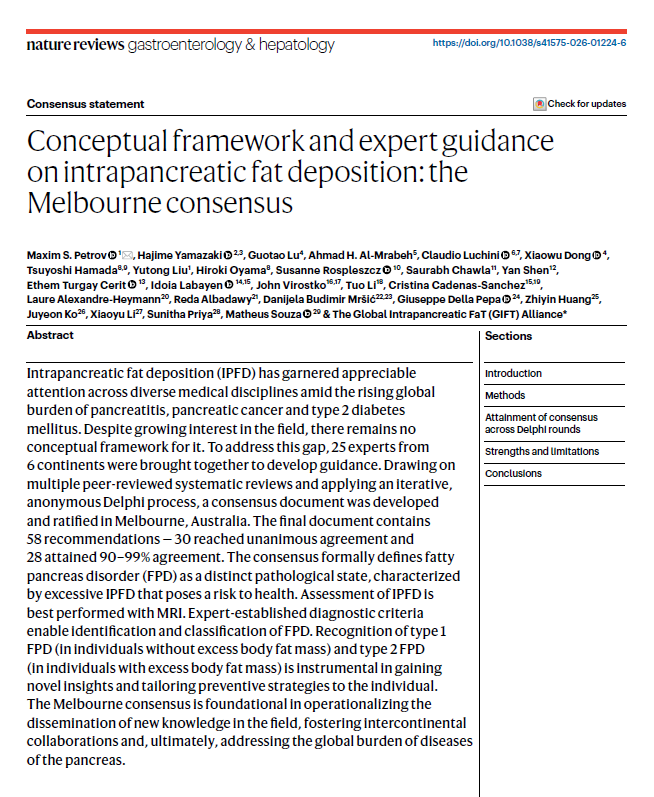
📍𝐌𝐚𝐫𝐜𝐨 𝐂𝐨𝐧𝐜𝐞𝐩𝐭𝐮𝐚𝐥 𝐲 𝐆𝐮𝐢́𝐚 𝐝𝐞 𝐄𝐱𝐩𝐞𝐫𝐭𝐨𝐬 𝐬𝐨𝐛𝐫𝐞 𝐞𝐥 𝐃𝐞𝐩𝐨́𝐬𝐢𝐭𝐨 𝐝𝐞 𝐆𝐫𝐚𝐬𝐚 𝐈𝐧𝐭𝐫𝐚𝐩𝐚𝐧𝐜𝐫𝐞𝐚́𝐭𝐢𝐜𝐚: 𝐄𝐥 𝐂𝐨𝐧𝐬𝐞𝐧𝐬𝐨 𝐝𝐞 𝐌𝐞𝐥𝐛𝐨𝐮𝐫𝐧𝐞 (Nature Reviews Gastroenterology & Hepatology | 2026)
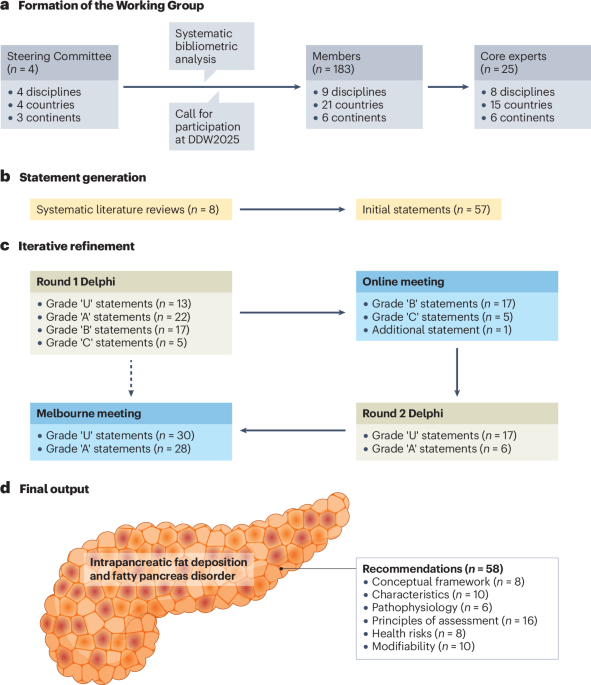
🕒 𝗣𝗼𝗯𝗹𝗮𝗰𝗶𝗼́𝗻: Proceso Delphi modificado en 2 rondas con 25 expertos clave (8 disciplinas, 15 países, 6 continentes) y 183 miembros colaboradores de la Alianza Global de Grasa Intrapancreática (GIFT, por sus siglas en inglés: Global Intrapancreatic FaT Alliance). Se evaluaron revisiones sistemáticas e investigaciones previas con cohortes prospectivas y meta-análisis que abarcan más de 100000 participantes (n > 100000).
📈 𝗣𝗲𝗿𝗹𝗮𝘀 𝗖𝗹𝗶́𝗻𝗶𝗰𝗮𝘀:
• Prevalencia poblacional: Un meta-análisis de 100000 participantes muestra que aproximadamente 1 de cada 5 adultos (20 por ciento) presenta Depósito de Grasa Intrapancreática (IPFD, por sus siglas en inglés: Intrapancreatic Fat Deposition) excesivo.
• Riesgo de pancreatitis aguda: El Trastorno de Páncreas Graso (FPD, por sus siglas en inglés: Fatty Pancreas Disorder) eleva 3.9 veces el riesgo de pancreatitis aguda en cohortes prospectivas generales (p < 0.01).
• Causalidad genética en pancreatitis: Un análisis de Aleatorización Mendeliana confirmó que cada aumento de 1 desviación estándar en IPFD incrementa el riesgo de pancreatitis aguda en 1.4 veces y de pancreatitis crónica en 1.6 veces (Intervalo de Confianza del 95 por ciento [IC 95%], p < 0.01).
• Pancreatitis post-ERCP: El FPD detectado en Tomografía Computarizada (TC) previa al procedimiento aumenta el riesgo de pancreatitis post Colangiopancreatografía Retrógrada Endoscópica (ERCP) en 3.7 veces.
• Cáncer pancreático esporádico: Meta-análisis de 23 estudios muestra una probabilidad 3.2 veces mayor de FPD en cáncer de páncreas; la Aleatorización Mendeliana demuestra una Razón de Riesgo Intertemporal (HR, por sus siglas en inglés: Hazard Ratio) de 1.5 por cada incremento de 1 desviación estándar en IPFD (p < 0.01).
• Precursor tumoral IPMN: En pacientes con Neoplasia Mucinosa Papilar Intraductal (IPMN, por sus siglas en inglés), el FPD al inicio incrementa 4.6 veces el riesgo de desarrollar Adenocarcinoma Ductal Pancreático (PDAC) concomitante a 12 años de seguimiento.
• Diabetes Mellitus Tipo 2 (DM2): El FPD incrementa el riesgo de DM2 incidente en un 81 por ciento a 11.1 años; cada aumento del 1 por ciento en IPFD eleva el riesgo de diabetes en un 7 por ciento.
• Cirugía bariátrica metabólica: Logra una reducción absoluta de IPFD del 3.9 por ciento a los 3 meses, alcanzando una reducción del 42 por ciento en la frecuencia de diabetes (p < 0.01).
• Respuesta farmacológica: Meta-análisis de 8 ensayos clínicos aleatorizados demuestra que los Agonistas del Receptor del Péptido Similar al Glucagón tipo 1 (GLP-1 RA) reducen el IPFD en 1.6 por ciento y los Inhibidores del Cotransportador de Sodio-Glucosa tipo 2 (SGLT2i) en 1.4 por ciento (p < 0.01).
• Inexactitud de ultrasonido: La Ultrasonografía Endoscópica (USE) presenta una discrepancia del 94 por ciento al compararse con la Resonancia Magnética (IRM, por sus siglas en inglés: Magnetic Resonance Imaging), clasificando erróneamente al 79-94 por ciento de los sujetos.
📉 𝗖𝗼𝗻𝗰𝗹𝘂𝘀𝗶𝗼́𝗻: El FPD representa un estado patológico temprano, independiente de la obesidad general, medible de forma precisa mediante IRM cuantitativa y con alto impacto causal en pancreatitis, DM2 y cáncer de páncreas. Su reversión mediante dieta, ejercicio, GLP-1 RA, SGLT2i o cirugía bariátrica constituye un pilar para la prevención primaria y terciaria de enfermedades pancreáticas.
🔗 𝗗𝗢𝗜: https://t.co/lec0lpWyCq
#Pancreas #Gastroenterologia #Endocrinologia #Medicina #Internista
Fatty Pancreas Disorder (FPD): The Melbourne Consensus 2026
The first international consensus defining fatty pancreas as a distinct disease entity.
🔹 The One-Line Message
Not all fatty pancreas is innocent. Excess intrapancreatic fat is now recognized as a distinct pathological condition—Fatty Pancreas Disorder (FPD)—with important implications for diabetes, pancreatitis, and pancreatic cancer.
📌 What is Fatty Pancreas Disorder?
- FPD is a pathological state characterized by excessive intrapancreatic fat deposition (IPFD) that increases the risk of adverse health outcomes.
- It is not merely an incidental imaging finding and should be considered an organ-specific disease process.
---
🔬 What Constitutes Intrapancreatic Fat?
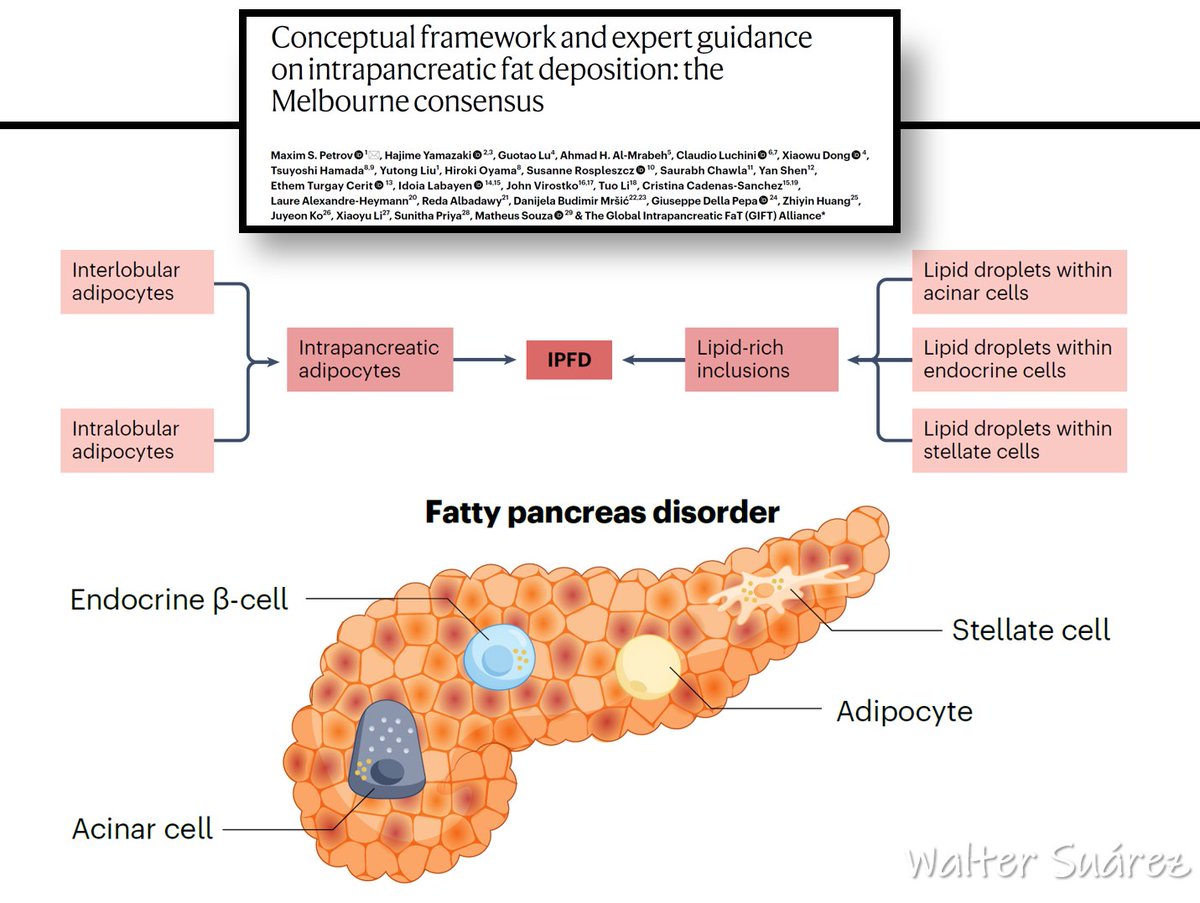
- IPFD comprises:
- Intrapancreatic adipocytes
- Lipid-rich inclusions within pancreatic cells
- Focal fat masses are excluded from the definition.
⚠️ Important Clinical Concepts
- A small amount of pancreatic fat is physiological.
- Pancreatic fat can increase:
- Without weight gain
- Without fatty liver
- Therefore, pancreatic steatosis should not be viewed simply as an extension of MASLD.
---
🩺 Two Distinct Types of FPD
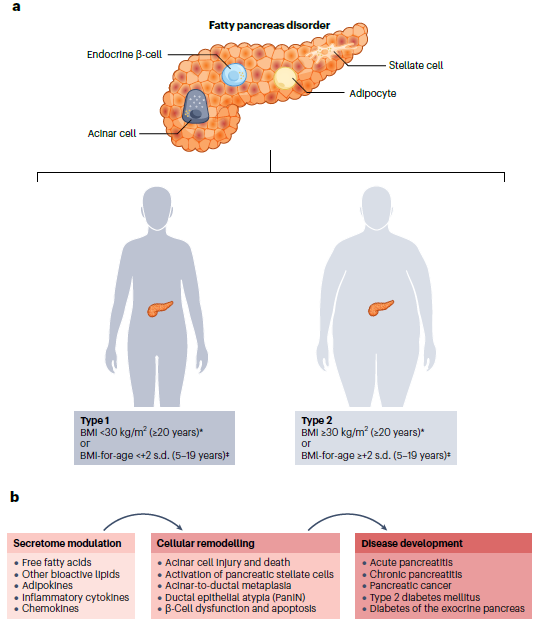
Type 1 FPD
- Excess pancreatic fat without excess body fat
- Suggests mechanisms beyond obesity.
Type 2 FPD
- Excess pancreatic fat associated with excess body fat
- Reflects obesity-related pancreatic fat accumulation.
This classification may help personalize prevention and future therapeutic strategies.
---
🎯 Why Does It Matter?
FPD is associated with an increased risk of:
- Type 2 diabetes mellitus
- Acute and chronic pancreatitis
- Pancreatic cancer
- Exocrine pancreatic dysfunction
- Other pancreatic disorders under active investigation
---
🖥️ How Should We Diagnose It?
✅ MRI with voxel-wise fat quantification is the preferred diagnostic modality.
❌ Conventional endoscopic ultrasonography (EUS) should NOT be used to diagnose FPD, despite its widespread availability.
💡 Pathogenesis
- FPD usually reflects cumulative lifetime pancreatic insults rather than a single identifiable cause.
- The emphasis shifts from identifying one cause to understanding overall pancreatic fat burden and long-term risk.
⭐ Clinical Take-Home Messages
- Fatty pancreas is now a defined disease entity, not merely a radiological curiosity.
- Pancreatic fat should be evaluated independently of liver fat.
- MRI is the current gold standard for diagnosis.
- Recognition of FPD may improve risk stratification for diabetes, pancreatitis, and pancreatic cancer.
- Future research will determine whether reducing pancreatic fat translates into better clinical outcomes.
📚 Reference
The Melbourne Consensus on Fatty Pancreas Disorder (FPD). Nature Reviews Gastroenterology & Hepatology. 2026.
Article:
https://t.co/sjVVa33kCh
Fatty pancreas disorder is classified into type 1 (without obesity) and type 2 (with obesity), both representing an early organ-specific state that reshapes the pancreatic secretome and cellular architecture and can drive pancreatitis, diabetes and pancreatic cancer.
https://t.co/pk3xmTMT4t
Consenso que establece un marco conceptual integral y guía sobre la acumulación de grasa intrapancreática y los desórdenes que la acompañan.
¡¡¡A leer, zagales!!!
Link en mi bio
o
https://t.co/w96Cn3SaZ2
Fatty pancreas disorder is now defined as a distinct, organ-specific pathological state of excessive intrapancreatic fat that raises the risk of pancreatitis, pancreatic cancer and multiple forms of diabetes, best diagnosed with MRI.
https://t.co/B6p6n5rt5s
New from us in Current Obesity Reports!
https://t.co/V7QPngZw0f
Lifestyle change reaches the pancreas too. In our synthesis, diet and exercise significantly reduced intrapancreatic fat deposition, with the largest numerical effect observed when combined.
#GITwitter#MedTwitter
Just out in @NatRevGastroHep!
Time to adjust the ROIs and place the pancreas at the center of the ectopic fat conversation.
The Melbourne consensus advances how intrapancreatic fat deposition is defined, measured, and interpreted.
#GITwitter#MedTwitter
New from us in Current Obesity Reports.
In this synthesis of MRI studies, intrapancreatic fat deposition was substantially higher in type 2 diabetes, beyond differences in BMI, age, and liver fat.
https://t.co/JRQpIuMuFM
#diabetes#GITwitter#MedTwitter
New from us in Current Obesity Reports.
In this synthesis of MRI studies, intrapancreatic fat deposition was substantially higher in type 2 diabetes, beyond differences in BMI, age, and liver fat.
https://t.co/JRQpIuMuFM
#diabetes#GITwitter#MedTwitter
New publication in Liver International!
In our synthesis, we found that SLD is common in autoimmune liver diseases and is linked to greater metabolic burden.
https://t.co/PXYacDiKeP
Great teamwork with @IvannaDiazA, Saeed and @PojsakornDan#livertwitter#GITwitter#MedTwitter
BMI Impacts VCTE measures
🚨 How does discordance play out in 🇮🇳 cohorts against MRE
As BMI increased, discordance skyrocketed 📈
💡7.7% (BMI <25) ➡️ 64.7% (BMI ≥35)
For obesity-aware fibrosis assessment in MASLD
👇🏽
https://t.co/WeMiIy1sVJ
One of my dreams was to be part of top meetings in GI/Hep, like #DDW2026
Thanks to wonderful colleagues, our work will be there. One day, I hope to attend in person. For now, I’m grateful and cheering from Rio.
Excited to see Stella and Saeed shine tomorrow!
Looking forward to the poster presentations by Stella and Saeed at #DDW2026!
Our posters will be presented on May 5th (Exocrine Pancreatic Diseases and Diabetes session).
#GITwitter#MedTwitter