Excited to highlight our newest work on an induced proximity-based targeted transcriptional repression platform termed Transcriptional Repression via Active Chemical Epigenetic Reprogramming (TRACERs)! Congrats to @CEStieger and co-authors and our @NovartisScience collaborators!! (1/9)
https://t.co/c0z00qn3s6
Exciting breakthrough technology from the lab, now live in @CellCellPress ! Instead of cutting the genome where proteins bind (e.g., Cut&Tag), D&D-seq scars the DNA with a deaminase, allowing single cell genome mapping of TFs and chromatin remodellers!
I am very happy to share that our paper is now published in @Nature 😊
Cell-type-targeted mitochondrial transplantation rescues cell degeneration.
https://t.co/lQACEJLDwg
@IOB_ch (1/6)
What would it look like to see all ~13,000 proteins inside a single human cell at once?
We share ProtiCelli — a generative model that makes this possible. Besides benchmarking, we demonstrate utility in many tasks.
Preprint: https://t.co/faBevXiBBa
A thread 🧵👇
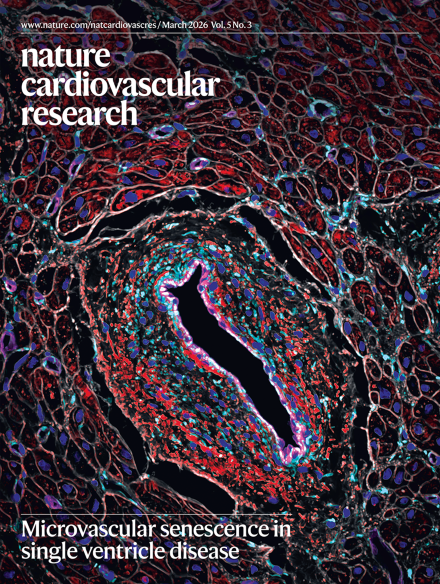
❤️Our March issue is out❤️Read about an AI model using echocardiography images improves cardiac diagnosis, LVAD unloading alleviates cellular senescence, inhibition of a hematopoietic death regulator shows cardioprotection, and more.
https://t.co/lMEE4jJVgB
Ex-vivo culture of human hypertrophic cardiomyopathy hearts: Functional and metabolic changes during long-term culture: iScience https://t.co/UTyIepNRlf
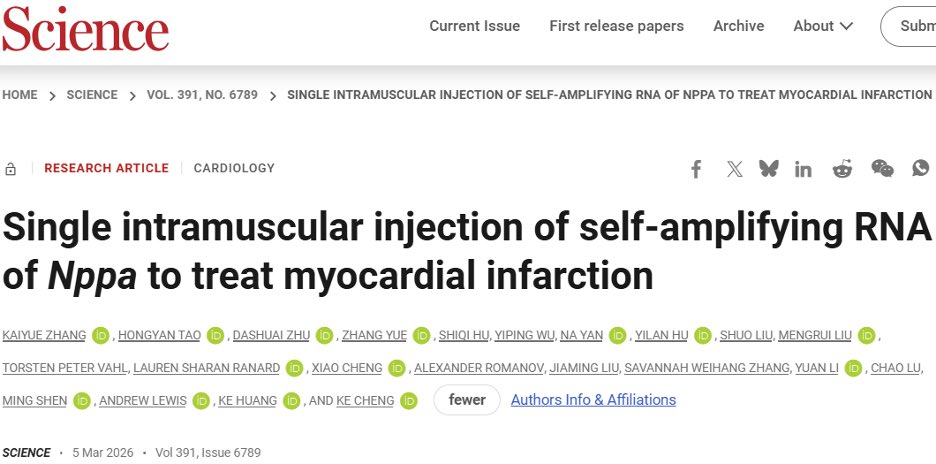
Congratulations to Kaiyue Zhang on the publication @ScienceMagazine. In the paper, we built an “RNA factory” on muscle for heart repair. https://t.co/DRDhOLKbLl
Omoto et al reveal activating #leptin signaling in the #brain helps the #heart heal after ischemic injury by sending signals to #BrownFat to reduce scarring & improve heart function. Learn about a new brain–fat–heart communication at https://t.co/Bhi8vSQ6rM
@CVIRLab
This muscle cell gatekeeper has implications for a broad range of muscle-related conditions.
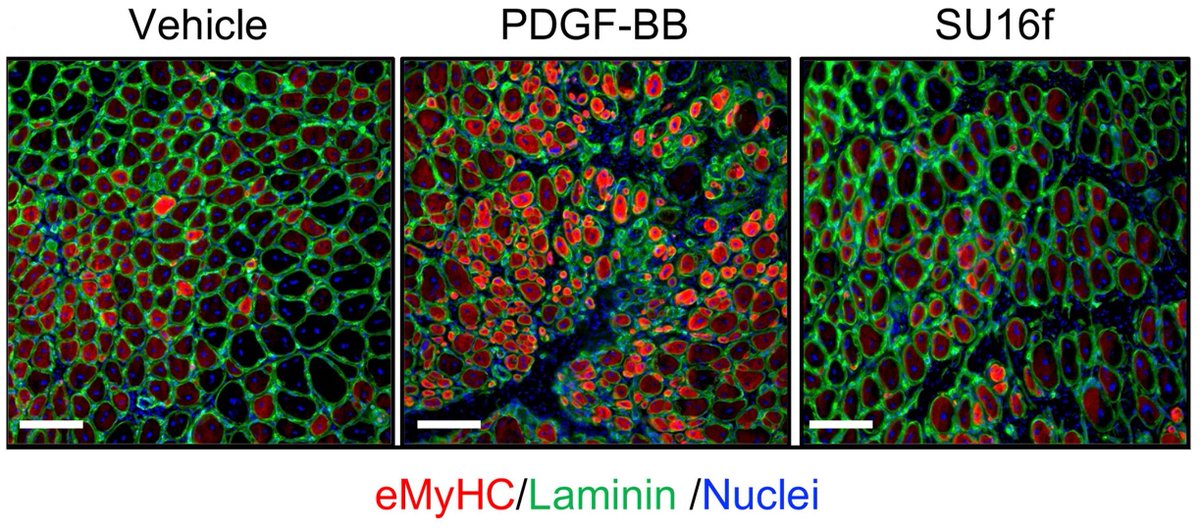
Using murine and human models, Siwen Xue @siwen_xue Daniel C. Berry @dcberrylab & team @WeillCornell show block of the protein PDGFRbeta enhances myofiber repair and regeneration, whereas activation of it slows down recovery by limiting cell size and fusion: https://t.co/kk98Vdlchy
The image shows muscle regeneration in mice treated with the PDGFRbeta inhibitor SU16f.
#myotwitter
RESEARCH | @thebioKIMist@JasonRCantor et al. (@Morgridge_Inst):
Differential localization of the hexokinase HK1 isoform compared to the HK2 isoform, explains the conditional essentiality of HK2 in cancer cells cultured in physiologic media.
https://t.co/9DluG7FUQZ
Ever wondered how the human liver looks like at single-cell, spatial protein resolution? We used single-cell Deep Visual Proteomics to map human liver zonation at the protein level - one hepatocyte at a time. Our paper is out in @NatMetabolism!
https://t.co/VbSqyHnSTq
Check out Skeletal Muscle's Featured Article:
Displaced myonuclei are attributable to both resident myonuclear migration and stem cell fusion during mechanical loading in adult skeletal muscle
@KevinMurachPhD
➡️Read more: https://t.co/HH2lq5F8G5
Thrilled to share our new @ScienceAdvances paper where we provide evidence that mechanical stimuli drive skeletal muscle growth through TWO distinct mechanisms—and use BONCAT to visualize where the growth occurs. Take a look: https://t.co/Hk6SpXK5aJ