The West still doesn’t understand how deeply destructive leftism-communism (wokeness) is.
It doesn’t even have the words to describe its perniciousness and perfidy:
Take the English word “hypocrisy.” It is too weak.
In Polish, there is a much stronger word: obłuda [ob-woo-dah].
“Obłuda” is not merely saying one thing and doing another. It is the deliberate performance of virtue while knowingly living a lie. It is moral fraud elevated into a system. It is the requirement to publicly affirm what everyone privately knows to be false.
People who grew up under communist rule encountered this everywhere: in politics, in the media, in education, in workplaces, and in everyday social life. Official slogans proclaimed justice, equality, truth, and solidarity, while reality was characterized by privilege, corruption, censorship, fear, and double standards.
{Two-tier – does it remind you of anything?}
This environment also produces a kind of cognitive adaptation often described as doublethink – the ability to hold two contradictory beliefs at the same time, and to accept both as true when required. It is not merely lying to others, but a learned internal tolerance toward contradiction itself, where inconsistencies are tolerated because survival depends on it.
This literally twists people’s minds…
But even obłuda does not fully capture the broader condition. A even closer term is zakłamanie [zah-kwah-MAH-nyeh] – a state of systemic untruth, where falsehood is not occasional or incidental, but fully integrated into everyday life. It is an environment in which people learn, from necessity, to separate what is said publicly from what is believed privately.
Those who lived under communist systems often describe not just hypocrisy at the individual level, but "zakłamanie" as a social condition: a culture saturated with contradictions, where language loses its connection to reality and public speech becomes ritual rather than truth.
Within such systems, demoralization becomes widespread. Not merely in the sense of disappointment, but as a deeper erosion of trust, integrity, and shared standards of truth. People learn that honesty is often punished, while conformity – regardless of sincerity – is rewarded.
This dynamic contributes to what can be described as negative moral selection: a process in which those most willing to compromise truth, signal loyalty, or manipulate narratives rise disproportionately within institutions, while those who insist on integrity, competence, or independent judgment are sidelined or simply destroyed.
Over time, this produces not only institutional dysfunction, but a broader social cynicism. Public life becomes performative. Words lose their meaning. Truth becomes inverted. And many people adapt by withdrawing trust from institutions altogether, while forced to continue participating in their rituals.
Many Western observers interpret communism primarily as a failed economic model. Those who lived under it often describe something deeper and more total:
a system that normalized organized deception and demanded participation in it,
a lived experience of zakłamanie, reinforced by demoralization and sustained by incentives that selected for opportunism over integrity.
Lying is hurting people – and this is lying at the scale of the whole society – lying as a system.
The West is only starting to discover that – you should be learning from us in Central and Eastern Europe who experienced it for generations…
And without words like obłuda and zakłamanie, much of this experience is flattened in translation. What remains is only a partial picture – one that risks missing the psychological and cultural mechanisms that shape life under those terrible, anti-human systems.
@DeShindig@pinapic Ho ascoltato e ho sentito, come non condividere avete ragione su tutta la linea. Grazie per l'ottimo e meritorio sforzo per aiutare ad aprire spazi e cervelli!
L'aspetto rilevante, qui, non e' DT che offende, aggredisce e poi se ne va rifiutandosi di rispondere.
L'aspetto rilevante e' la professionalita' ed il coraggio di @kwelkernbc di fronte ad un simile personaggio.
Ora provate ad immaginarvi una situazione simile in Italia. Aiuta a capire perche' c'e' piu' speranza si aggiusti la situazione politica USA che la nostra.
Senza giornalismo coraggioso ed indipendente non c'e' democrazia e, alla fine, nemmeno liberta'.
La proposta @pdnetwork “Diritto a restare” è una caricatura.
Hai un problema enorme: giovani che se ne vanno, salari bassi, case fuori mercato, produttività ferma, carriere bloccate, territori senza imprese serie.
E cosa proponi?
200 euro al mese per tre anni sugli stipendi degli under 35 assunti con nuovi contratti stabili.
Cioè soldi pubblici messi sopra il contratto, per un periodo limitato, sperando che questo convinca un giovane a restare dove non trova opportunità, casa, mobilità sociale, impresa, ricerca, futuro.
È una misura costosa, mal disegnata e socialmente debole.
Costa 7.200 euro per ogni lavoratore coinvolto in tre anni. Se ne coinvolgi 100.000, sono 720 milioni. Se ne coinvolgi un milione, sono 7,2 miliardi. E non hai cambiato nulla di strutturale.
In più rischi il classico effetto bonus: paghi anche assunzioni che sarebbero avvenute comunque, incentivi sostituzioni tra lavoratori, crei una soglia artificiale a 35 anni e lasci fuori pezzi enormi del problema: autonomi, precari, disoccupati, NEET, giovani che un contratto stabile nemmeno lo vedono.
Il PD di @ellyesse dovrebbe pensare a salari legati a produttività, concorrenza, capitale umano, università migliori, imprese che crescono, meno rendite, case accessibili, servizi, infrastrutture. Non rincorrere i Bonus come un Movimento qualsiasi
Invece continua a pensare che ogni dramma sociale sia risolvibile con un trasferimento pubblico e uno slogan morale.
Poi si stupiscono se Meloni governa per vent’anni.
Вчера многие опять решили, что я из комфортного далёка требую от россиян идти свергать Путина.
Разумеется, это не так. Я говорил, что россиянам нужно сделать что-то не с Путиным, а с собой.
Я говорил не о нынешнем Путине, а о следующем.
О том, что общество в России должно измениться так, чтобы теперешний Путин стал последним.
Да, приказ о войне Путин отдавал ��динолично. Но диктатуру, при которой такое возможно, он создавал не в одиночку. Множество людей участвовало в этом. А большинство как минимум безучастно взирало на строящуюся диктатуру.
И так было даже тогда, когда выступление против перехода к очередному вождизму вовсе не грозило теми опасностями, которыми протест чреват сейчас.
Сколько людей вышли на Сахарова в декабре 2011? Тысяч 100. В 12-миллионной Москве. Меньше 1%. Да выйди тогда хотя бы 5%, 600 тысяч то есть, никакого Путина давно уже в Кремле не было бы.
Всего 5%.
Но их не нашлось.
И, пока это не изменится, за нын��шним Путиным непременно появится следующий. Может, не сразу, с перерывом, но появится.
И опять будет пожизнный вождь, единоличное правление, война и маразм.
Чтобы прекратить бесконечную череду путиных на троне, нужно не Путина убрать, а трон.
А трон - он не в Кремле.
Он в головах людей. В головах большого числа людей. Вот именно оттуда, из голов, трон и надо убрать.
Milioni di persone ingenue hanno fede cieca nel potere taumaturgico della spesa pubblica come soluzione ad ogni problema. I politici lo sanno e sanno anche che la spesa pubblica è ormai così inefficiente da avere moltiplicatore minore di uno, quando non negativo, ma pur sapendolo cercano di sfruttare questa superstizione diffusa, senza curarsi delle conseguenze. I politici non sono ingenui sono altro.
Perfino l'Ungheria comincia a buttare fuori a pedate le spie russe incrostatesi durante la presidenza Orban.
Solo un noto paese a forma di stivale, dove batte sempre il sole e la classe politica vive in casette di marzapane, persegue il tuttapposto volemose bene.
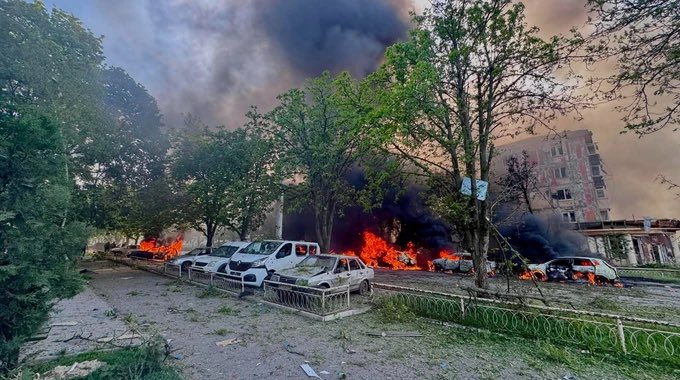
Russians murdered 26 civilians just today:
▪️Zaporizhzhia — 12 dead
▪️Donetsk region — 5 dead
▪️Poltava region — 5 dead
▪️Dnipro — 4 dead
Then russians want a one-day ceasefire to celebrate all the killing.
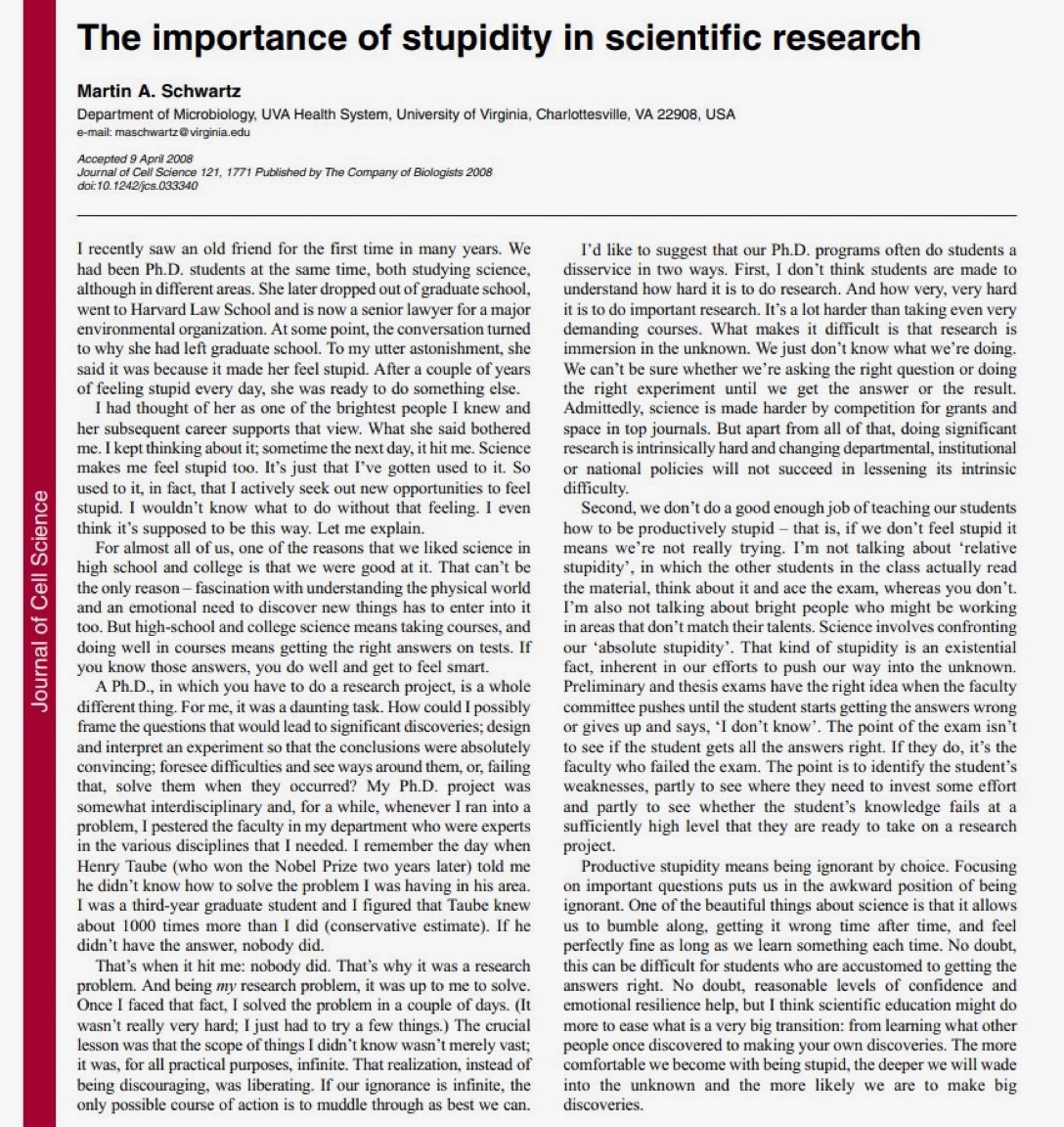
This article should be mandatory reading for every medical student, PhD candidate, researcher—and honestly, for anyone who mistakes expertise for certainty.
“The importance of stupidity in scientific research” sounds provocative, almost offensive. But Martin Schwartz is not glorifying incompetence. He is describing the real operating system of discovery.
Science is not built on knowing.
Science is built on tolerating not knowing.
That distinction matters.
Most of education rewards correctness.
School teaches us to answer.
Exams reward speed, certainty, and precision.
You feel intelligent when you get things right.
Research is the opposite.
Real research begins exactly where competence ends—at the frontier where nobody knows the answer, including the people you thought must know.
That moment is psychologically brutal.
You ask the expert.
The expert shrugs.
You assume you’re missing something.
Then you realize: no—this is the work.
You are not failing.
You are standing at the actual boundary of knowledge.
That feeling—“I must be stupid”—is often not a sign of inadequacy.
It is often the first sign that you are finally asking an important question.
Medicine struggles with this.
We train doctors to avoid uncertainty, to fear being wrong, to perform confidence.
But the best clinicians and the best scientists know how to sit inside ambiguity without collapsing into fake certainty.
This is why AI in medicine also deserves caution.
Systems trained only to reproduce established answers may become extraordinarily good at passing exams while being terrible at discovering what matters next.
Guideline intelligence is not the same as scientific intelligence.
Discovery requires productive stupidity:
the willingness to stay with the uncomfortable,
to look ignorant,
to ask naïve questions,
to be wrong repeatedly without protecting your ego.
Most people want the authority of expertise.
Very few want the humiliation required to earn it.
But progress lives there.
Not in certainty.
Not in performance.
Not in sounding smart.
In the quiet discipline of saying:
“I don’t know… yet.”
And continuing anyway.
Mi verrebbero da fare analisi sull'inopportunità di queste misure temporanee. Mi verrebbe da analizzare il costo, e compararlo a quello di altre misure molto più urgenti. Ma non lo farò.
Dirò semplicemente che siete una banda di immensi e dannosi cialtroni.
Sto preparando un post per domani sulle due ganasce che stanno per soffocare l'Europa tra riassetto energetico e ridefinizione delle alleanze militari. Ci attendono tempi molto duri e dobbiamo selezionare una classe politica adeguata a gestirli. Basta improvvisati e populisti.