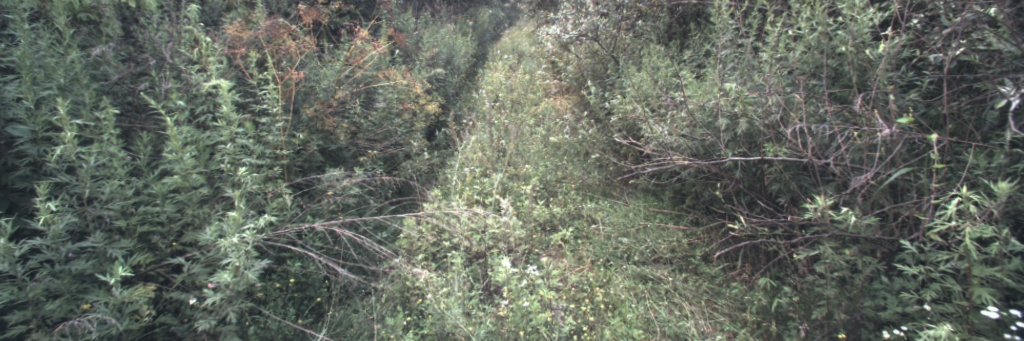
How your robot moves depends on what it’s driving over, especially when moving at >10m/s over loose gravel or ice 🚙💨
What if dynamics models could be conditioned on exactly the terrain they expect to drive over? Introducing SpatialBEV!
Accepted at #CoRL2026 🤠
0/7
@AngchenXie This was a fun read Angchen and @NikhilSoban353 ! I really appreciated the experiments to support your Planner-IDM factorization. Modeling the dynamics AND adapting them is crucial. Looking forward to any perception-based additions you may work on 👀
@facontidavide Yeah I think the dwindling appreciation for good code/maintainers (or art, writing, papers, etc.) is a very sad thing indeed. AI makes creating exponentially easier, which is great (mostly), but I feel the craft of creating is getting lost in a blur
@TylerHan19 And all overshot b/c they didn't account for the extra rolling resistance to slosh through the ice too.
But yeah, I'd be curious to see negative obstacle performance too! Haven't dug too deep in that. Some of your prior work did a great job looking at those scenarios
How your robot moves depends on what it’s driving over, especially when moving at >10m/s over loose gravel or ice 🚙💨
What if dynamics models could be conditioned on exactly the terrain they expect to drive over? Introducing SpatialBEV!
Accepted at #CoRL2026 🤠
0/7
@TylerHan19 Thanks! I saw a pretty neat failure case while testing. We were driving over a frozen tire rut. We broke through the ice becoming like a "train on tracks." When given left steer, all models predicted left. None could reason about/predict this induced geometric constraint.
Terrain isn’t noise. No, it’s a core part of robot dynamics.
Great work done with Sam Triest, Matt Sivaprakasam, Isaiah Adu, @smash0190 , and @Amigoshan@AirLabCMU at @CMU_Robotics
🌐 https://t.co/NSTcNq9jx3
📄 https://t.co/sqtcB8hBNd
7/7
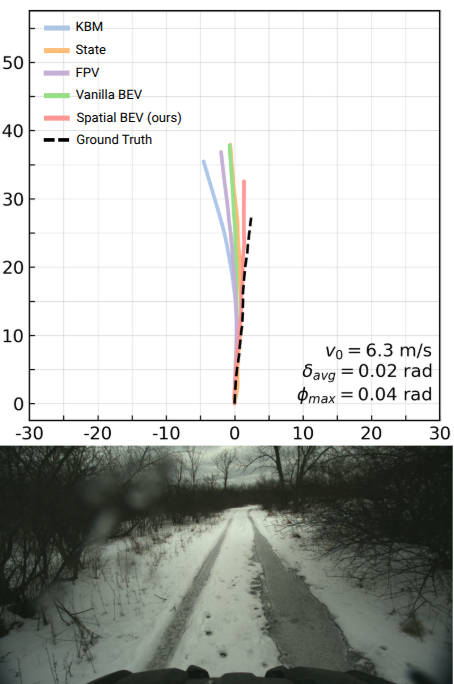
On diverse, real-world, offline data, our structured representation reduces prediction error from the best baseline by 17%.
And it gets better with dense maps: inpainting occluded BEV regions grows our gain over Vanilla BEV from 4.6% to 19.4%.
3/7
Sorting our data into bins by trajectory variance, a clear pattern emerges: the higher the variance, the higher the prediction error. (Our benchmark works!)
Some baselines (FPV) look fine on average but seriously fail on the long tail.
6/7
Where does each model look?
Notice how VanillaBEV (encoded once) has high activations nowhere near the actual robot motion? Meanwhile, SpatialBEV queries right along where it thinks the robot will go.
Much more useful!
2/7
BEV maps give great terrain cues, but prior work underexploits them.
SpatialBEV re-queries the map at each step, conditioning each prediction on the terrain the robot is predicted to traverse. These features inform corrections too.
https://t.co/NSTcNq9jx3
1/7