Everyone copied Jev. I tested the open alternatives (TypeLLM, Open-Jev, Nimble, tev1, GLiNER, Julia-1, Laya) on long, messy real-world pairs. One local setup matched Jev: 98.6 % / 100 %. Here's which one, and why it might not be yours. #ai#jev https://t.co/RQlM6Y7rEW
📋 #OpenCode shipped an early dev build of OpenCode Rune, its desktop client rewritten from scratch in #Rust on Rune, Anomaly's own native UI framework. No #Electron, no DOM, no Chromium at startup, and the repo claims 10 to 100x faster and lighter than the old app. Native on macOS, Windows and Linux, and the same app runs in the browser over WebGPU. #AI
⚡ Windfoil GPU text draws each glyph's exact vector coverage straight from its outline on the GPU, so terminals, diffs and streamed transcripts stay sharp while zooming or scrolling. Backends are Metal, DX12, Vulkan and WebGPU.
🎯 Chromium still exists, but only as an opt-in sidecar. The built-in browser pane (Ctrl+Alt+B) downloads an isolated CEF process on first use, so installs that never open it never pay the startup cost.
🔧 Native engines throughout: Ghostty-VT terminal tabs, virtualized syntax-highlighted code views with split diffs, GPU generative UI and vector diagrams, Word, Excel and PowerPoint previews via Vello, and local Hex voice dictation.
🧪 The repo has no automated tests and no mocks by policy, on the principle that application code is truth. Instead the binary renders any scene or one of 111 playground stories offscreen to PNG (--snap), dumps its live element tree (--tree) and replays scripted input (--script), which also lets agents self-test the UI without a display.
📊 The codebase is #openSource under the MIT license, with four architecture tiers and hot-reloadable strict Luau plugins (--plugin-hot), SQLite storage with a memory-mapped draft journal for crash safety, 63 locales with RTL support, and embeddable crates such as session-view. The client is a thin front end to an OpenCode service on 127.0.0.1:4096. Builds ship as macOS dmg, Windows setup, and Linux AppImage, DEB and RPM, each for x64 and arm64.
🌐 https://t.co/Rj0N2TrZt7
📋 #DirectoryTree Progress is an #opensource#Laravel package that tracks the progress of long-running work: imports, exports, syncs, backfills, cleanup jobs, webhook replays and queued workflows. It answers what ran, how far it got, what failed and which models were touched. MIT licensed, PHP 8.2 and up, Laravel 11, 12 or 13.
⚡ Install it with composer require directorytree/progress, publish the migrations with php artisan vendor:publish --tag=progress-migrations and run php artisan migrate. A job implements TracksRun and uses InteractsWithRun next to Queueable. The package creates the run, starts it before handling and completes it after successful processing, while terminal failures are recorded automatically. You only call advance() per item.
🎯 Counters measure work, the ledger describes outcomes. advance() counts a processed item, missed() counts a failure, record() writes a ledger entry for a model or metadata, and count: false keeps a resource in the history without inflating totals. advance(10, failed: 2) means 10 processed with 8 succeeded. Counted entries are atomic, written in the same transaction as the counters.
🔧 Lifecycle: Run::start() creates a running run, Run::create() plus begin() keeps it pending until a worker is ready. complete(), fail() and cancel() are idempotent and the first terminal state wins. restart() resets the same record in a single transaction, and restartIfFailed() checks the state under a row lock so a second worker cannot wipe progress that was already restarted.
🚀 The job integration does the bookkeeping: TracksRun exposes $this->run in middleware(), handle() and failed(), restarts a previously failed run on queue:retry or Horizon, skips completed and cancelled runs, and leaves the run active when a job is released. RestartFailedRun and SkipIfRunFinished cover manually managed jobs, and a Laravel batch can own one run shared across many child jobs.
📊 Eloquent native: the tables are runs and run_items, HasRuns gives a model $import->runs, ledger status casts to RunItemStatus (Completed or Failed), owner and subject are morphs, and scopes like Run::active() or $run->items()->failed() keep queries short. Cursor-backed runs omit the total and report an indeterminate percentage until completion.
🌐 https://t.co/exGBb1C6Qm
📋 Diagram Design is an #opensource agent #skill that gives #AI agents taste for diagrams: 52 types, drawn as one self-contained HTML + SVG file, in your brand. MIT licensed, 73,800 stars. No shadows. No Mermaid slop.
⚡ You do not write diagram syntax. You describe the diagram in plain words, the agent picks the type, states its plan, then writes one .html file you open by double-clicking. No build step, no JavaScript, no external images.
🎯 52 diagram types, each in three variants: minimal light, minimal dark, full editorial. Architecture, sequence, state machine, ER, flowchart, swimlane, quadrant, radar, loop, treemap, Gantt, Sankey, Wardley, fishbone, org chart, Venn, pyramid, timeline.
🔧 The taste is written down as rules: one accent color for the one or two things that matter, 1px hairline borders, no shadows, max 10px border radius, every coordinate, width and gap divisible by 4. Three faces: Instrument Serif, Geist, Geist Mono. Mono is for technical sublabels, not a blanket dev look.
🚀 Brand onboarding pulls palette and fonts from your URL, so every later diagram matches your site. Saved profiles per client live in ~/.diagram-design/profiles/, a .diagram-design marker per project picks the brand, and first use in a new project stops and asks before shipping default-skinned output.
🔄 It redraws what you already have: https://t.co/txvk9l4mN7, Mermaid, Excalidraw and PlantUML files come back with the same content, set by four dials. Format (html, svg, png), size (doc, 16:9 slide, social square, print A4), detail (faithful down to simplified) and audience (engineer, mixed, executive). Every import ends with a fidelity ledger of what was merged, collapsed or dropped.
📊 87 monochrome IT and cloud icons, CI checks against overlapping nodes and clipped labels, optional motion with a reduced-motion fallback, and export to SVG, PNG or vector PDF. Runs inside Claude Code, #OpenAI Codex, #GitHub Copilot, Cursor, Gemini CLI, Cline, Windsurf and Pi. Install: npx skills add cathrynlavery/diagram-design
🌐 https://t.co/nBLPj7ondC
Best models to run on your DGX Spark(s)
One DGX Spark - only two options:
- Qwen3.8 Flash Next: pick this if your focus is frontend
https://t.co/uWEkjBKe39
- Inkling 2 Mini: pick this if you want great 3D and backend performance. It will also fit 64 GB DGX Spark.
https://t.co/dwtXjJHk0X
I know people want to run DeepSeek V4.1 Flash and GLM 5.3 Flash on one spark, but they'd have to be heavily quantized and you'll have a bad experience. Do yourself a favor and don't do it.
2x DGX Sparks:
- GLM 5.3 Flash - my preferred choice!
https://t.co/Xein7tYXH3
- DeepSeek V4.1 Flash - great alternative
https://t.co/GG9H4IkXlt
4x DGX Sparks:
- DeepSeek V4.1 Flash - fastest thing you can run on your 4 Sparks
https://t.co/uqBE5REo3a
- GLM 5.3 (full) - best thing you can run in terms of quality
https://t.co/zRlziMkDbF
6x DGX Sparks:
- GLM 5.3 (full) - best thing you can run in terms of quality, and runs AWESOME.
https://t.co/zRlziMkDbF
8+ DGX Sparks: Valhalla
Run GLM 5.3 + DeepSeek V4.1 Flash, or just go nuts and run GLM on all 8 sparks.
You can also use Imagination Studio on one of the Sparks for awesome local image and video generation:
https://t.co/L2oUqLm3eH
Find all my recipes here:
https://t.co/GL5XkXVRsr
📋 #AWS Emulator is a local emulator of #Amazon cloud services that runs on your own machine, so you can build and test applications without a live account. Every line of it was written by autonomous #AI agents. The team says it has not written or reviewed any of the code. The source sits on GitHub under a CC0 license and changes constantly.
⚡ Three teams of agents share the work. One writes fidelity tests from the public AWS API Models and verifies each scenario against real AWS before submitting it. One replays those tests against the emulator and files every divergence as an issue, grouped by likely root cause. One takes exactly one issue per agent and fixes it.
🎯 The guardrails do the reviewing. Every fix passes a merge gate for compilation, coding standards, security and fidelity, and a failed check sends the change back for rework. Hundreds of agents work the same codebase at once and land thousands of fixes a day, while tens of thousands of fidelity tests replay without calling AWS at all.
🔧 It started as a weekend experiment. #Anthropic had shown agents building a C compiler on their own, so an engineer gave #Kiro three instructions: write tests from the AWS CLI, iterate until they pass against real AWS, then build an in-memory implementation that passes the same tests. A working Amazon SQS arrived in 15 minutes, the rest of AWS over a weekend.
🚀 The first release covers 438 AWS API Models. Commits flow through CodeCommit and a release pipeline on AWS Developer Tools, get packaged as a downloadable binary, and reach GitHub only at the end. Every filed issue is public: fixed ones in issues/things-that-now-work, open ones in issues/things-that-do-not-work. An early version even grew its own Python interpreter for Lambda.
🌐 https://t.co/Kpw4odIvxy
📋 A single developer shipped three local #AI projects written in pure x86-64 NASM assembly: a Qwen3-0.6B #LLM inference engine, a bootable bare-metal OS and a from-scratch GPT trainer. Zero C, zero Rust, zero libc, MIT licensed. #opensource
⚡ The Linux inference binary is a 14,712 byte static ELF that runs Qwen3-0.6B between 18.3% and 35.6% faster than llama.cpp CPU with Q8_0 on an #AMD EPYC 7642, peaking at 126.8 tok/s decode at 40 threads.
🎯 The full benchmark table: 20.70 vs 16.63 tok/s at one thread (+24.5%), 69.24 vs 51.08 at four (+35.6%), 103.64 vs 80.79 at eight (+28.3%), 121.86 vs 103.03 at sixteen (+18.3%), 125.86 vs 105.08 at forty (+19.8%). Results stay bit-exact from 1 to 40 threads, and 64 of 64 greedy tokens match PyTorch FP32.
🔧 The entire Qwen3 architecture is hand-written: GQA with 16 query and 8 KV heads, per-head QK-Norm before RoPE, split-half NeoX RoPE, SwiGLU MLP, tied embeddings, a persistent multi-turn KV cache, and a BPE tokenizer built on a 524,288 slot Fibonacci-hashed open-addressing merge table that matches HuggingFace AutoTokenizer token for token.
🚀 The 24,252 byte bare-metal kernel boots the same model through Multiboot 1 in under 94 ms and exposes VGA, PS/2 keyboard and serial interfaces, with no Linux underneath. On KVM it reaches 134.9 tok/s, up to 54% faster than llama.cpp at four threads.
📊 The 32,944 byte trainer implements its own backward pass and AdamW and matches PyTorch gradients at cosine 1.0 across all 21 tensors. The 17,252 lines of assembly need an x86-64 CPU with AVX2, FMA and F16C (#Intel Haswell and newer). llama.cpp still wins on batched prompt prefill, since llm.asm decodes token by token.
🌐 https://t.co/1ys8G78MHb
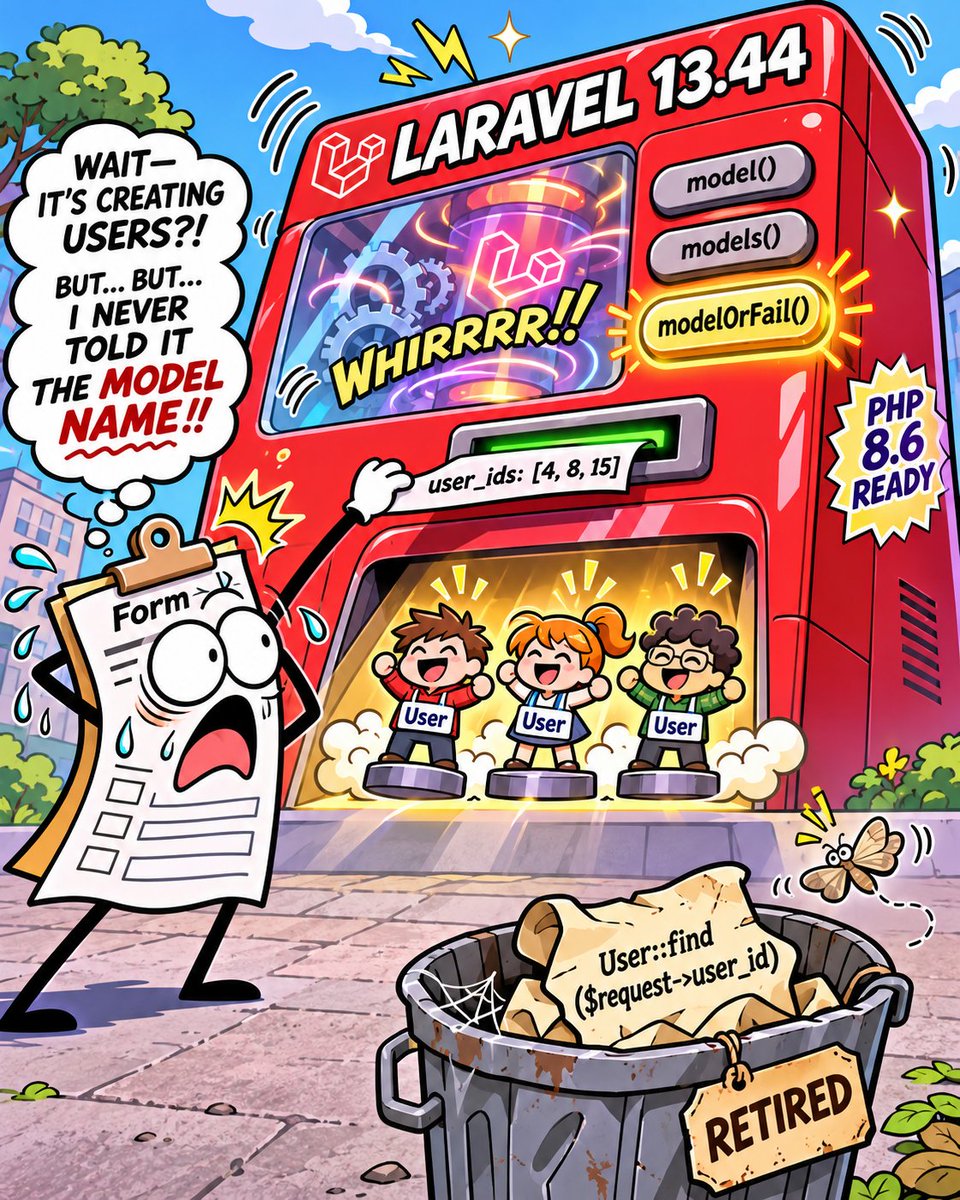
📋 #Laravel 13.44.0 is out: #Eloquent model lookups inside form requests, alerts for slow database transactions, a #PostgreSQL friendly row lock, an option to load only the schema dump, and #PHP 8.6 support.
⚡ Form requests can load models straight from input IDs now. $request->model('user_id', User::class) returns the model or null, modelOrFail() throws a ModelNotFoundException, and models('user_ids', User::class) returns an Eloquent collection. The class argument is optional: without it Laravel guesses App\Models\User from the key. Thanks to Steve Bauman, PRs 62523 and 62576.
🎯 DB::whenTransactionRunsLongerThan(CarbonInterval::seconds(15), $callback) registers a callback for transactions that run too long. It fires after the outermost transaction commits or rolls back, and the arguments tell you the connection, which event happened and how many milliseconds it took. A plain number counts as milliseconds, nested transactions are not timed separately. Thanks to Jack Bayliss, PR 62423.
🔧 lockForNoKeyUpdate() joins the query builder. On PostgreSQL, lockForUpdate() also takes the lock a foreign key check needs, so inserting a child row waits while the parent is locked and two transactions can deadlock. The new lock leaves those inserts free. MySQL, SQLite and SQL Server keep the same behaviour as before, so the call is safe on every driver. Thanks to Ali Morgan, PR 62544.
🚀 migrate and migrate:fresh accept --schema-only: Laravel loads the schema dump into the new database and skips the migrations that would normally follow, which helps when migrations run separately in tests. copyToDisk() and moveToDisk() now take an $options argument for visibility or S3 headers, and a plain string is read as the visibility. Thanks to Jack Bayliss and Javad Seydi.
📊 PHP 8.6 support landed: the deprecations Laravel triggered are fixed, including the deprecated SORT_LOCALE_STRING flag, strcoll() and a trimming issue in the validator. The release also brings strict JSON Schema enum and uniqueItems comparisons, pipelined #Redis cache writes, faster distinct validation on large arrays and a test run against PostgreSQL 19.
🌐 https://t.co/wMEER2upon
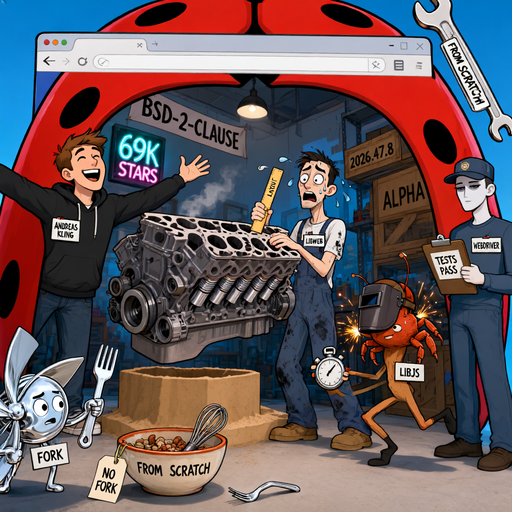
📋 Ladybird is now in #alpha: an independent #browser with a new engine, built from the ground up, not a fork of Chromium or Gecko. Downloads for #macOS and #Linux. #opensource#WebDev
⚡ The engine is Ladybird's own: LibWeb and LibJS grew out of SerenityOS into a complete browser stack in #Rust, now released under BSD-2-Clause with about 69k stars on GitHub.
🎯 The alpha is a rolling channel with automatic updates, so the browser improves quickly and you no longer have to build from source to see it. Current build: 2026.47.8.
🔧 Feedback is built in: report a broken site from inside the browser, and after a crash read the report before deciding whether to send it. Security researchers are invited to pwn it and disclose via SECURITY.md.
🚀 For web developers: #WebDriver for automated testing plus the Firefox DevTools protocol, so existing test suites and tooling can point at Ladybird.
📊 macOS 14.4 or later on #Apple silicon, Linux x86-64 and ARM64 via Flatpak, APT for Ubuntu 24.04 and 26.04, RPM for Fedora 44 and 45, plus a source tarball. Expect crashes and broken sites: this is an alpha.
🌐 https://t.co/dPNYdfcL68
📋 Kagi Mail is now in public beta: a private #email and #calendar service with a @kagimail.com address or your own domains. Free for 60 days, then $99/year plus sales tax, and included with Kagi Ultimate. #Kagi
⚡ The basics: a @kagimail.com address, unlimited aliases, unlimited domains, a built-in calendar and 50 GB of storage. It runs on open standards and open-source infrastructure, the Stalwart server with IMAP, JMAP and CalDAV, so you can use Kagi's apps or any client you already like.
🎯 Intelligence: brief your inbox in your own words, for example "label anything where beta users send product feedback". Inbox Highlights show what needs you today and learn from what you dismiss. Ask your inbox in plain language and get direct answers with the source email, including text inside scanned PDFs and photos. A newsletter view keeps newsletters out of real mail, and one switch turns all #AI off.
🔧 Private by default: tracking pixels and remote images are blocked or proxied so senders cannot tell when or where you opened their mail, sender screening holds new senders until you approve them, and suspicious senders trigger a phishing warning while verified senders show their logo. No ads, no profiling, no selling, no sharing.
🚀 For power users: keyboard-first with a command palette and search operators, Sieve rule-based filtering without any AI involved, an MCP server with read access to your mail, Kagi Translate built in, and proofreading plus translation while you write. Email Assistant answers questions about your mail at [email protected].
📊 No lock-in: export your mail, calendar and workflows at any time with one click, and keep access to your mailbox for six months after leaving. Contacts and full Kagi Assistant integration are targeted for Q1 2027, native mobile apps for Q3 2027.
🌐 https://t.co/oPUY2qATr4
📋 #Samsung Research's new paper "Beyond Primitive Bloat" shows why #GaussianSplatting detail turns blurry and fixes it without adding more Gaussians. A small #AI module called #CCNN sits on top of any splatting renderer, sharpens the coarse image, and sets a new state of the art on six benchmarks. #3DGS
⚡ The scaling wall: on Mip-NeRF 360 the baseline's training PSNR follows an exponential primitive curve with an R² of 0.998. Held-out quality starts to fall after roughly 4 million Gaussians, so extra primitives buy memory and optimization cost while novel views get worse.
🎯 The proof: the sharp target image is modelled as a continuous function queried at pixel coordinates and conditioned on a coarse splat. Approximation error can only drop toward zero when coordinate queries, a local neighborhood and the coarse low-fidelity signal are used together. Remove any one of the three and it breaks.
🔧 The module: CCNN pairs the coarse render with a 2D coordinate query map, convolves both through its layers in a single feed-forward pass, and predicts a residual image. Add the residual to the coarse render and you get the final view. Training and inference stay in the same pipeline.
🚀 The results: added to five baselines including 3DGS, MCMC and NHT, it wins on all six datasets (Mip-NeRF 360, Tanks and Temples, Deep Blending, OMMO, Shelly, NeRF Synthetic). NHT + CCNN hits 29.19 dB PSNR on Mip-NeRF 360, against 28.54 dB for Zip-NeRF. MCMC + CCNN reaches 28.58 dB.
📊 The cost: 3DGS + CCNN still renders at 190.9 FPS with 736 MB per scene, so no storage penalty and only marginal training overhead. The same module also lifts 1D/2D regression and Real-ESRGAN super resolution.
🌐 https://t.co/7UVtu5uvnH
Run GLM 5.3 (full) on your DGX Sparks
This release is special. It has a no-compromise on quality configuration. No shortcuts were made to make it "faster". Just pure quality.
Runs on TensorFold.
Two ways to run this:
- GLM 5.3 K4 by @wrldsuksgo2mars (default)
- GLM 5.3 DERISKED EXL3 4 bpw /w Cyber calibration, quantized from @Blackfrost_AI's DERISKED BF16.
Performance & stats (TP4):
~288k context, single stream only.
~39 tok/s in prose, non-greedy, thinking on
- Prefill: 1571-1300, depends on context
Performance & stats (TP6):
~845k context, up to 4x stream.
~49 tok/s in prose, non-greedy, thinking on
~76 tok/s in prose, 4 concurrent streams
- Prefill: 1767-1308, depends on context
Basically TP6 buys you a lot of context and improved decode speeds. TP4 is completely usable. Similar performance on both quants.
What "DERISKED" means
Not every refusal is removed in @Blackfrost_AI models, and that's on purpose. Blackfrost calls its method DWM, Directional Weight Modification. Instead of deleting refusal like abliteration, it softens one behavior by a set amount.
Why not go to zero? Pushing closer to zero refusals on some models brings dropped tool calls, broken reasoning, loops and hallucinations. For cybersecurity work, a model that drops even one tool call is a problem.
What DWM keeps:
- Fewer refusals on real security questions
- Built-in protections stay intact
- One dial to tune the strength
Usable beats uncensored.
Get it here:
https://t.co/Z3bBwbMJKe
📋 #Anthropic Cybersecurity Skills is a community #opensource library of 818 #cybersecurity skills for #AI agents, built on the https://t.co/MRmy1eWZDa standard and mapped across six industry frameworks. Not affiliated with Anthropic PBC, just aimed at the same agent ecosystem.
⚡ Six frameworks, one library: MITRE ATT&CK v19.1 maps 805 of the 818 skills across 290 techniques, NIST CSF 2.0 covers 804, MITRE D3FEND 139, NIST AI RMF 97, MITRE F3 (Fight Fraud) 94, MITRE ATLAS 93. Each skill carries only the frameworks that fit its subject: a forensics skill gets ATT&CK and CSF, an AI security skill adds ATLAS and AI RMF.
🎯 The gap it fills: security repos hand you wordlists, payloads and exploit code. None of them hand an agent the decision workflow a senior analyst follows, when to use a technique, what to check first, how to verify the result. Every SKILL.md encodes exactly that: When to Use, Prerequisites, Workflow, Verification.
🔧 Progressive disclosure keeps the context window small. About 30 tokens to scan a skill's YAML frontmatter, 500 to 2,000 tokens to load the full workflow. An agent scans all 818 skills in one pass, shortlists a dozen by tags and description, loads the top three, and executes them step by step.
🚀 34 domains: Cloud Security 66, SOC Operations 63, Threat Hunting 58, Threat Intelligence 52, Web Application Security 46, Network Security 43, Digital Forensics 41, Identity and Access Management 40, Malware Analysis 39. AI Security adds #LLM red-teaming with garak and PyRIT, prompt injection, MCP and agentic security.
📊 Install with one command: npx skills add mukul975/Anthropic-Cybersecurity-Skills
Apache 2.0, Python, 36.7k stars, 4.5k forks, 26+ platforms: Claude Code, GitHub Copilot, Cursor, Codex CLI, Gemini CLI, LangChain, CrewAI and any MCP-compatible agent. Offensive and dual-use techniques are included, so authorized testing only.
🌐 https://t.co/gZtu1cFH1H
Well, then? Are you still waiting minutes until your editor has loaded? (👋 JetBrains)
Or would you like something that is up and running within one second?
📋 #Zed 1.30 is out, and this one is not about a shiny new #AI agent. It is about the boring stuff that actually costs you hours: less GPU, less interface, faster project scanning. The #Rust editor trims what #Microsoft keeps adding on top, without the plugin bazaar. #opensource
⚡ Reduced GPU usage across the app: more efficient rendering for paths (such as Git Graph lines), shadows and content hidden behind other elements. Spinners now animate without re-rendering the views around them, and that is where the longer battery life comes from.
🎯 A model picker in the Git Panel's commit editor, so you choose which #LLM writes your commit messages. The choice is saved to agent.commit_message_model, per project: a cheap local model for routine commits, the big one for the nasty merges. GPT-6.1 Terra joins the #OpenAI provider, Gemini 4 Hydrogen gets an Extra High thinking level, and GitHub Copilot models use their full context window when there is no long-context surcharge.
🔧 The interface gets out of the way: the new title_bar.show setting hides the title bar always (never) or only in fullscreen (hide_in_full_screen), with always as the default. Good news for small laptop screens and tiling window managers.
🚀 Large projects feel faster: quicker scans when you open a big repo, faster fuzzy matching with many candidates, better performance for multibuffers with many files, a more responsive completions menu, and smoother behavior while external builds create and delete thousands of files.
📊 Also in 1.30: keyboard navigation in the agent thread switcher with ctrl-tab, g r t for go to type definition in Vim mode, ] n and [ n for selecting syntax nodes, a zed --debug-state flag that prints window, display and platform state as JSON, and one breaking change: file_finder.prefill_query_from_selection now defaults to false.
https://t.co/xWAue0wFY2
📋 Inertia Notifications is a free, #opensource package that brings toasts, a notification center and notification preferences to #Laravel and #InertiaJS apps, with components for #Vue and #React. It joins the Inertia UI family next to Inertia Modal, Inertia Table and Inertia Forms.
⚡ Toasts flash straight from PHP: Toast::success('Profile saved')->flash(), and the toast appears after the next Inertia response because it rides on Inertia flash data. It survives redirects and shows only once. Success, info, warning, error and loading types are built in, and toasts can carry actions that make real Inertia requests, like an Undo button with a spinner and a retry when the request fails. From JavaScript, toast.track() turns an Inertia visit into a loading toast with progress.
🎯 The notification center is a bell in your layout with unread counts, categories, snoozing, archiving and bulk actions, plus a full page via Inbox::page(). It builds on Laravel's own notification system: add the inbox channel to via() and return an InboxMessage from toInbox(). Live updates come through Laravel Echo or polling, with unread counts in the tab title and on the app icon, desktop notifications, and web push through push() with no extra Composer or npm package.
🔧 Collapsing keeps a busy inbox quiet: give notifications a group and call collapse(minutes: 60), and ':actors liked your post' becomes 'Jane and 9 others liked your post' in the inbox, in toasts, in push and in digests. Announcements target an audience such as admins or a plan, expire on their own and are stored once, so users who sign up later still see them.
🎨 Preferences let users choose categories and channels, mute a whole channel like all email, set notification hours or pause everything, while locked security categories always get through. Categories live in config and can use digests: schedule inertia-notifications:send-digests every minute and users get hourly, daily or weekly mail in their own timezone. unlessReadWithin(minutes: 10) skips the email when the notification was already read in the app.
🧪 Styling runs on CSS tokens with light, dark and shadcn themes, or go headless with the Vue composables and React hooks; there is no Headless UI, Radix or Floating UI dependency. Toast::fake() with assertFlashed() makes the package testable like Laravel's own fakes, and testing helpers cover the notification center too.
📊 Requires #PHP 8.3+, Laravel 12 or 13, Inertia 3.11+ and Tailwind CSS 4.3+. Install with composer require inertiaui/notifications, then php artisan inertia-notifications:install publishes config and migrations and can add the package guidelines to Laravel Boost. Free forever under the MIT license.
🌐 https://t.co/SKAKLauz8n
📋 php-wasm-builder 1.0 is out: it compiles #PHP to #WebAssembly, with the PHP version and the extensions you pick, and your code inside. A page then runs it, with no PHP server. node runs it too. PHP 8.3, 8.4, 8.5 and 8.6 all work. #opensource
⚡ Whole #Symfony applications run as they are. The Symfony Demo runs with its admin, Doctrine, SQLite and 30 languages, and an EasyAdmin back office runs for a record shop that never existed. Behind them are only static files on GitHub Pages: no server to pay for or patch, and your data never leaves the tab. Existing PHP libraries like JoliTypo, JoliMarkdown and structured-data run in the browser, without a port to JavaScript.
🎯 Under the hood, Emscripten compiles the C program and its JavaScript glue plays the kernel: stdout, files in memory. PHP gets in through its embed SAPI, and a small run.c starts PHP, runs your code and stops it, so each run is a whole request, shared nothing. Extensions come with their C libraries: oniguruma for mbstring, libxml2 for dom, ICU for intl, all linked into a single .wasm file.
🔧 The whole toolchain lives in a Dockerfile, so you only need Docker. One stage per library, and a first stage turns the extensions you ask for into a plan: with mbstring and dom only oniguruma and libxml2 are compiled, add intl and only ICU is compiled, then PHP. Everything else comes from the Docker cache. With castor: castor composer require lyrixx/php-wasm-builder, a Stack in castor.php, and castor wasm:build writes php-web.mjs and php-web.wasm. 1.0 is the promise of semantic versioning, after 14 minor versions in one month, half of them breaking something.
🚀 For Symfony, php.request() behaves like a web server and returns status, headers and body. serveInFrame() shows the app in an iframe with PHP in a Web Worker, serveInServiceWorker() puts it on its own page with address bar and history. Chrome stops a service worker after 30 seconds of nothing, and the next request starts it again while the SQLite database stays in IndexedDB. A warmup during the Docker build plus opcache in files took the example's requests in node from 115 ms to 35 ms.
📊 The price is size: PHP 8.6 with the default extensions is 8.7 MB, 3.1 MB gzipped. The Symfony example with its vendor/ is 7.2 MB gzipped, and intl pushes a build to 16.4 MB gzipped. The module is 32 bits, so PHP_INT_MAX is 2,147,483,647 and timestamps stop in 2038. There is no network and no processes: curl, Guzzle, Symfony HttpClient, proc_open and exec fail, and a Fiber kills the module.
🌐 https://t.co/byQxkjbGGp
php-wasm-builder 1.0 is out, and I'm really excited about it!
It compiles PHP to WebAssembly, with your code inside. The whole Symfony Demo runs in your browser, with no PHP server.
And this EasyAdmin demo is so cool 👇
https://t.co/ocGrDZA3Qt







![michabbb's tweet photo. Well, then? Are you still waiting minutes until your editor has loaded? (👋 JetBrains)
Or would you like something that is up and running within one second?
📋 #Zed 1.30 is out, and this one is not about a shiny new #AI agent. It is about the boring stuff that actually costs you hours: less GPU, less interface, faster project scanning. The #Rust editor trims what #Microsoft keeps adding on top, without the plugin bazaar. #opensource
⚡ Reduced GPU usage across the app: more efficient rendering for paths (such as Git Graph lines), shadows and content hidden behind other elements. Spinners now animate without re-rendering the views around them, and that is where the longer battery life comes from.
🎯 A model picker in the Git Panel's commit editor, so you choose which #LLM writes your commit messages. The choice is saved to agent.commit_message_model, per project: a cheap local model for routine commits, the big one for the nasty merges. GPT-6.1 Terra joins the #OpenAI provider, Gemini 4 Hydrogen gets an Extra High thinking level, and GitHub Copilot models use their full context window when there is no long-context surcharge.
🔧 The interface gets out of the way: the new title_bar.show setting hides the title bar always (never) or only in fullscreen (hide_in_full_screen), with always as the default. Good news for small laptop screens and tiling window managers.
🚀 Large projects feel faster: quicker scans when you open a big repo, faster fuzzy matching with many candidates, better performance for multibuffers with many files, a more responsive completions menu, and smoother behavior while external builds create and delete thousands of files.
📊 Also in 1.30: keyboard navigation in the agent thread switcher with ctrl-tab, g r t for go to type definition in Vim mode, ] n and [ n for selecting syntax nodes, a zed --debug-state flag that prints window, display and platform state as JSON, and one breaking change: file_finder.prefill_query_from_selection now defaults to false.
https://t.co/xWAue0wFY2](https://pbs.twimg.com/media/HX_pRXYbwAAuSco.jpg)


