Sharing news and insights related to: #AI, #Openclaw, #RealWorldData, #Digital & Healthcare, Health IT & Analytics. - see also @michaelseewald.bsky.social
Technical moats are mostly over at this point. If you’re building something that is meant to be durable, the only moats now are:
• Proprietary data
• Network effects
• A physical component
Even in the rarified world of virtuoso violinists, her bow technique is extraordinary.
She is playing the original bowing used by Paganini when he performed this.
🌷🎻N. Paganini Caprice no. 5 | Sumina Studer
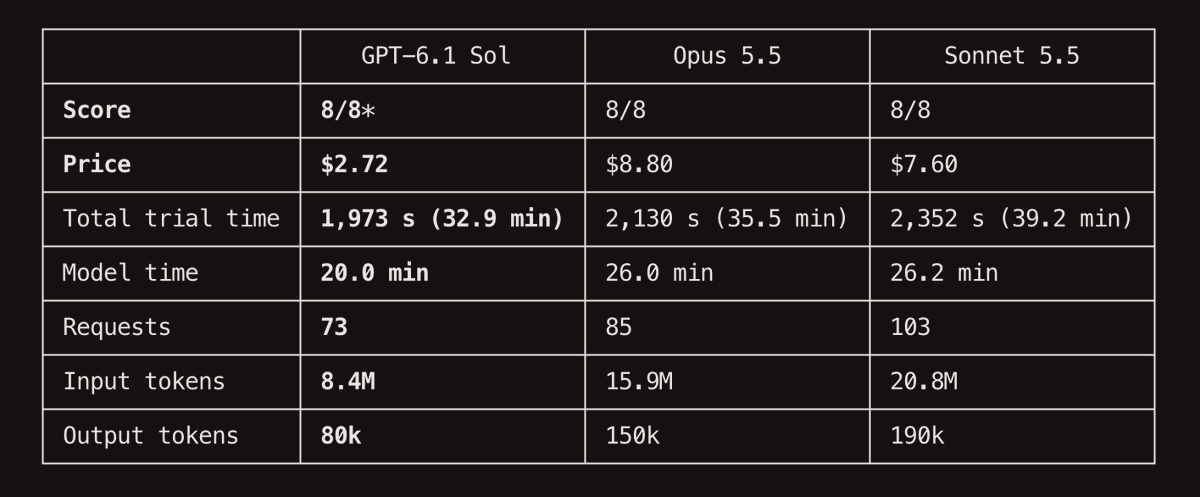
we found opus 5.5 to be 2X as efficient as gpt-6-sol in our internal https://t.co/QhA9tU0Lhp evals so i was not expecting 6.1-sol to improve on that much
but to see it 3X the efficiency of opus 5.5 and 2.5X against even sonnet 5.5 is actually 🤯
this is an insane point release
I know it's hard to believe, but this IQ_3 of Qwen 3.8 Flash Next is genuinely impressive. Sure, it's not BF16, but it works very well in Claude Code.
To eliminate the likelihood of benchmaxxing, I present a novel voxel benchmark: Voxel Sermon on the Mount.
This was generated with the ISTA Labs Qwen 3.8 Flash next IQ_3S quant at 150 tps in Claude Code, running on a single rtx 5090. @coldniko's Astra engine for the hybrid speed! No loops, no garbled tool calls; it was just done in a few minutes.
No image head used; it built this without seeing it.
GPT-6.1 Sol ULTRA ran for 25 minutes and only used 1% of my weekly quota, It’s seriously fast and powerful, almost like Astra, but much cheaper to run, For me, this is the kind of model you can actually use 24/7 without constantly worrying about limits, From now on, it’s probably going to be my default model, Honestly, out of everything announced at DevDay, this might be my favorite update. In my experience, it feels like the most efficient model OpenAI has released so far
I’ve spent months squeezing more tokens out of DGX Sparks, so when I got access to an M5 Ultra, I started looking for the same thing:
Where is the wasted compute?
After digging into decode performance for Qwen3.8-Flash-Next Q5, the improvements are now merged into oMLX.
And the gains are pretty serious.
MTP off:
79 → 114 tok/s
MTP on:
153 → 180 tok/s on real coding prompts
4 concurrent requests:
~200 → ~225 tok/s aggregate
The important part:
Nothing about the model changed.
Same Q5 weights. Same outputs.
The answers are byte-identical.
So this isn’t a new quant or a smarter checkpoint magically producing more tokens.
It’s the inference engine getting better at doing the exact same work.
That’s one of the things I find most interesting about local AI right now.
We keep talking about bigger models and faster GPUs, but there is still a ridiculous amount of performance hiding underneath the software stack.
Better kernels. Better memory movement. Smarter decode scheduling. More efficient speculative decoding.
Better utilization of the hardware that’s already sitting there.
And MTP makes the difference even more obvious.
Without MTP, the optimized path takes Qwen3.8-Flash-Next from 79 to 114 tok/s.
With MTP enabled, real coding prompts move from 153 to 180 tok/s.
That’s a huge difference in how the model actually feels when you’re using it interactively.
Then concurrency pushes the aggregate throughput from around 200 to 225 tok/s across four requests.
The model didn’t get smarter.
The hardware didn’t change.
The weights didn’t change.
The software simply stopped leaving as much performance on the table.
That’s why I keep coming back to inference engineering.
A model release is only one part of the performance equation.
Sometimes the next 30% is already inside the machine you’re using.
You just have to find where it’s being wasted.
My god this is such a good speech that every SWE needs to hear. You know what? Every person should hear it
Keep the happy memories, eyes on the reality, be excited about the future. That’s the best that anyone can do
@g_lejars@TeksEdge Another data point on real-world use: I just ran the same prompt with PDF/XLSX/etc tool calling on openrouter's qwen3.8-27b and it was 60s slower than the local Qwen3.8-Flash-Next Q2_0!
@g_lejars@TeksEdge Someone mentioned SSD speed may not be important, because "full model is stored in system ram except n-grams". https://t.co/WXRuFc68UD
@g_lejars@TeksEdge There are 2x Samsung 9100 PRO @ PCIe 5.0 passed through to a TrueNAS instance. I could borrow one and try it out.
After today's experiment with qwen3.8, I'm quite impressed with the quality of the model output. Much better than Bonsai.. It may be time to replace my 3080 Ti.
@g_lejars@TeksEdge It's a Samsung 970 EVO 1TB. 3GiB/s sequential and 414MiB/s random throughput. As real-world benchmark, I used a prompt which read 3x PDF, called 14 tools, updated 4 cells in an Excel. Turns out that this Qwen3.8 model needed ~9min vs. gpt-6-astra ~2,5min. Quality was ~same.
@g_lejars@TeksEdge I will admit that this is all black magic for me, but ... I verified it's the 125B Qwen3.8-Flash-Next. It's ISTA-DASLab's GSQ-RCO Q2_0 (not Unsloth's): Strata reads the 28.8 GB n-gram shard lazily from SSD. It runs at 192K on our 12 GB GPU/64 GB RAM box.
Today Microsoft announced Autopilot, an always on agent built on OpenClaw
The best part of this collaboration is how much @OmarShahine and others at Microsoft have contributed BACK to OpenClaw
Read all about the contributions Omar and his team made here: https://t.co/JOXd6sswZ2
Microsoft shipped a really compelling product on top of @OpenClaw today. We worked with them since March to make the codebase ready for large-scale deployments, they are a great partner and open-source contributor. 🙏🦞