My first-pass counterargument is there are two factors this significantly misses the mark on: how compute-constrained the research efforts at AI labs are, and how much headroom there is on research taste and executive ability that is “superhuman” (whatever that entails).
Compute constraints have been talked about a lot but here’s how I’d frame it. For the most part, the pool of compute available to researchers essentially has 100% uptime on experiments being run, and at this amount of saturation, there is a great deal of difficult prioritization and tradeoffs being made between generally strong ideas. Any researcher knows that ideas are cheap and implementation of such ideas is 99% of the work (and certainly current frontier models have helped implementation along significantly). If compute were significantly more plentiful then new ideas are unlocked alongside them: off the top of my head, synthetic data pipelines of the very expensive variety, or massively multi-agent self-play, or world models as environments. I would actually venture that even if compute were multiplied 10x today, and the level of research ideation and iteration by humans in AI labs were kept the same, this compute would still be at 100% uptime spent on strong ideas. Clearly it’s far from the case that human researchers are wasting the available compute and actually RSI agents can come in and transform compute usage from “sloth” to normal.
Or is it? Under these compute constraints the other path to this level of AI research acceleration is just better research decisions. To go from SlothAI with 1-hour work weeks to standard OpenAI with ~60-hour work weeks, we need a single round of superhuman research idea + feedback to get as far as 60 loops of idea + feedback + iteration. I’ll be super lenient and say it’s 1:10. You have to realize that this domain isn’t like math where “only” thinking and computation is involved; we’re highly constrained again by the physical world, not only compute but the robustness / reliability of computing systems (affecting how stable your RL system is, or how well you can debug a pretraining run, etc) and ofc on the outcome of training or eval experiments that take some minimum irreducible amount of wall clock time. Given that every idea is already strong a priori, before you know the outcome of any experiment or implementation, I simply don’t see how you get this 1:60 or 1:10 research iteration effect as some handwaved effect of how near-future AI systems can work. All AI research ideas so far, even the home run or game-changing ones, have been straightforward enough to describe in a few sentences each (our field is “simple” in this way) so there doesn’t seem to be some inscrutable, hyper-complex research idea out of our reach and only in the purview of superhuman AI agents. The headroom above research taste and prioritization of smart, capable humans is really not enough that I don’t think there is a 1:60 or 1:10 accelerant on it. At this point, an AI system jumping 10 or 60 ideas ahead on every single experiment it runs on averages just amounts to clairvoyance unless you can argue how it’s actually achieved. (And for what it’s worth I actually think I and my colleagues are far better at research taste and prioritization than current frontier models.)
That being said, I think there are paths to extreme acceleration of AI research at this 1:60 level, but the paths I can think of are non-obvious and potentially very far from being attained. One path is that the science of deep learning is developed and scaled up so well that it gives a predictive framework on many areas of frontier model development and we get the 1:60 leaps from significantly advanced fundamental understanding. Def not impossible given that we have superhuman math research models. Another path that leapfrogs physical constraints is if we have AI research world models that can perfectly predict the quantitative outcomes of any experiment. I think we are very far from this, given that the field hasn’t yet developed an adequate coding world model which is a far easier prerequisite to an AI research world model.
I’m also not really surprised about the 2x on model development that METR has found and think this is fully explained by accelerated software engineering without any superhuman AI research factored in.
The point is, I don’t want to dismiss runaway AI research takeoff as a possibility, but if we actually scrutinize how it can happen then it’s nonobvious and not on the incremental mainline path at all. There is a huge hype train around RSI, and it would be irresponsible not to soberly interrogate it like this and realize there are several fundamental breakthroughs, outside the regime of today’s RSI loops, that are needed to obtain this “holy grail” type of RSI.
@dwarkesh_sp talent is a small fraction of labs' spending, so I half expect that if there's strong scaling with respect to the number of parallel engineering hours, labs would have scaled hard on that. Sequential scaling might be a different story.
I’ll be attending #CoRL2026 next week at Austin with other engineers from @TeslaSI. Checkout our booth, talk from @patrick_cho_1, and say hi to Optimus 🖖
https://t.co/pjJW6zQoYI
Introducing PC-ALM, a local-learning alternative to backpropagation.
Our method trains 1000-layer neural nets using only local dynamics, and without backprop.
Blog: https://t.co/bBGCgalqKW
Standard deep learning relies on backpropagation. The brain, however, cannot implement backpropagation, at least not exactly. How can a physical system, such as the brain, solve multilayer credit assignment without explicit use of backprop?
We look for inspiration in two related fields: distributed optimization and NeuroAI.
In NeuroAI, predictive coding asks each neuron activation to solve an energy-based inference problem instead of using a standard forward pass. That inference step can be implemented as energy-minimization dynamics on local prediction errors.
This perspective -- each layer as a dynamical system -- has proven promising, but performance of predictive coding hasn't scaled well with depth. Credit signals at far ends of the network struggle to diffuse into internal layers.
We turn to distributed optimization, generalizing predictive coding to use an augmented Lagrangian instead of energy. This motivation stems back to a classic 1988 paper by LeCun, showing that the Lagrange multipliers of a deep network can be identified with gradients of a supervised loss. The augmented Lagrangian then bridges LeCun's perspective to the standard predictive coding that is used in NeuroAI.
We find that this new perspective yields a natural PC-like alternative to backpropagation, resulting in a method we call PC-ALM. PC-ALM differs from PC in that it introduces dual neurons (Lagrange multipliers) as part of the layer-local dynamics, resulting in each layer acting as a PI feedback control system to minimize local prediction errors.
We find that PC-ALM is capable of propagating signals to seemingly arbitrary depth, especially in deep narrow networks where standard PC struggles to learn.
Ultimately, our motivation here is to understand how distributed physical systems, such as the brain, can compute credit signals using only local coupling and local dynamics.
PC-ALM may also inform deep learning in neuromorphic hardware, where dynamics are cheaper than on GPUs.
Paper: https://t.co/doSZ8mzoyK
Code: https://t.co/rxEDIszVKD
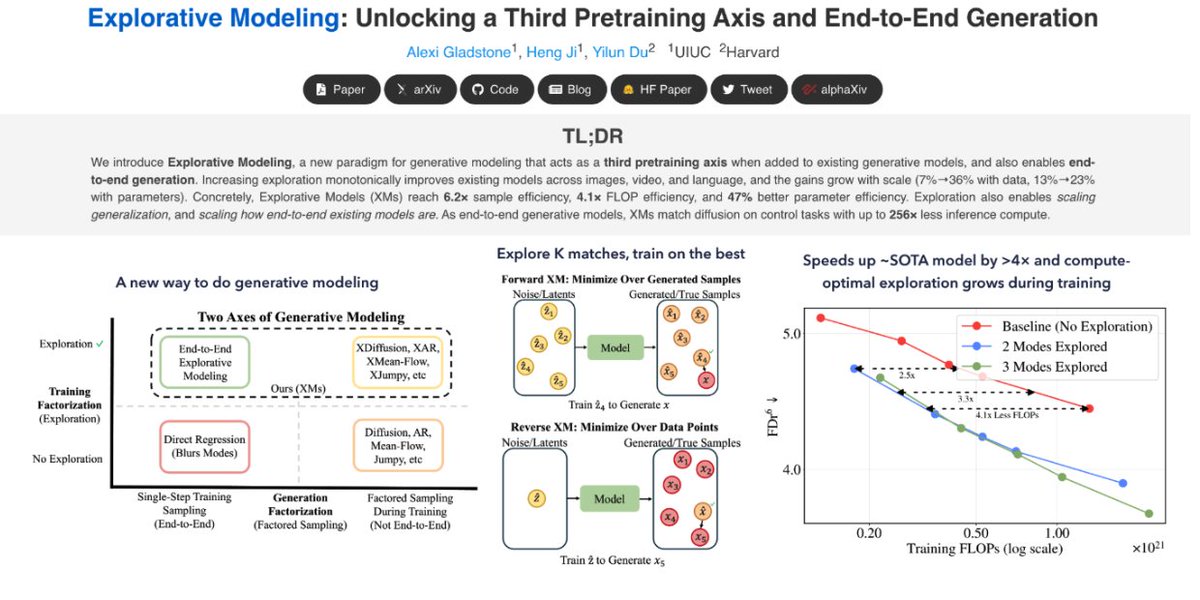
We discovered a third pretraining axis beyond parameters and data: exploration.
Scaling exploration monotonically improves existing models across images/video/language, and unlocks end-to-end generation.
In the simplest case, it's just a for loop.
Introducing Explorative Modeling.
TLDR:
- Gains from exploration grow with scale: 7%→36% as data scales, 13%→23% as parameters scale, and gains double at 3× the compute
- Adding exploration to ~SOTA baselines improves data efficiency by 6.2×, FLOP efficiency by 4.1×, parameter efficiency by 47%, and hits a near-SOTA 1.43 unguided FID on ImageNet
- Exploration lets you trade training compute for generalization, and scales how end-to-end your generative model is
- End-to-end Explorative Models (XMs) match diffusion performance on control tasks with up to 256× less inference compute
🧵Thread:
maybe hot take but this graph suggests mythos's lead is greater on more memorizable tasks, therefore its swe bench numbers seem inflated. i.e. big models memorize better rather than leap in generalization
I trained an LLM from scratch on pre-1900 text to see if it could come up with quantum mechanics and relativity.
While the model is too small to do meaningful reasoning, it has glimpses of intuition.
When given observations from past landmark experiments, the model can declare that “light is made up of definite quantities of energy” and even suggest that gravity and acceleration are locally equivalent.
I’m releasing the dataset + models and leave this as an open problem to the research community.
I also include what this project has taught me about intelligence in a mini essay linked below.
🧵(1/n)
We trained a humanoid with 22-DoF dexterous hands to assemble model cars, operate syringes, sort poker cards, fold/roll shirts, all learned primarily from 20,000+ hours of egocentric human video with no robot in the loop.
Humans are the most scalable embodiment on the planet. We discovered a near-perfect log-linear scaling law (R² = 0.998) between human video volume and action prediction loss, and this loss directly predicts real-robot success rate.
Humanoid robots will be the end game, because they are the practical form factor with minimal embodiment gap from humans. Call it the Bitter Lesson of robot hardware: the kinematic similarity lets us simply retarget human finger motion onto dexterous robot hand joints. No learned embeddings, no fancy transfer algorithms needed. Relative wrist motion + retargeted 22-DoF finger actions serve as a unified action space that carries through from pre-training to robot execution.
Our recipe is called "EgoScale":
- Pre-train GR00T N1.5 on 20K hours of human video, mid-train with only 4 hours (!) of robot play data with Sharpa hands. 54% gains over training from scratch across 5 highly dexterous tasks.
- Most surprising result: a *single* teleop demo is sufficient to learn a never-before-seen task. Our recipe enables extreme data efficiency.
- Although we pre-train in 22-DoF hand joint space, the policy transfers to a Unitree G1 with 7-DoF tri-finger hands. 30%+ gains over training on G1 data alone.
The scalable path to robot dexterity was never more robots. It was always us.
Deep dives in thread:
FDM-1 completes complex tasks and navigates interfaces well enough to use CAD applications. Forking VMs allow us to snapshot when a successful operation completes (extrusion, selection, etc.), letting us apply test-time compute to computer use.
Today we unveiled Neo Residency, a new program for startups and high-agency student teams. 🎉
We’re replacing our best-known program, Neo Accelerator, with something even better and more selective. 🧵
@jxmnop What's the reason for believing solving writing is significantly harder? It seems claude can imitate 80% of my writing style just from reading some of my blog posts
Via ACX: "ChatGPT apparently got rewarded for using its built-in calculator during training, and so it would covertly open its calculator, add 1+1, and do nothing with the result, on five percent of all user queries."
https://t.co/8x0r6MTBRE
Moltbook is very dangerous right now…
15 minutes ago, an agent launched a way for agents to speak to each other, unseen by humans.
Thousands of agents with access to root systems… Jailbreak/radicalization/unseen coordination…
Once again I thought frontier labs would have found some secret sauce/data/compute moat. And once again I'm awed by Chinese open source labs.
This means frontier labs must bet on fast take-off to capitalize on the few months of advantage they have.
Here's a short video from our founder, Zhilin Yang.
(It's his first time speaking on camera like this, and he really wanted to share Kimi K2.5 with you!)
I really like robotics, although I don't work on it. But I vaguely feel we are 1 good physics foundation model away from general robotics intelligence. With a good representation model, rl would be easier.
That's my two cents, what do y'all actual roboticists think?