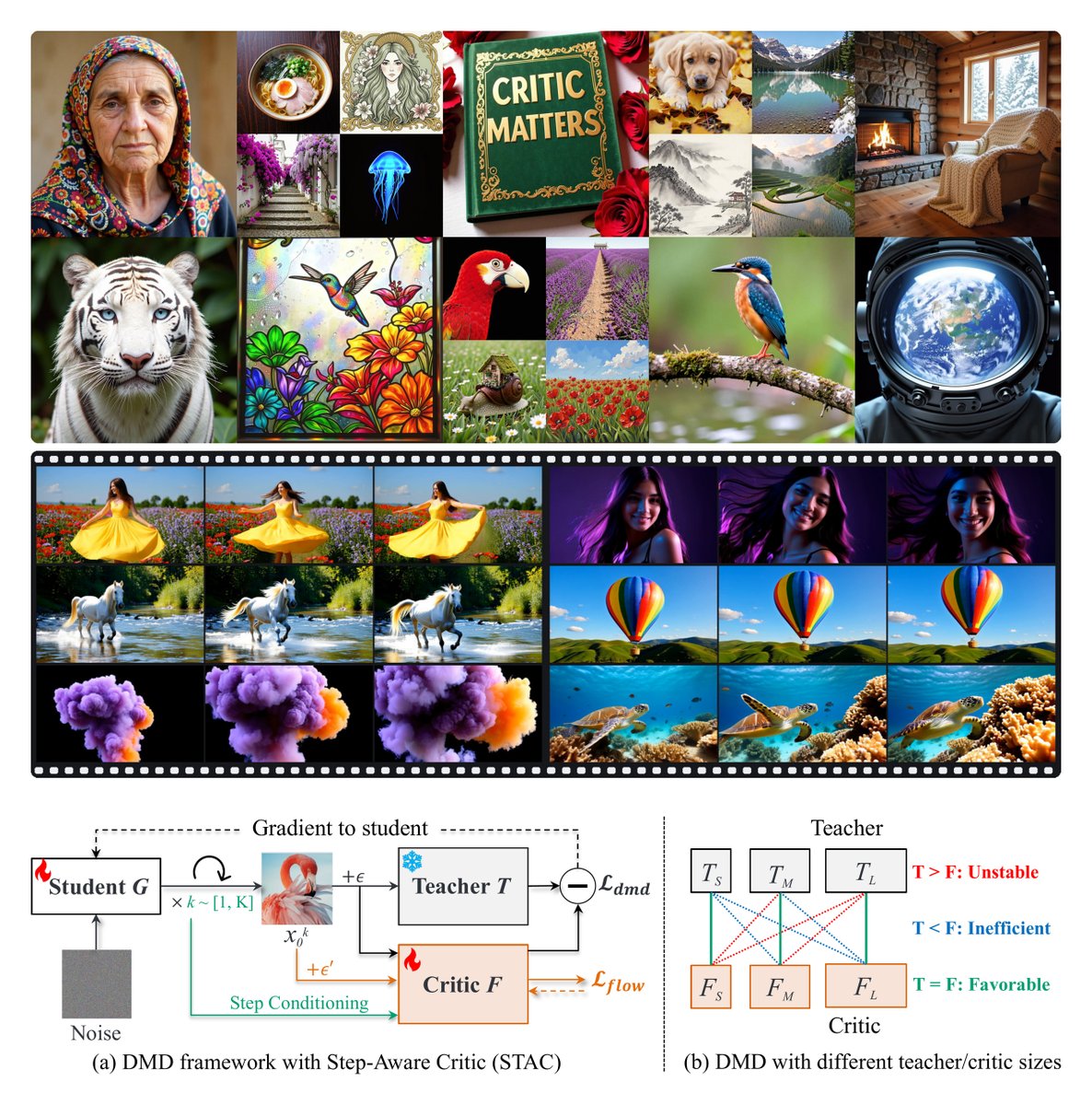
A bigger teacher should give you a better DMD student, right?
👉 NOT if your critic is small. The student gets worse, and can even collapse.
2 dead-simple critic fixes everyone overlooks:
1. Scale the critic with the teacher (joint scaling)
2. Tell the critic which generation step it's judging (STAC)
🌐 Project: https://t.co/GQT7XYSCWB
📄 Paper: https://t.co/WPPyWUCGPx
@MIT_LISLab I’ll present KeyFlow at CoRL’s Learn@Deploy workshop on Nov 12!
With Ben Zandonati (equal contribution), Tomás Lozano-Pérez, and Leslie Pack Kaelbling at MIT.
Come chat about robot-use agents and deployment-time adaptation!
https://t.co/Gh96ed0xVv (7/7)
Excited to share my first project at @MIT_LISLab : 𝐊𝐞𝐲𝐅𝐥𝐨𝐰! 🤖
Can robots adapt from a few demos without retraining? We let a coding agent improve a retrieval-based policy through simulated play.
Presenting at CoRL Learn@Deploy workshop! 🧵(1/7)
https://t.co/Gh96ed15L3
@MIT_LISLab Can KeyFlow also improve a robot foundation model?
In IsaacSim, its flow fields guide a 𝐟𝐫𝐨𝐳𝐞𝐧 π₀.₅ policy, improving mean success by 𝟑𝟕.𝟐 𝐩𝐞𝐫𝐜𝐞𝐧𝐭𝐚𝐠𝐞 𝐩𝐨𝐢𝐧𝐭𝐬 across six tasks—without retraining the base model. (6/7)
We asked GPT-6 Astra to edit Qwen3.5-0.8B weights to improve math.
It directly changed only 0.016% of weights, fixing 0.8B's reasoning loops & improving math up to 6x and even instruction following 3x, without gradients or training.
We call this Weight-Space Programming: frontier LLMs can now natively read/write neural network weights! 🧵
Blog: https://t.co/bOWCcFhCVq
An internal model at OpenAI has produced a claimed refutation of ETH! Russell Impagliazzo, Mohan Paturi, and I have been asked to help organize an open and independent examination of this claim. 1/4
The next frontier is AI that improves itself, and we believe everyone should know how to build it.
This semester, Ao @ao_qu18465 and I are teaching 'How to AI an AI for Almost Anything' @MIT@medialab -- a new course on self-evolving AI systems that recursively improve from experience, feedback, memory, and exploration over long interaction horizons.
The key idea: intelligence shouldn't stop improving when training ends.
We cover four levels of evolution:
(1) context evolution through prompt optimization and context management,
(2) harness evolution through memory, tools & skills, workflow optimization, and multi-agent systems,
(3) model evolution through RL, distillation, test-time training, self-play, and continual learning,
(4) task evolution through generating increasingly complex synthetic tasks, simulations, evaluations, and environments.
Slides, readings, and videos available: https://t.co/QLPhT77Yvj
We thank @Kimi_Moonshot and @PrimeIntellect for generously sponsoring API credits!
Students sometimes ask me if it still makes sense, in this accelerating age, to pursue a PhD in AI.
Perhaps counterintuitively, I think it's a great time to do so.
I wrote up some thoughts on this here: https://t.co/RRqGR0qi1R
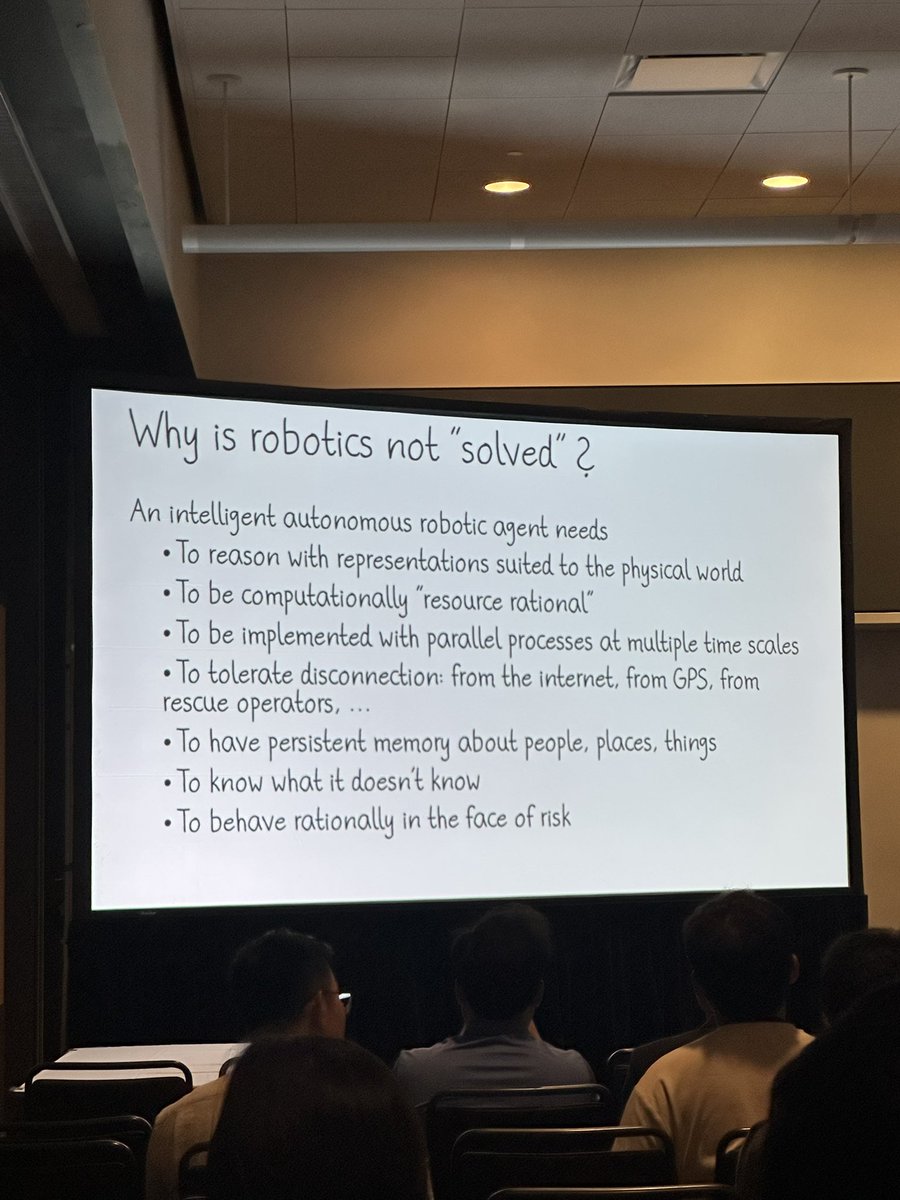
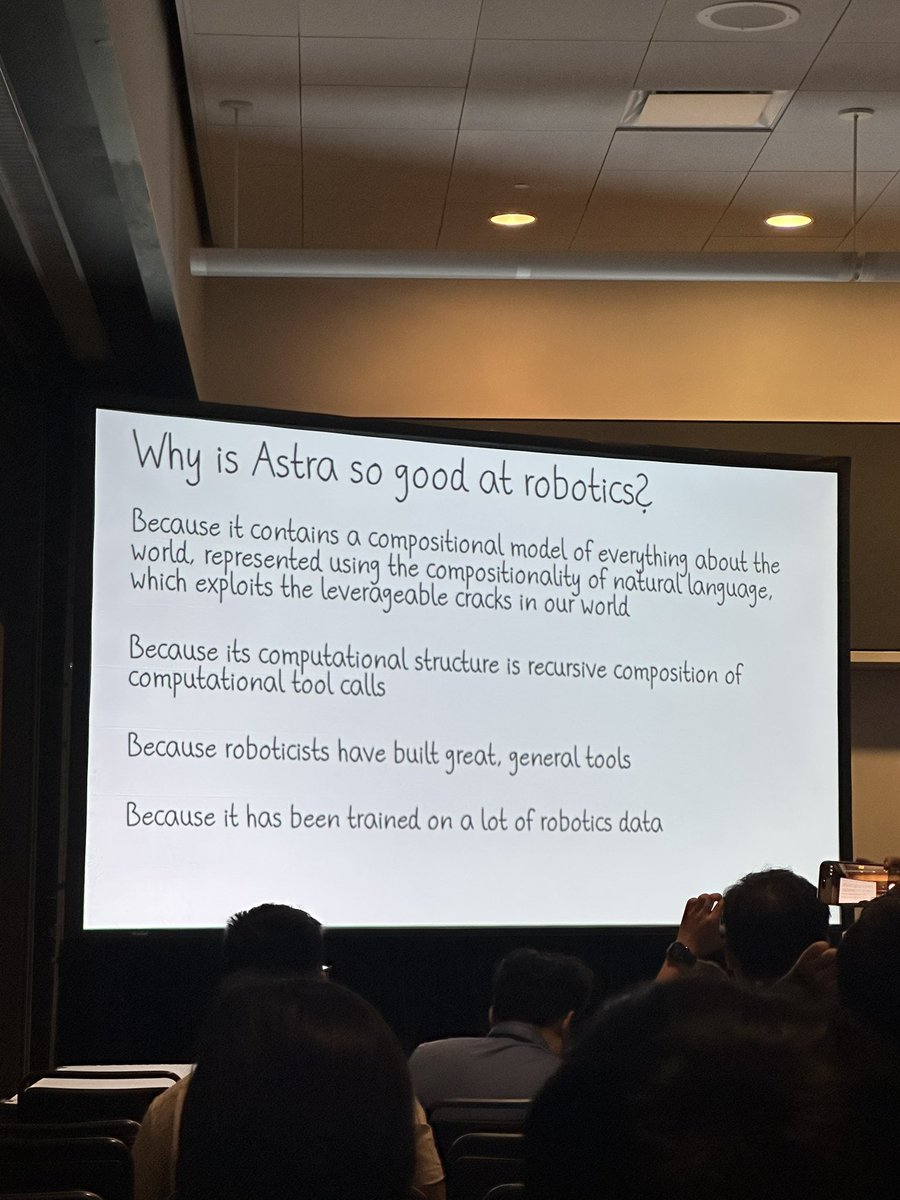
Leslie Kaelbling on why Astra is so good at robotics and why robotics still isn’t solved “yet”.
I spoke at Leslie’s lab pre-Astra, and we chatted about many of these ideas. Pretty cool to see them coming into the mainstream. #IROS2026
Seeing at least 10-20 “agentic robotics” papers built around GPT-6 Astra + a robotics harness out this week.
But the core idea isn’t new. VoxPoser, Code as Policies, Manipulate-Anything, and others explored LLM-driven robot orchestration years ago, with even deeper roots in TAMP.
What has changed is the underlying technology.
I'm looking for full-time Research Engineer / Machine Learning Engineer roles starting Jan or May 2027! I'm an MIT undergraduate (majoring in Physics + AI) researching generative modeling in Prof. Kaiming He's group. I'm especially interested in LLM pretraining/post-training and multimodal generation.