Fast-forward to my stance on what DTC can learn from Japanese people guessing chicken genders
https://t.co/7R9GoVA9kf
https://t.co/6eqRS1DLZn
Great convo with someone whose podcast really saved me some trial-and-error on DTC'ing!
Michael Ting might be the smartest person I've met in ecommerce in the last year.
No exaggeration. When our mutual friend @alexmcea introduced us, it was one of those "you HAVE to talk to this guy" messages.
And he was right.
Michael is Head of Revenue at JAXXON, an 8-figure, monstrously profitable men's jewelry and accessories brand. His background is in engineering and quantitative analysis, and he's brought that rigor to the entire DTC performance marketing process.
The insight that first got my attention? JAXXON doesn't measure their ad spend primarily with ROAS or third-party attribution. They do it with a metric you aren't even tracking:
Cost per email lead.
Here's the framework:
👉 Because they can perfectly connect emails captured + email addresses at checkout, it's a highly reliable metric
👉 They track lifetime value curves for each lead
👉 Because they're highly seasonal & moment-driven, this allows them to see the value of their spend when the click is farther or closer to the moment
👉 Optimizations are built within a "make hypotheses, be wrong sometimes, and learn" framework
I've literally never heard anyone talk about attribution and marketing mix optimization this way. It's brilliant.
Go follow @michaelandeggie now, then get the episode wherever you get podcasts below 👇👇👇:
@ron_ecomm I think of building a “portfolio” of bets where similar to stocks/bonds/cash we keep a healthy mix of incremental vs. transformative projects… the mix of which is determined by whether we’re more focused on short-term or long-term performance
@theisaacmed It’s most useful when I’m actively using my mouse & keyboard but want to narrate my thoughts (e.g., giving feedback on a new dashboard)
If you’re interested in EGT should check out this brand: https://t.co/jU14FB1AUu
Large Asian bio-tech which is one of the only supplement companies to manufacture raw materials themselves… just started selling in USA (made here) - I’m not affiliated in any way… I just know the CEO
Probs need to add a correction factor (see Bonferroni) to these tests since you're running multiple cells - not sure Intelligems includes (would be cool if they did)
If you're running control + 4-cell test then there's a pretty high chance you'll consistently get false positives without a correction
- Marketing budgeting = risk management, not optimization
- Confidence intervals are probably too high
- We underrate the impact (positive and negative) of luck
.@michaelandeggie (GM of DTC, JAXXON) believes there is no optimal ad account … only different time horizons.
He joins @connorrolain + @couuor to share how:
- Cost per email is a north star
- Sacrificing March can max BFCM
- Good decisions still go wrong
- 80% confidence = 3x your tests
- Your risk tolerance is your edge
- 50% shot at 3x > guaranteed 15%
“We used to try to win every day. Then we were trying to win every week … What’s going to grow the brand is being able to sacrifice entire months.”
Monte-Carlo Simulation Results
Addendum to: "Reasons why 95% might be better than 80%"
- Because of the roadmap quality decay assumption, the optimal confidence is also a function of # of sessions too
I'd posit that the quality decay assumptions becomes unrealistic after too many tests (e.g., I probably wouldn't run a test that I thought had a 15% chance of winning)
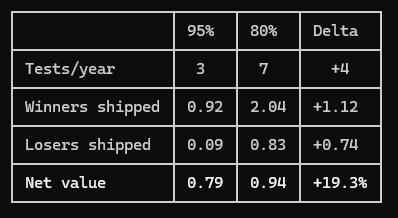
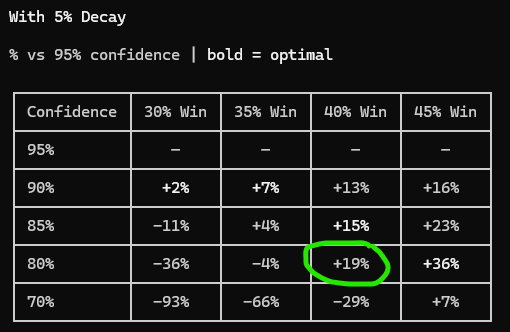
Running your A/B tests to 80% confidence could generate you +19% better results vs. 95%
Here's a hypothetical (but realistic) situation:
- You've got a long roadmap of A/B test ideas and adequate resources = you're limited by testing time
- You've prioritized the tests = the current test is expected to be ~5% better than the next one
- Your first test has a 40% chance of working and your initial winners & losers cancel each other out
- You're currently @ 2% CVR and you expect your first test to have a 0.04% impact
---------------------------------------------------
Here's the finding for 80% vs. 95% confidence:
- You'll implement ~2.3x more tests
- 12% will be losers vs. 1% @ 95% confidence
- Without quality decay you'll net +61% higher impact
- With quality decay you'll net +19% higher impact
---------------------------------------------------
Takeaway: Take time to consider WHY you're running tests to a certain confidence
Reasons why 95% might be better than 80%
- Low test success rate (e.g., <40%)
- Limited resources (e.g., you have ideas but you can't code them fast enough)
- Limited # of good ideas (e.g., the quality of your roadmap significantly declines vs. the early tests)
- Limited # of potential ideas (e.g., there's a finite # of potential offer tests I could potentially run)
- You prioritize perfection vs. impact
CMV: Traffic* should always be checked when analyzing holdout tests
Three Reasons:
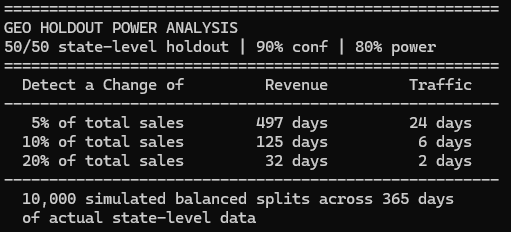
1) Takes 300+ days to reach statistical power** on $ (See attached chart for simulated 9-figure ARR)
2) Helps diagnose the root-cause (e.g., ads driving traffic but low-CVR or vice-versa)
3) It can improve precision of incremental $ through application Bayesian stats***
Takeaway: For holdout tests, incremental $ is still the most important metric, but we need to be checking more metrics
-----------------------------
* Traffic = total sessions, add-to-cart sessions, and checkout sessions
** Tests should be run for statistical power, not statistical significance
*** Ex. You could use incremental checkout session growth as a "prior" in order to estimate incremental orders (See CUPED)