“It’s claptrap” isn’t an argument.
You would have heard the same regarding VAT, income tax, CGT…everything.
Anything that’s new is ‘claptrap’ to a person whose job was helping people dodge taxes, sure.
Just got off the phone with my college roommate.
His daughter was diagnosed with leukemia in January.
He has insurance. Good insurance. The kind you feel safe having.
7 months later:
Savings: wiped out. 401k: cashed early. Penalties and all. House: refinanced to cover the gaps insurance decided weren’t their problem.
He told me he’s not the same person anymore.
Said watching your child fight for her life while simultaneously fighting an insurance company over coverage codes does something to you that doesn’t go away.
They did everything right.
Two incomes. No debt. Responsible their whole lives.
One diagnosis undid all of it in 7 months.
And somewhere a health insurance CEO is getting a $30 million bonus this quarter.
I don’t know how people defend this system with a straight face.
I really don’t.
This is fucking horrific. Pochin telling England to keep winning so blokes don't batter their wives, instead of telling abusers not to abuse.
Can't believed what I have just watched.
i have to say "a single person having a trillion dollars does nothing to hurt poor people or worsen global poverty" is a very stupid thing to say about *elon musk* a guy who quite famously has already used his billions to get the us government to end all international aid
“Re-run the 1970s”? Oh my! My household disposable income would love that!
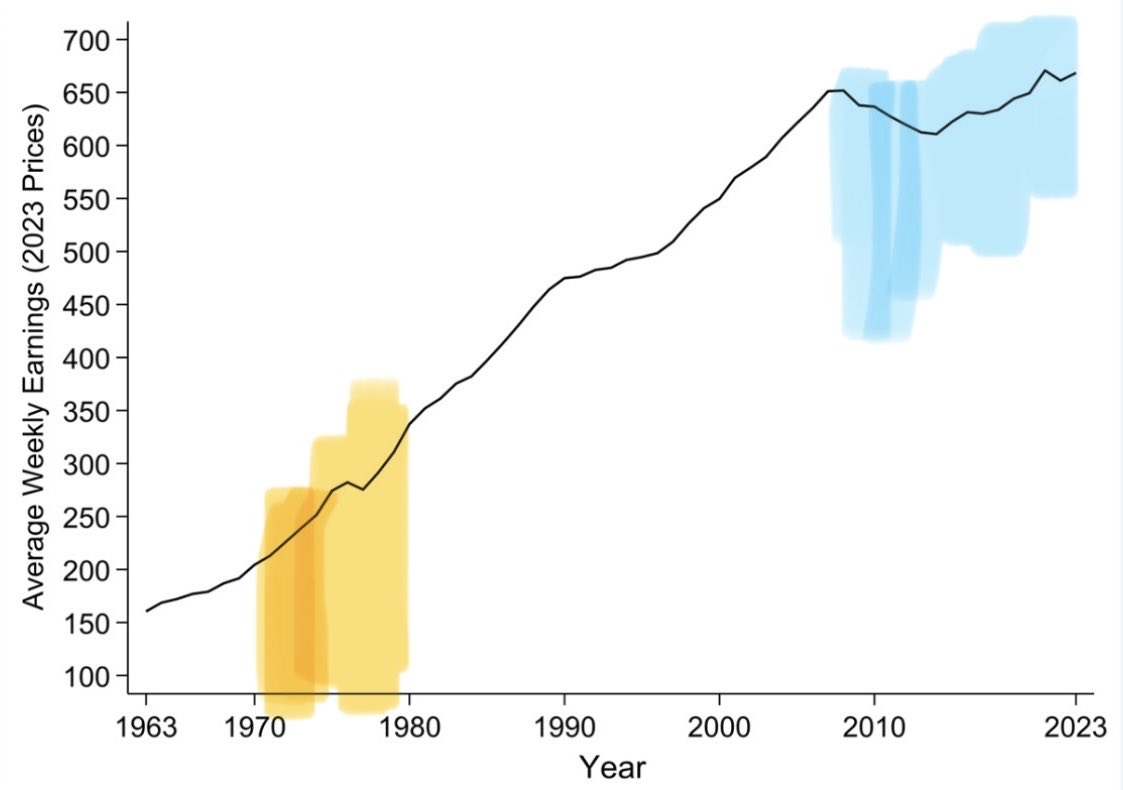
They’re trying to persuade you that the blue bit = a better economic performance than the yellow bit, because in the yellow bit there were lots of strikes.
1970s Britons ended the decade 30% richer than when in started. Meanwhile, ~20yrs after the collapse of market-liberal financialisation, we’re still ~as wealthy as we were in 2007. Two lost decades, most of them played out under Conservative governments. But hey, at least we don’t have feral trade unions & a solid inheritance of nationally owned assets to flog anymore!
we live in age of great moral panics about things that don’t matter and zero moral outrage over some of the most egregious societal sins we’ve ever seen
He's supposed to be a 'macroeconomist'. He's not, he's a nervous, scaremongering investor. With 2.8% inflation and about 250 billion in $ reserves, we don't need an IMF loan.
Even in 1976 with 16% inflation and low $ reserves the loan was unnecessary - it was to replenish $ reserves to pay off a stupid G10 loan meant to maintain a fixed exchange rate rather than let the £ float freely. They couldn't leave the Bretton Woods mentality behind, even though it was over.
The £ drifted down from $1.8 to around $1.05 in a few years anyway and fluctuated up to 2007. Then the whole shebang crashed. The global finance system runs on the 'confidence' of spivs and gamblers. That's the problem.
Again, an awful lot of gaslighting re: "neoliberalism", denying the existence of a ~50yr policy/governance agenda on the basis of "the state spends a lot of money".
Public spending as %-of-GDP isn't high because we've had a period of Leftwing hegemony. (Outside of the arts, the academy & the social/cultural policy sphere, that's obvious nonsense). Rather, it's high because:
👉Demographic pressures have pushed up the 2 massive spending outlays, health & pensions – a problem common to the vast majority of Western democracies
👉UK growth/productivity has been stagnant for ~18yrs, since The City of London collapsed under the weight of its own poor investments, while spending pressures have continued to grow apace
👉We have a growing (& expensive) debt pile as a result of the taxpayer twice being forced to bail out the private sector to the tune of several hundred £BN – 1st during GFC, 2nd during Covid lockdown
👉We have huge revenue pressures from "sticking plaster" subsidies covering up the underlying issue of chronic low investment, e.g. housing benefits ballooning while municipal capex on housebuilding shrinks; or tax credits/UC top-ups disguising stagnant real wages; or increasing day-to-day NHS spending after years of squeezed capital budgets/social care sector collapse
Neoliberalism is defined by privatisation, the embrace of globalisation/free trade, monetarist central banking, the emasculation of the labour movement, & the transformation of the state from a prime actor in national production/investment into a post-hoc fiscal distributor. It has been consciously driven by market-liberal true believers (some even self-identifying as "neoliberals") – on the Right by Hayekian/Friedmanite think tanks, business groups & various Conservative ideologues, and on the Left by Third Way modernisers (see Blair) and their intellectual forebears in Marxism Today's revisionism, the Democratic Left etc. etc.
Pretending none of this happened (because 'muh the state still spends £££') is pure sophistry. They want us to believe they didn't sell off airlines, steelmakers, coal mines, energy generators, water companies, car manufacturers, banks, bus/train contracts & millions of council houses. That they didn't deregulate financial services to get their 'Big Bang'. That they didn't abolish rent controls, or capital/exchange controls, or wage boards, or price commissions. That they didn't outsource core services and state capacity to corporate providers. That they didn't impose some of the most draconian/restrictive trade union laws in the democratic West. That they didn't cede monetary policy to an independent central bank, or cede trade/migration policy to an unelected, supranational, continental bureaucracy. That they didn't squeeze public investment or prioritise tax cuts over infrastructure spending. That they didn't eschew industrial policy and take a lax approach to deindustrialisation because the future was services & the "knowledge economy".
This isn't simpy an accumulation of random policy titbits, but is the outcome of a coherent intellectual project that has consistently rebalanced the labour/capital relationship in the latter's favour. These people are conning you.
What's likely to happen next in the global economy? I'll keep it as simple as possible.
Firstly, the most significant sudden shortage in energy supplies in our history will cause supply-side inflation as the prices of most everyday goods rise. The bond market parasites will demand higher yields and longer maturities, spooking governments about deficit spending, which will have to rise anyway because of increased welfare demands caused by increasingly precarious employment. Irreconcilable tension right away.
Secondly, consumption and aggregate demand will fall, stalling growth and combining with inflation to cause what we used to call 'stagflation'. Skyrocketing prices will trash aggregate demand, asset prices, investment, employment and tax revenue, leading to a reversal into the realm of deflation, as experienced during the US Great Depression. Higher interest rates will further limit investment and state spending, tipping the whole shebang into a deflationary vortex.
Thirdly, states will have to react. So will voters. Far-right populism could expand, so the left will have to stop pissing about with identity politics and get back to political economy. The only partially effective measures capable of pulling back deflation, preventing widespread poverty and quelling civil unrest would be price controls, defict spending, public investment and employment, nationalisation of all infrastructure and key industries, a huge shift in progressive taxation aimed at the wealthy, negative bond yields (or the elimination of the primary and secondary bond markets), tarrifs on selected imports, and strict capital exchange controls.
Of course, the global creditor class would see all this as more instability and a threat to their power and free money. They would hoard their money, squeal for higher yields and interest rates and launch mass-media ideological campaigns to discredit politicians and intimidate voters. Hordes of irredeemably stupid individuals would agree with them and support the misery as an essential 'market correction'. Hours of fun on X.
Sounds very messy, doesn't it? So messy, in fact, that we might as well forget the whole thing and revive the only serious antidote and alternative. It's called socialism. It's not the most easily administered system, and some of the more avaricious, narcissistic and entitled individuals would experience limits on their economic freedoms, but anything is better than the chaotic lunacy that is late-stage capitalism.
One thing that characterises political discourse in this country is the screaming horror that ensues, not at, say, poverty or genocide or homelessness, but whenever somebody suggests a policy that's outside a very narrow band of politically acceptable ideas.
You see recurrent versions of this everywhere, i.e. the idea people get more conservative as they get older. This is broadly true of exactly one generation blessed to grow up with shared prosperity and a welfare state that then decided no one else deserved those things.
In 1975/76: £21.3bn on building homes.
£1bn on housing benefit.
In 2021/22: £3.7bn on building.
£26.8bn on housing benefit.
The state didn't abandon housing.
It stopped building and started subsidising landlords instead.
it’s a bit ridiculous to say “the time you spend scrolling could be spent building a business/writing a novel/reading the classics”. sometimes that’s true but usually scrolling happens as a result of cognitive fatigue, and the idea that you can just “swap in” another intellectually demanding task means you’re treating your body/mind as a machine
a better approach would be “the time you spend scrolling could be spent taking a stroll/napping/staring out the window/having a meandering conversation with a friend”. that’s both more palatable and probably what we’re actually craving when we reach for our phone: a brief break from the demands of life, and a time to let our mind relax
People retweeting this asking why we don’t do this anymore and it’s because there’s freaks who record you and then will make fun of you online for having fun