@JahKod@BoardLotSultan@mistatash@ehdande Understanding is one thing. Executing anything legitimate is another. His reputation at Britam then cytonn speaks to this
@miamoreazure@ehdande@joshuamalidzo@Ndonglaw043@pwanyama@LawSocietyofKe It's not lost on anyone that despite being a frivolous litigant, this petitioner thrives on public misinformation. Granted, we expect a huge pact of disinformation arising out of the conservatory orders. Main test remains legitimatizing Ponzi Schemes against Kenya's laws
@BoardLotSultan I doubt the figure being bandied here is correct. The assets remain largely undeveloped but heavily geared through astronomical professional fees. The mastermind of this heist keeps floating a figure of 14% at best to be recovered.
@BoardLotSultan Probably the management anticipated this scenario and opted to offer CHYS as a separate product. That's why the court drama will go on unless a proper inquiry is done on funding, ownership structures and beneficial owners. Proper company law practice not debt litigation we see.
The Supreme has a love for two tracks. The Two Track JR in Dande has its Spirit in the Two Track HC-ELRC decision yesterday. But like many others of its decisions, will soon come with the PRACTICAL CHALLENGES.
@Ndonglaw043 The cytonn application will raise more questions than it seeks to address - matters touching on business legitimacy, CMA oversight rules, consumer protection amidst the interplay between constitutional and insolvency rules. Interesting case! @ehdande@liznkukuu@Kenyajudiciary
@Ndonglaw043 The cytonn scam still faces quite an uphill task. How to persuade the SC to determine the vesting orders unlawfully limited constitutional rights instead of them being a lawful exercise of insolvency powers. Under the doctrine of tracing, 'They were all cytonns'.. LJ Mabeya
@Ndonglaw043 Cytonn faces quite an uphill task. How to persuade the SC to determine the vesting orders unlawfully limited constitutional rights instead of them being a lawful exercise of insolvency powers. 'They were all Cytonns'.. LJ Mabeya
@MwangoCapital Reminds me of what SC commented in one of his posts. Cytoon, like all Ponzi Schemes, are stubborn. In the end, the culprits get eggs on their face for their judicial adventurism. Interesting case this one. @ehdande@liznkukuu@Kenyajudiciary
@ehdande@CytonnInvest@joshuamalidzo@Kenyajudiciary@Ndonglaw043
This was never about whether Article 40 protects property in the abstract. It was about whether assets acquired and held within an integrated financing structure linked to an insolvent entity could lawfully vest in the Official Receiver under Sections 444 and 445 of the Insolvency Act.
Simply rebranding an insolvency dispute as a constitutional question doesn’t automatically create Supreme Court jurisdiction under Article 163(4)(a). The constitutional issue must have been genuinely determined by the High Court and the Court of Appeal—not introduced later as a new angle for appeal.
If the lower courts decided the matter by interpreting insolvency law and applying it to the facts, then the real question remains whether those courts correctly applied the Insolvency Act—not whether every unsuccessful litigant can transform a commercial dispute into a constitutional one by invoking Articles 24, 40 and 50.
The Supreme Court’s jurisdiction depends on the substance of the issues decided, not the labels attached to them on appeal. #KenyaLaw #Insolvency #SupremeCourt #AccessToJustice
Edwin Dande @ehdande@CytonnInvest@liznkukuu and his associates want Kenyans to believe this was merely a business failure. The numbers tell a different story.
While investors remain trapped in a liquidation process stretching into its sixth year, basic obligations at Alma continue to expose the consequences of governance failures.
The latest Alma service charge arrears schedule reveals accumulated unpaid service charges of KES 2,938,081 across multiple units as at June 2026.
This raises uncomfortable questions. How does a development marketed as a premium investment destination end up with millions in unpaid service charge obligations? Why are creditors being asked to wait indefinitely while the assets they funded continue to deteriorate under the weight of unpaid operational expenses?
The Cytonn story was never simply about delayed returns. It was about a corporate culture where money could be raised aggressively, projects could be marketed relentlessly, but accountability remained optional.
Every unpaid service charge, every neglected obligation and every creditor still waiting for recovery points to the same underlying problem: a failure of stewardship.
The schedule shows arrears spread across numerous units, with some units owing more than KES 20,000 and others exceeding KES 50,000. Unit D-210 alone reflects arrears of KES 55,203.
Creditors did not invest billions so that assets would slide into disrepair. They invested in the expectation that those entrusted with their money would act responsibly and account for every shilling.
The central question remains unchanged:
Where did the investors’ money go, who benefited from its deployment, and who will ultimately be held accountable?
Dande has always been remarkably successful at attracting other people’s money. The unresolved issue is whether he will ever be equally successful at accounting for it.
KES 14 billion was collected from investors. Today, creditors are being taken through circus of unpaid service charges while still searching for accountability. @Kenyajudiciary@jsckenya@KJA_Kenya
The Alma narrative raises more questions than answers. @ehdande@CytonnInvest@KenyaPower_Care@KenyaPower
We are told that @KenyaPower Kenya Power and Lighting Company (KPLC) disconnected power due to unpaid bills. Yet screenshots from the residents’ group show Block C power was restored the very same night after residents mobilized funds and made payments in the early morning hours.
The obvious question is:
If KPLC had physically disconnected the supply, who restored it in the middle of the night?
Was there a KPLC technician dispatched at those hours?
Was there an official reconnection order?
Was the disconnection merely a switch-off at a local distribution point?
Or was the situation something entirely different from the public narrative being advanced?
Electricity restoration does not happen by magic. There should be a paper trail, system records, payment records, authorization logs, and accountability for whoever re-energized the block.
The timeline matters:
• Power allegedly disconnected.
• Residents mobilize funds overnight.
• Payments start reflecting before dawn.
• Power returns almost immediately.
Before anyone asks the public to accept a simplified explanation, the critical question remains unanswered:
Who turned the lights back on, at what exact time, and under whose authority?
@BRS_Kenya@Kenyajudiciary@KenyaPower_Care
Because the reconnection story may be more revealing than the disconnection story.
Mr. Dande’s @ehdande@CytonnInvest lament is revealing, not because it exposes judicial excess, but because it exposes a profound misunderstanding of insolvency law and the consequences of liquidation.
The irony is staggering. The same parties who for years insisted that Cytonn entities were separate legal persons, insulated from creditors and beyond the reach of investors, now suddenly invoke the rights of homeowners whenever the liquidation process begins to touch assets acquired, developed and maintained using creditors’ money.
A few uncomfortable truths.
First, liquidation is not a tea party. It is a statutory process designed to identify, preserve, secure and realize assets for the benefit of creditors. Once a winding-up order is issued and assets vest in the Official Receiver or liquidator, the court’s concern is no longer the convenience of occupants but the protection of the insolvency estate.
Second, the suggestion that the court acted “suo motu” ignores the elementary reality that courts exercising insolvency jurisdiction possess broad supervisory powers to preserve estate assets and prevent dissipation. Insolvency courts are not passive spectators waiting for every conceivable consequence of their orders to be separately pleaded while assets deteriorate before their eyes.
Third, the outrage over service charge is particularly curious. Residents demand security, functioning lifts, lighting, waste collection, cleaning, maintenance and management. Those services require funding. Who exactly is expected to pay for them? The creditors whose money financed the developments? The taxpayers? Or should the Official Receiver simply perform miracles?
One cannot simultaneously demand essential services and oppose the very mechanisms necessary to fund those services.
Fourth, the claim that title holders were denied a hearing deliberately ignores the obvious remedy available under law. Any person asserting proprietary rights superior to those of the insolvency estate may move the court, file objections, seek joinder, seek declarations, seek review or pursue an appeal. The courts are open. What is impermissible is to litigate through social media while expecting the insolvency process to grind to a halt.
Most tellingly, while residents complain about dirty corridors, non-functioning lifts and security concerns, those complaints actually demonstrate why court intervention became necessary. The condition of the developments illustrates precisely the danger of allowing uncertainty, competing claims and management paralysis to persist.
The Official Receiver did not create Cytonn’s collapse. The Official Receiver inherited it.
The liquidation court did not create the insolvency. It is attempting to manage its consequences.
What some critics appear to want is an insolvency regime where creditors bear all losses, residents enjoy all benefits and the court is powerless to preserve assets. That is not insolvency law. That is wishful thinking.
The law is clear. Court orders remain binding until set aside. Insolvency orders remain effective until varied or overturned. Assets under liquidation must be preserved. And creditors are entitled to have the process conducted in a manner that maximizes recovery rather than accommodates political narratives.
The real question is not why the court acted.
The real question is why those who spent years resisting accountability are suddenly shocked that liquidation has consequences.
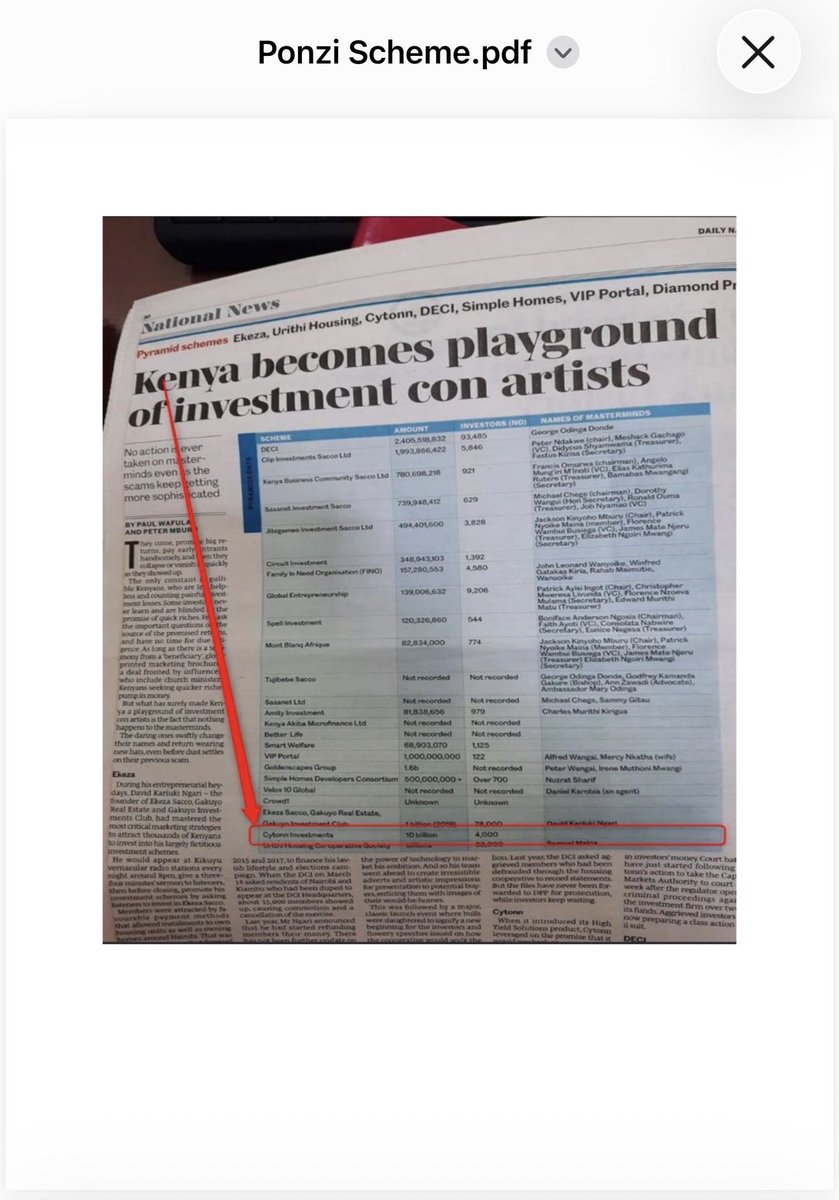
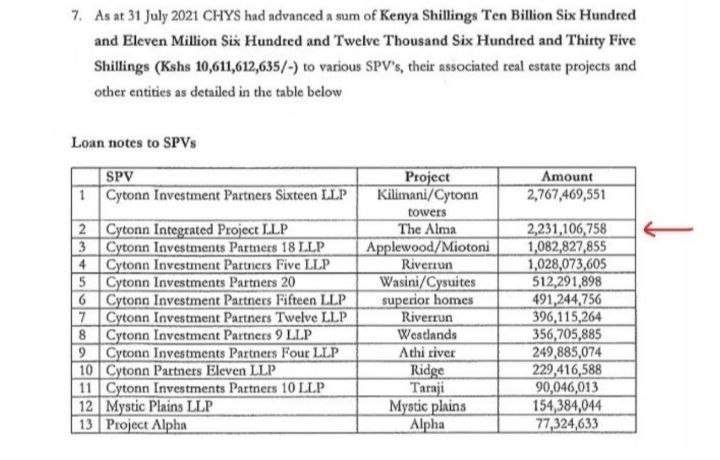
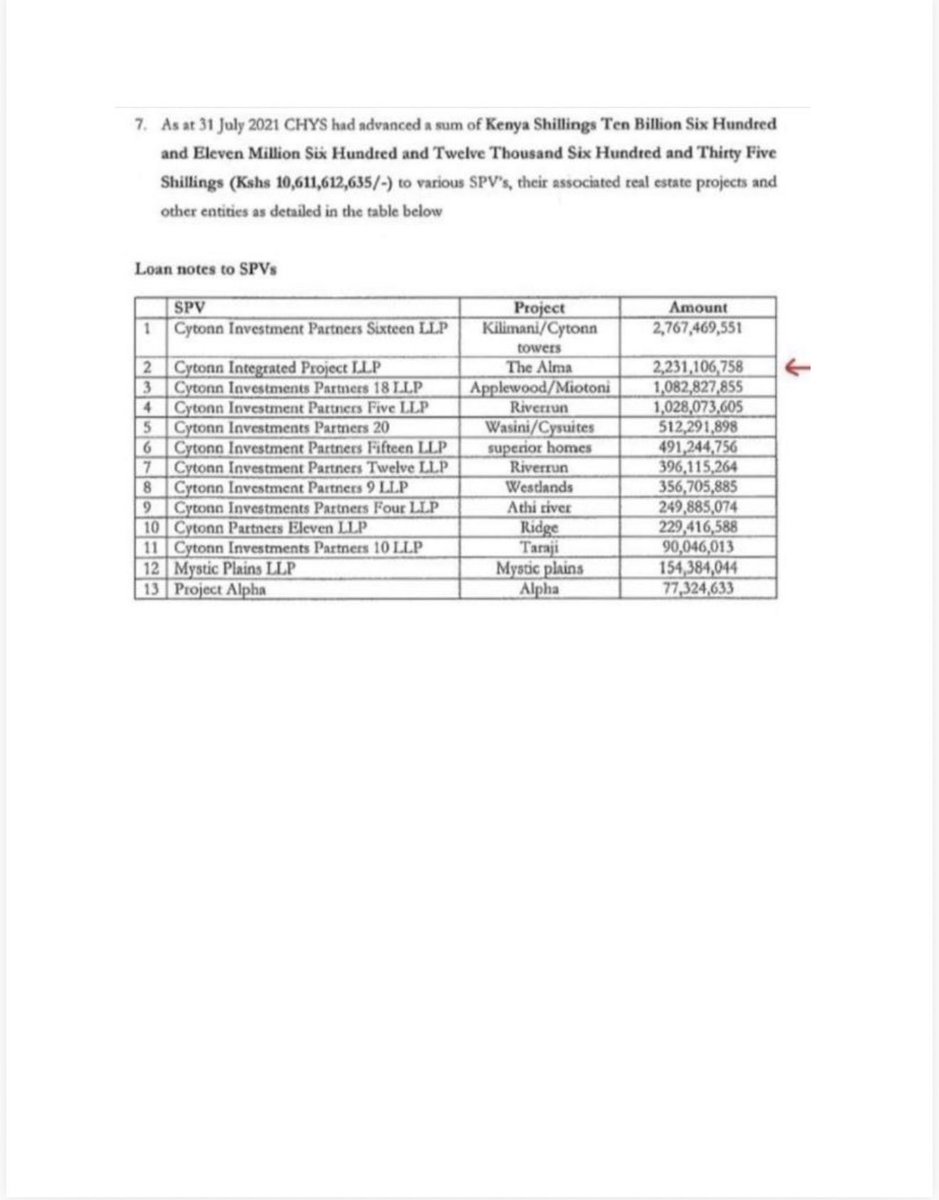
@ehdande Nation article listing Cytonn among major collapsed schemes, the CHYS loan schedules showing over KShs 10.6 billion advanced to related SPVs, Justice Mabeya’s finding that the arrangement was “akin to a fraud,” and the Court of Appeal’s affirmation of liquidation. We can no longer allow the requisite entities to continue burying their heads in the sand @DCI_Kenya@CMAKenya
For years, Cytonn’s promoters told investors that CHYS and CPN were separate from the SPVs.
The courts have now exposed the reality.
CHYS advanced over KShs 10.6 BILLION of investors’ money to a web of related SPVs including Alma, The Ridge, RiverRun, Applewood, Taraji, Westlands number 24, Superior Homes, Mystique plains, Situ village , Kanzi, Rongai , Cytonn Education services etc etc and CySuites. These projects were built using creditor funds, not the promoters’ personal money.
Justice Mabeya described the arrangement as a “scheme akin to a fraud.”
The Court of Appeal went further and upheld the liquidation process, affirming the Official Receiver’s mandate to trace, seize and realise assets linked to the Cytonn network for the benefit of creditors.
This is why the Cytonn case is fundamentally different from an ordinary failed business.
When investors deposited money into CHYS and CPN, they were not funding independent third parties. Their money was transferred through interconnected entities under common control and management.
The argument that the SPVs should keep the assets while creditors keep the losses was always legally and morally unsustainable.
Corporate personality is a shield for legitimate enterprise, not a weapon for moving billions of shillings through related entities while denying creditors access to the very assets their money created.
The liquidation is not a raid on private property.
It is the recovery of investor-funded assets for investor-funded debts.
That is why every court from the High Court to the Court of Appeal has consistently moved towards substance over form.
The era of hiding behind SPVs is coming to an end.
#@CytonnInvest
#InvestorJustice
#Insolvency
#CreditorsRights
This stays close to the judicial findings and documentary evidence and emphasizes the core insolvency principle that creditors follow the money (tracing) and the assets (vested) acquired with it.