1. Get comfortable with statutes - and in particular the Criminal Code. You need to be able to sensibly parse statutory provisions even when no court has looked at them yet. And you will understand cases better when you independently examine the provisions they construe.
As evidenced by the unbridled promotion and implementation of technology at the expense of human dignity, we are truly experiencing an eclipse of the sense of what it means to be human. It is imperative to recover an understanding of the true meaning and grandeur of humanity as intended by God. It is in this sense that the challenge we currently face is not technological, but anthropological, and it is my hope that the Encyclical Letter to be published within a few days will contribute to answering this challenge.
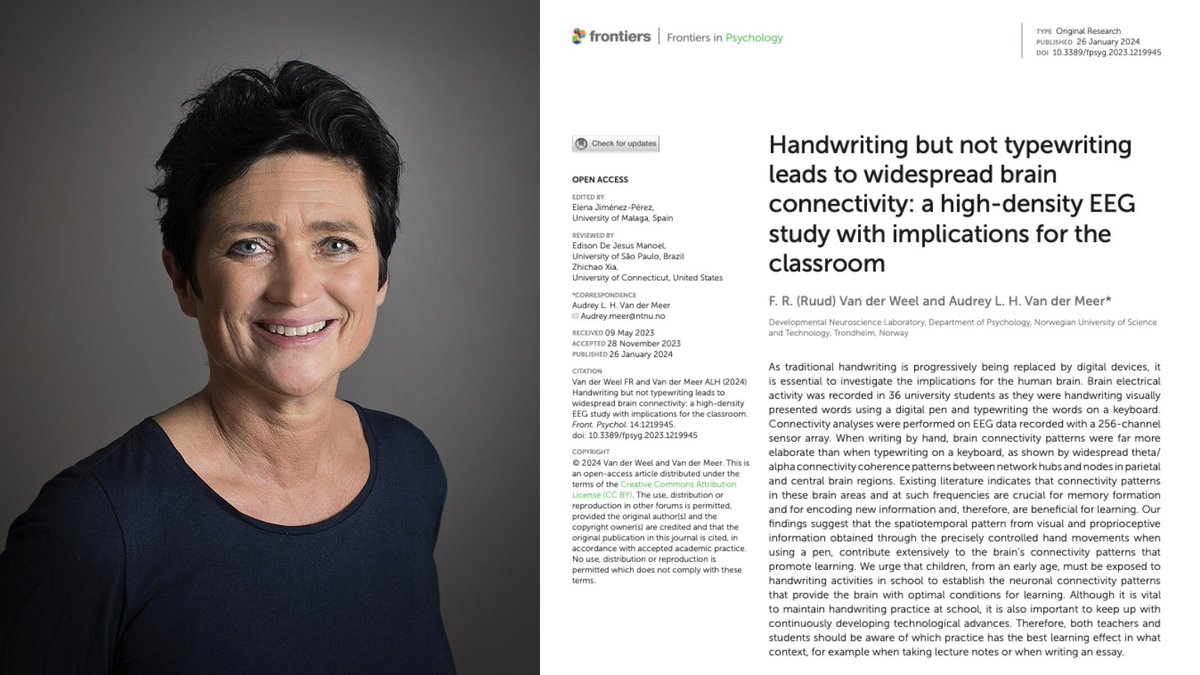
A Norwegian neuroscientist spent 20 years proving that the act of writing by hand changes the human brain in ways typing physically cannot, and almost nobody outside her field has read the paper.
Her name is Audrey van der Meer.
She runs a brain research lab in Trondheim, and the paper that closed the argument was published in 2024 in a journal called Frontiers in Psychology. The finding is brutal enough that it should have changed every classroom on Earth.
The experiment was simple. She recruited 36 university students and put each one in a cap with 256 sensors pressed against their scalp to record brain activity. Words flashed on a screen one at a time.
Sometimes the students wrote the word by hand on a touchscreen using a digital pen, and sometimes they typed the same word on a keyboard. Every neural response was recorded for the full five seconds the word stayed on screen.
Then her team looked at the part of the data most researchers had ignored for years, which is how different parts of the brain were communicating with each other during the task.
When the students wrote by hand, the brain lit up everywhere at once.
The regions responsible for memory, sensory integration, and the encoding of new information were all firing together in a coordinated pattern that spread across the entire cortex. The whole network was awake and connected.
When the same students typed the same word, that pattern collapsed almost completely.
Most of the brain went quiet, and the connections between regions that had been alive seconds earlier were nowhere to be found on the EEG.
Same word, same brain, same person, and two completely different neurological events.
The reason turned out to be something nobody had really paid attention to before her work. Writing by hand is not one motion but a sequence of thousands of tiny micro-movements coordinated with your eyes in real time, where each letter is a different shape that requires the brain to solve a slightly different spatial problem.
Your fingers, wrist, vision, and the parts of your brain that track position in space are all working together to produce one letter, then the next, then the next.
Typing throws all of that away. Every key on a keyboard requires the exact same finger motion regardless of which letter you are pressing, which means the brain has almost nothing to integrate and almost no problem to solve.
Van der Meer said it plainly in her interviews.
Pressing the same key with the same finger over and over does not stimulate the brain in any meaningful way, and she pointed out something that should scare every parent who handed their kid an iPad.
Children who learn to read and write on tablets often cannot tell letters like b and d apart, because they have never physically felt with their bodies what it takes to actually produce those letters on a page.
A decade before her, two researchers at Princeton ran the same fight using a completely different method and ended up at the same answer. Pam Mueller and Daniel Oppenheimer tested 327 students across three experiments, where half took notes on laptops with the internet disabled and half took notes by hand, before testing everyone on what they actually understood from the lectures they had watched.
The handwriting group won by a wide margin on every question that required real understanding rather than surface recall.
The reason was hiding in the transcripts of what the two groups had actually written down.
The laptop students typed almost word for word, capturing more total content but processing almost none of it as they went, while the handwriting students physically could not write fast enough to transcribe a lecture in real time, which forced them to listen carefully, decide what actually mattered, and put it in their own words on the page.
That single act of choosing what to keep was the learning itself, and the keyboard had quietly skipped the choosing and skipped the learning along with it.
Two studies. Two countries. Same answer.
Handwriting makes the brain work. Typing lets it coast.
Every note you have ever typed instead of written went into your brain through a thinner pipe. Every meeting, every book highlight, every idea you captured on your phone instead of on paper was processed at half depth.
You did not forget those things because your memory is bad. You forgot them because typing never woke the part of the brain that would have made them stick.
The fix is the thing your grandmother already knew.
Pick up a pen. Write the thing down. The slower road is the faster one.
On Thursday and Friday, the Supreme Court hears oral arguments in Degale and Bilinski - both concerning the fault requirement for the offence of sexual assault. Here is my quick S*bst*ck primer, setting out the basic interpretive considerations. Link below.
On Thursday and Friday, the Supreme Court hears oral arguments in Degale and Bilinski - both concerning the fault requirement for the offence of sexual assault. Here is my quick S*bst*ck primer, setting out the basic interpretive considerations. Link below.
When it comes to university and AI, the good thing is that original and creative thinkers can now truly shine. The bad thing is that number of such thinkers is dramatically smaller than what it should be.
"It is the first time a literary work has been found playing a functional, spiritual role in the mummification process. And it suggests that for a Roman-era Egyptian, the “Iliad” — specifically some lines from Book 2’s “Catalogue of Ships” — was perhaps as crucial for navigating the afterlife as a magical spell."
I think this will also eventually extend to higher ed -- elite universities will end up focusing on “low tech” undergraduate education
bluebooks, oral exams, discussion based learning
Glad to get to see @RalphGoodale speak last night on current geopolitical issues at the @usasklaw 2026 Stack Lecture. Great turnout of 200 people from the Regina legal community.
Niche tweet, but there's a lot of discussion of "viewpoint diversity" in academic hiring, and what it means, and whether it's an affirmative good.
In law schools, at least, I think it's a good thing and important. I thought I would say what I think viewpoint diversity is, and why I think it's good and important in academia—focused, at least for now, on scholarship. (As I said, it's a niche tweet—feel free to skip.)
I'll start with an observation. One of the things you realize when you start law school is that legal argument is a cultural practice and a language, not a science governed purely by logic. As a result, whether a particular legal argument is deemed persuasive often depends on the legal culture that the judge who is to be persuaded is steeped in, and how the lawyer has framed the issue in light of that legal culture.
There are some parts of the legal culture that are broadly shared by essentially all lawyers. But the legal culture splinters, too. On a lot of topics, there is no one prevailing legal culture, but rather two or more different legal cultures.
To pick an accessible example, you may have one group that sees a close reading of text as the important part and policy and purpose as sideshows, while another group sees policy and purpose as the focus while the details of text are side shows.
Often, these different legal cultures emerge organically from different political or ideological perspectives, which themselves change over time. It's human nature, I think. People are naturally enthusiastic about the modes of legal thinking that tend to deliver results they like. Over time, they gravitate to modes of thinking that have tended to lead to those results.
People won't see themselves as result-oriented in coming to those views. Rather, they will just notice (being insightful people) that certain modes of thinking usually lead to pretty inherently attractive outcomes, and the principled arguments for those modes of thinking will be more present in their minds than the principled arguments against them.
Attitudes towards the different schools of thought tend to follow. Every approach has its principled arguments for and against—no approach is perfect. But people will naturally focus on the principled arguments in favor of viewpoints that lead to results they see as fundamentally heartwarming, positive, or great. And on the flip side, they will naturally focus on the the principled arguments against viewpoints that tend to lead to results they see as fundamentally troubling or terrible.
What does this have to do with viewpoint diversity in academic hiring?
A lot, I think.
First, when it comes to evaluating the merit of scholarship during the hiring process, professors naturally tend to put a thumb on the scale of work within their subcultures. Scholarship speaking from within their legal subculture will resonate with them more than scholarship speaking from a different subculture. It's enough of a difference that, if they're not paying attention to the dynamic, what they casually perceive as just trying to hire the best people will often mean trying to hire the best people among those within their particular legal subculture.
As I see it, the importance of "viewpoint diversity" starts with just being aware of this limit to our own perceptions and the need to overcome our own biases. In law, at least, you tend to hire the best people only when you're aware that good ideas don't only come from the particular legal subculture that you personally live in, and that you need to try to step outside yourself to see that people with other views and assumptions have good ideas, too.
So that's the start, and it's basically just about overcoming our own biases as we try to measure merit.
The next part of it is the belief, based on experience, that a clash of ideas tends to sharpen them. Scholarly ideas are like a muscle. They need to be stressed to become strong. I can't be sure if I'm right unless I encounter someone who disagrees with me and who challenges me, and who forces me either to defend my view or change it. Ideally, the challenge is not just on a minor point, like how best to express an idea, but on a more fundamental issue like whether the basic premises of the argument are right or wrong.
A big benefit of viewpoint diversity is that it tends make that clash of ideas a lot more likely. If everyone basically thinks the same way, there are less likely to challenge basic premises. They won't think of basic critiques as readily, and they won''t be as willing to raise them, as those outside their subcultures would be. So to make your own work stronger, it's far more valuable to get feedback from those who don't share your basic premises than those who do. Having viewpoint diversity on a faculty creates an environment that makes it more likely to strengthen scholarship among those in the majority group.
This second value of viewpoint diversity doesn't have an obvious normative "to do" in response. Different people will have different senses of what it should lead to. Maybe it simply emphasizes the importance of the de-biasing discussed above. And it doesn't mean just (roughly) left and right, or left and center, or political ideology: Different subcultures can be different methodologies, PhD disciplines, and different subject areas, too. But I think that clash of ideas based on different views of the law is a key way to improve legal scholarship, and that having viewpoint diversity makes that clash more likely to happen.
There are other benefits to viewpoint diversity, I think. I haven't addressed those to students in class, who get to learn different worldviews in their courses that can help them persuade judges from different worldviews, too. But this tweet was long enough.