And what of Germany’s historical responsibilities to the Palestinians? Nazi murder of 6m Jews in Europe created the conditions that led to the violent displacement of majority of Palestinians. Or are Palestinians, like Nama and Herero, not white enough in German eyes to expect equal regard?
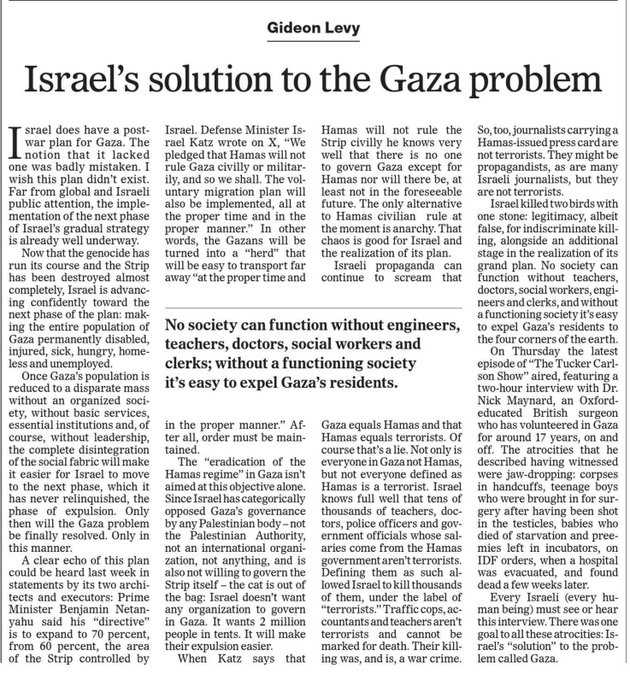
Now that Gaza lies in ruins—shattered, like a beloved face after a long brutality—Israel moves with a terrible confidence to the next act: The act of leaving every soul there not merely wounded, but permanently disabled. Injured, sick, hungry, homeless, without work, without hope. This is not war’s collateral damage. This is design.
As my friend Gideon Levy writes—and he knows, he knows—this is the prelude to expulsion. Think of it: a society without teachers, without doctors, without social workers, without engineers, without clerks. That is not a society. That is a holding pen. A slow erasure. And when nothing functions—no school, no hospital, no office, no heart—then it becomes ‘easy,’ they tell themselves, to scatter the people to the four corners of the earth. Like seeds from a broken pod, except no soil will take them.
We must name this. Not with rage alone, though rage is honest. But with the cold, clear tears of recognition: they are making life impossible so that departure becomes the only ‘choice.’ And the world watches, adjusts its spectacles, and calls for restraint. Restraint! There is no restraint in a slow drowning.
Mark Israel's Day Parade in New York today by watching & spreading Israel's true history from the mouths of its own founders & leaders.
Education is propagandists' worst enemy:
@PollakDan@DanielBShapiro The only kinetic action that should be taken is to catapult warmongers like you into outer space so the rest of us can work on achieving peace.
The EU has no Middle East strategy because *checks notes* there's too much going on in the Middle East. You can't make this up. This is the EU foreign policy chief. In 2026.
Palantir were kind enough to sum up its hideous ideology in 22 points. And I have taken the liberty of annotating each one of them. Here is my interpretation of all 22 of them (preserving the original numbering - for the original see their tweet below):
1. Silicon Valley owes an immeasurable debt to the ruling class who bailed out the criminal bankers that wrecked the livelihood of the majority of Americans. The engineering elite of Silicon Valley will defend that ruling class to the death (literally!), in the name of the majority of Americans whom they treat with contempt – i.e., like cattle that have lost their market value.
2. Palantir is eyeing the Apple Store, salivating over the prospect of creating its own technofeudal estate. Time to replace the iPhone with another device that dissolves what is left of people’s privacy.
3. Palantir shall give nothing away for free. It cares uniquely over its own growth which it pursues by sowing fear so that it can sell a fake sense of security.
4. Glory to brute force! Ethics is for suckers. The West needs more of Palantir’s murderous software.
5. AI-powered killer robots are coming. The task is to profit magnificently by building killer robots first and ask questions later. To be able to do so, Palantir will do whatever it takes to avoid at all cost any international treaties that limit AI-driven killer robots.
6. Every poor sod (lacking the connections to avoid being thrown into the trenches with killer drones targeting them from the sky) must be drafted into the army. Forget paying soldiers a salary. All payments should be directed to Palantir, where our own people will be serving their ‘national service’ – leaving the dying to non-shareholders.
7. Palantir works overtime to equip US Marines with killer bots that take away from the US Marines whatever remnants of ethical judgment they are left with on the battlefield. American society should be rendered perfectly incapable of any debate that restricts Palantir’s capacity to get the US Military to eliminate any remaining opportunity to reject its software’s choice of targets.
8. Palantir deplores the fact that the public sector is still not totally devoid of a conscience. Public servants must be fired en masse, except some very few approved by Palantir who will receive huge salaries, paid by taxpayers.
9. Palantir thinks that Donald Trump must be beatified for throwing himself into public service. Not forgiving folks like Trump everything risks our soul, not to mention that it raises the prospect of officials that restrict Palantir’s evil project.
10. Politics needs to be AI-like, devoid of anything that can be mistaken for human empathy. Those who look to the political arena to nourish their soul and sense of self must be sent to the gulag forthwith!
11. There are some people too eager to hasten Palantir’s demise. They should rethink, or else!
12. Palantir makes no nuclear weapons but is happily developing other weapons of mass destruction. We proudly announce that we are now ready to add to nuclear Armageddon the AI-driven threat to humanity’s existence.
13. No other country in the history of the world has committed so many war crimes in the name of progress and freedom. The United States offers infinite freedom to people like Palantir’s founders to profit so handsomely by inflicting so much damage upon humanity.
14. American power has feasted on causing one war after another, one putsch after another, one avoidable financial disaster after another. Too many have forgotten or perhaps have taken for granted America’s capacity to pursue forever wars in the name of peace and democracy.
15. German and Japanese Fascism must be made great again. The denazification of Germany was an overcorrection for which Europe is now paying a heavy price. A similar and highly misplaced commitment to Japanese pacifism must also end immediately!
16. We should applaud those who attempt to monopolise everything by means of generous government contracts. Billionaires must not be satisfied merely with their billions. To become even more obscenely rich they need grand narratives that help them convince the poor to use their freedom to keep them, the billionaires, in power. And, by the way, Palantir loves Elon, especially his grand apartheid-inspired narrative.
17. Silicon Valley must be free to do in America’s cities what it did in Gaza. Many politicians across the United States have essentially shrugged when it came to granting Palantir the right to annihilate all remaining civil liberties and human rights. This must end.
18. Epstein’s syndicate should be forgotten lest lovely people like Trump and the Clintons are deterred from entering government. The public arena must be scrutiny-free unless subversives like Sanders or Mamdani enter it.
19. We love banal public figures as long as they give Palantir all the juicy contracts. We also love colourful public figures who give Palantir all the juicy contracts.
20. We need more opium for the masses, as they are not sufficiently inebriated for us to be unimpeded in the pursuit of their complete subjugation. Questioning organised superstition is dangerous and must end.
21. Time to bring back Hitler’s hierarchy of races, with Palantir’s founders and Elon at its Aryan pinnacle. The idea that it is wrong to judge someone by the colour of their skin or their ethnicity or their religion must be jettisoned.
22. Blacks, Muslims, most Asians, and of course women, are inferior untermensch. Blokes in America, and more broadly the West, have for the past half century resisted putting these subhumans in their places in the name of inclusivity. It was a mistake. Such subhumans must never be allowed in, except as servants or sex service providers – at least until we can improve our robots, in which case we won’t need them at all.
Few points:
1- Western governments continue to insist, with ritualistic certainty, that the Strait of Hormuz is an “international waterway” that must be reopened "unconditionally". This absolutist posture reveals a profound failure to absorb the central lesson of the recent US–Israeli war on Iran: when a so-called international waterway is weaponized to launch an existential armed attack against the coastal state whose territory it crosses, the very concept of “unconditional” access becomes legally and morally indefensible.
2- The war has irrevocably altered legal interpretations and the strategic landscape. For the first time in modern history, a major international strait was used not merely for commerce or neutral navigation, but as the primary maritime corridor for a coordinated campaign of aggression - including strikes, logistics, blockades, and overflights aimed at destroying a coastal state’s sovereignty, infrastructure, and leadership. American and Israeli forces treated the Strait as a de facto launchpad and supply line for operations that, under any reading of the UN Charter, constituted an unlawful use of force.
In that context, Iran’s decision to regulate and, where necessary, restrict passage to belligerent-linked vessels was not an arbitrary closure. It was a proportionate exercise of the inherent right of self-defence under Article 51, fully consistent with the coastal state’s sovereign authority over its territorial waters.
3- A decisive factor that further strips the Strait of Hormuz of the very characteristics and rights otherwise attributed to international waterways is the dense network of US military bases stationed in the littoral Arab states encircling the Persian Gulf.
These installations—in Bahrain, Qatar, the UAE, Saudi Arabia, and Kuwait—serve no commercial or neutral purpose. They exist explicitly to project power against Iran, to threaten its vital interests, and to enable the very existential military operations witnessed in the recent war. Forward-deployed US aircraft, warships, missile systems, and logistics hubs turn the entire Gulf region—including the Strait itself—into an armed forward-operating zone directed at a single coastal state.
Under international law, an international strait derives its special transit-passage status from its role as a neutral corridor connecting two bodies of high seas or EEZ, used for peaceful international navigation. When one side of that corridor is transformed into a permanent military platform aimed at the destruction of the opposite coastal state, the waterway ceases to function as a “normal” international strait. It becomes instead an extension of a hostile military perimeter.
The presence of these bases fundamentally alters the legal character of the Strait. Unless and until these US military bases are completely removed from the littoral states of the Persian Gulf - and eventually replaced by a local collective security regime that ensures Iran and other every litoral states' security - the Strait of Hormuz cannot be treated as a standard international waterway entitled to unconditional transit passage.
The Western response has been to double down on the fiction of unconditional transit passage. But the recent conflict has exposed the fatal weakness in this outdated and inapplicable doctrine they so aggressively promote.
4- The war therefore demands a fundamental shift in how Western states and the international community conceptualize “international waterways.” Unconditional reopening is no longer credible. Conditions must now be devised and codified to prevent the future misuse of such straits as conduits for existential threats. Such safeguards would not “close” international straits but would preserve the legitimate right of peaceful navigation while closing the loophole that allows aggressors to exploit them.
Iran reopens Hormuz: Are Tehran and Washington getting closer to a deal?
🔹 Since yesterday, multiple developments suggest Tehran and Washington may be inching toward a deal. But rather than a breakthrough moment, what we may be seeing is a carefully staged, incremental process.
🔹 Starting with Lebanon, Israel’s agreement to a ceasefire there aligns with a key Iranian demand that any U.S.-Iran arrangement extend across the region, including the Hezbollah front.
🔹 This linkage was initially rejected by Israel, which escalated operations in Lebanon to preserve freedom of action. The shift toward a ceasefire likely reflects external pressure from the U.S., involving mediation by Pakistan and others.
🔸 One interpretation is that Donald Trump ultimately pushed Benjamin Netanyahu to accept the ceasefire to remove a major Iranian red line and enabling diplomatic movement.
🔸Iranian sources suggest Tehran made it explicit that no second round of talks with the U.S. while Lebanon remained active. Some accounts go further, saying that Iran had warned it would resume strikes, including against Israel, if no ceasefire emerged.
🔸Publicly, Trump denies any linkage between Lebanon and Iran talks. But it is difficult to see the ceasefire as entirely disconnected from progress on the diplomatic track.
🔹 A second signal is that Iran has reopened the Strait of Hormuz to shipping.
🔹 Trump frames this as proof that his pressure campaign is working, insisting the naval blockade will remain until a comprehensive deal is reached.
🔹 But a different reading is more plausible: both sides may be constructing a sequence that allows for de-escalation without visible concession.
Step 1: ceasefire in Lebanon.
Step 2: Iran reopens Hormuz.
Step 3: gradual rollback of U.S. naval pressure.
🔹 Crucially, the “blockade” itself may never have been fully enforced. Shipping data suggests Iranian vessels continued transiting the Strait, pointing to a signaling tool rather than a total economic cutoff.
🔹 In that sense, the blockade functions less as a coercive end-state and more as diplomatic leverage, allowing Washington to claim success while moving toward compromise.
🔸At the same time, Iran’s move appears to be highly conditional. Iranian FM says shipping is allowed, but only along routes designated by Tehran, close to its shores.
🔸This is significant, as it preserves Iran’s operational control and its ability to quickly reimpose restrictions if conditions change.
🔸Iranian state media outline three conditions:
• Only commercial shipping permitted
• No U.S./Israeli-linked vessels or cargo
• Full coordination with Iranian forces
🔸In other words, what they say is that the Strait is open, but on Iran’s terms.
🔸Tehran is also signaling that the arrangement is reversible. If the U.S. maintains or intensifies its naval pressure, Iran could shut the Strait again.
🔹 Another key point is that Iranian sources reject Trump’s claim that Tehran agreed to hand over highly enriched uranium, saying that the issue remains unresolved.
🔹 This suggests that what we are seeing is not a finalized agreement, but partial implementation of a previously negotiated framework, i.e., the initial ceasefire mediated by Pakistan.
🔹 According to Iranian accounts, the delay was due to Lebanon. Once that front was included, the framework could move forward.
🔸But not everyone in Iran is on board. The reopening of Hormuz appears to have surprised parts of the political elites, triggering criticism from hardliners.
🔸Their concern is that restoring shipping too quickly reduces economic pressure on adversaries, undermining Iran’s leverage.
🔸Others focus on messaging, arguing that even if the move is conditional, inconsistencies in public communication have allowed Washington to dominate the narrative.
🔸This is a key point in their view, as the U.S. can now portray developments as evidence that its pressure campaign worked, even if the outcome reflects mutual compromise.
➡️Overall, it seems that what’s unfolding is not so much of a decisive breakthrough but a managed de-escalation, structured to let both sides claim success while keeping options open.
#Iran’s Delegation in Islamabad: Signaling Strength Before Entering the Room
🔹After a full day of mixed signals, denials, and shifting conditions, the Iranian delegation finally arrived in Islamabad. The delay was part of a deliberate effort to shape the terms under which Iran is seen to be entering these talks.
🔹For most of the day, it remained genuinely unclear whether Tehran would participate at all. Early reports of the delegation’s arrival were officially denied, and Iranian messaging emphasized that without the inclusion of Lebanon in the ceasefire framework, there would be no negotiations.
🔹By the early evening, Mohammad Bagher Ghalibaf added another condition, publicly calling for the unfreezing of Iranian assets. This was less about sequencing demands and more about reinforcing a broader point that Iran is not approaching these talks from a position of urgency.
🔹These moves were clearly aimed at countering the narrative coming out of Washington that Iran was eager, if not desperate, to negotiate. Tehran’s objective was to reverse that framing before the talks even began.
🔹Even the timing of the arrival reinforced this posture. The U.S. delegation had already been in Islamabad for hours before Iran confirmed its participation. The optics were carefully managed to underline that Tehran is not the party seeking engagement at any cost.
🔹At the same time, the composition of the Iranian delegation offers important insight into how Tehran is approaching this round of negotiations.
🔹Ghalibaf’s role as head of the delegation is particularly notable. This is not a position typically held by a Speaker of Parliament. Under more conventional circumstances, one would expect the Secretary of the Supreme National Security Council (SNSC) to lead.
🔹His presence instead reflects something more structural about the current distribution of authority within the Iranian system, and how that is being projected externally.
🔹Beyond leadership, the delegation itself is highly structured, with distinct economic, military, political, and legal committees, each led by senior officials. This is not a small, exploratory team.
🔹The seniority of the delegations on both sides suggests that unlike previous negotiations, participants appear to have the authority to make decisions in real time, without constant referral back to their respective capitals. This could make the process more efficient and increase the likelihood of substantive outcomes.
🔹In this context, the appointment of JD Vance to lead the American delegation has been interpreted in different ways in Tehran. Some view him as relatively less hawkish compared to other figures in the administration, which could facilitate progress. Others see this as a test; both of his diplomatic capabilities and of whether perceived moderation will translate into actual flexibility.
🔹In contrast to earlier pre-war talks in Oman, which were limited in scope and personnel, the current setup points to preparations for a far more substantive and wide-ranging negotiating process.
🔹At the same time, Iran is entering these talks without relinquishing its most important sources of leverage. Maritime traffic through the Strait of Hormuz remains disrupted, and there is little indication from Iranian messaging that this pressure will be eased in the near term. On the contrary, officials have emphasized that the situation in the strait has fundamentally changed.
🔹This serves a dual purpose. On the one hand, it is aimed at increasing pressure on the United States to restrain Israeli operations in Lebanon. On the other, it preserves a coercive bargaining tool that can be used during the negotiations.
🔹The ongoing discussion within the Iranian parliament about formalizing stricter control over the strait – despite the impracticality of some of the proposed measures – should be understood in this context. It is part of a broader signaling strategy rather than a literal policy blueprint.
🔹There are also early indications that this pressure may be having some effect. Media reports suggest that Trump has already urged Netanyahu to reconsider military operations in Lebanon in order to avoid jeopardizing the Islamabad talks.
🔹From Tehran’s perspective, this reinforces a key strategic point, that Lebanon is not a secondary issue, but an integral part of the same regional equation.
🔹Domestically, the Iranian leadership has also moved to stabilize the political environment ahead of the negotiations.
🔹A statement by Mojtaba Khamenei the day before played a central role in this regard. He emphasized that Iran does not seek war, but will not abandon its rights, while at the same time reaffirming the unity of Iran’s broader regional alliance structure.
🔹Importantly, he also called on supporters to remain mobilized, making clear that the ceasefire should not be interpreted as a reason for disengagement. This combination of reassurance and resolve appears to have reduced visible criticism from more hardline constituencies, at least for now.
🔹Alongside this, state institutions, particularly the judiciary, have signaled that public disagreement and internal divisions will not be tolerated. This has contributed to a more controlled and cohesive domestic atmosphere in the immediate lead-up to the talks.
🔹At the same time, Iran’s external messaging has remained firmly anchored in deterrence. A statement from the Khatam al-Anbiya Central Headquarters emphasized that the armed forces remain fully prepared and ready to respond if hostilities resume.
🔹Iranian armed forces have also continued to signal that Hezbollah remains part of a unified strategic framework, warning that further Israeli escalation could trigger a broader response.
🔹At the same time, Iranian analysis of developments in Lebanon reflects growing concern about parallel diplomatic tracks.
🔹Reports of contacts between the Lebanese government and Israel, facilitated by the United States, are being interpreted as an attempt to sideline Iran and limit its influence over any eventual arrangement.
🔹From this perspective, even if a ceasefire emerges in Lebanon, Tehran risks being excluded from shaping its terms or claiming political credit.
🔹In practical terms, the results of Iran’s pressure so far appear limited. There are indications of partial de-escalation, including a halt in strikes on Beirut, but no comprehensive ceasefire has been achieved.
🔹Israel, for its part, has shown little willingness to commit to arrangements that would significantly constrain its operational freedom.
🔹This brings the focus back to Islamabad itself.
🔹Iran has made clear that physical presence does not automatically translate into substantive engagement. Participation in negotiations remains conditional on whether its core demands are addressed.
🔹Another open question is whether the talks will be conducted directly or through intermediaries, as in previous rounds. The format will be an important indicator of how far both sides are willing to go.
🔹The central message is consistent throughout. Tehran is willing to engage diplomatically, but it is determined to do so on terms that reinforce, rather than undermine, its position.
Norman Finkelstein just schooled everyone on international law. Finkelstein citing Article 51:
Iran is legally defending itself. The US and Israel are legally committing aggression. There's no debate
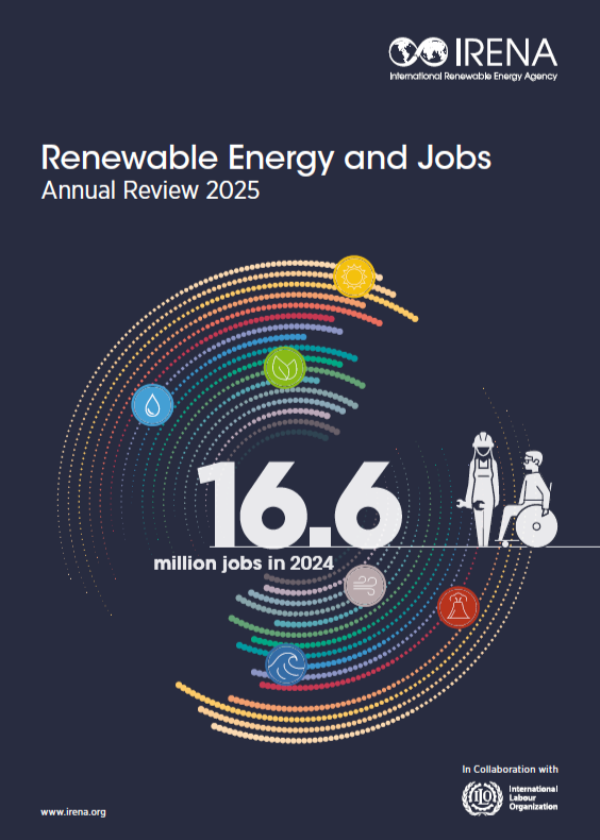
@IRENA & @ILO found that the #renewableenergy sector employed 16.6M people in 2024, but new challenges emerge. Read the visual story to find out more about the recent trends of renewable energy jobs worldwide: https://t.co/mjh4PPHKwj
#DYK: solar PV manufacturing & deployment remain geographically concentrated in 2024, affecting jobs creation in the #renewables sector? And 6 of the 10 countries w/ the largest no. of #solarenergy jobs are in Asia?
See more findings in renewables jobs throughout 2024: https://t.co/tESciujxxw
@ilo
NEW: A just #energy transition should translate technological & economic💰 advancements into the human side of the story. The latest annual review on #RenewableEnergy jobs shows growth w/ 16.6 M people employed in the sector in 2024. But are jobs evenly distributed across regions & technologies? Is the workforce inclusive? Find out more from the report: 👉https://t.co/tESciuk5n4
OUT NOW: @IRENA-@ILO NEW report on #RenewableEnergy jobs shows continued growth, but at a slower pace for the 1st time. At 2.3% increase from 2023, the 2024 employment no. indicates the impact of geopolitical & geoeconomic frictions & growing automation.
👷👷♂️See more findings in the annual review's latest edition:
https://t.co/H2jTKqSOYi
Today, women only account for 32% in the #renewableenergy workforce, risking the #energytransition of labour shortages & lack of diverse perspectives.
In this episode of 'All Things Renewable', @IRENA's expert discusses the barriers & strategies to address them, & highlights the role of indigenous women in advancing #energyaccess through decentralised #renewables solutions.
🎧 Listen to the eposide: https://t.co/jKNBTWz4WN
📆TODAY: Hear directly from @IRENA experts, govt leaders, private sector actors & civil society champions, on how to increase #women active engagement in global #EnergyTransition. Register to the webinar 'Renewable Energy: A Gender Perspective'👉https://t.co/R5bLIx29kg
💡#Women hold 32% of full-time jobs in #RenewableEnergy sector. Although higher than in other energy industries, the % hasn't changed since @IRENA 1st gender analysis in 2019. See more findings & ways to address the persistent gender #inequality: https://t.co/5wgXS7EuWg
As a longtime humanitarian who has battled famines and hunger crises, I fear that starvation in Gaza has now passed the tipping point and we are going to see mass-scale starvation mortality.
A thread on famine momentum, famine response, and what it means for Gaza today.
Today Israel killed at least five reporters in Gaza and some of the western news organizations they worked for didn’t even name them in their news alerts.