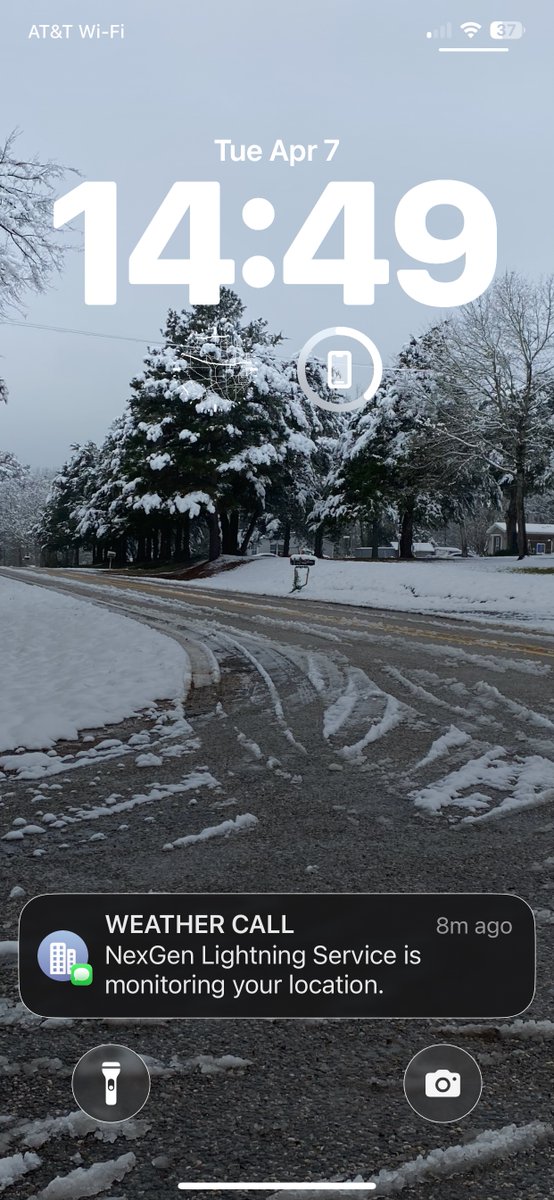
⚡️ With April upon us and the potential for storms on the increase in the coming days, I've just activated the Lightning monitoring feature from my partners at @WeatherCallLLC NexGen.
• For more info on this service that will also call YOU with urgent Severe, Tornado, & Flash Flood messages from ME, go to THIS site: https://t.co/GSh1UiFBCE #etxwx #txwx
The math on this project should mass-humble every AI lab on the planet.
1 cubic millimeter. One-millionth of a human brain. Harvard and Google spent 10 years mapping it. The imaging alone took 326 days. They sliced the tissue into 5,000 wafers each 30 nanometers thick, ran them through a $6 million electron microscope, then needed Google’s ML models to stitch the 3D reconstruction because no human team could process the output.
The result: 57,000 cells, 150 million synapses, 230 millimeters of blood vessels, compressed into 1.4 petabytes of raw data. For context, 1.4 petabytes is roughly 1.4 million gigabytes. From a speck smaller than a grain of rice.
Now scale that. The full human brain is one million times larger. Mapping the whole thing at this resolution would produce approximately 1.4 zettabytes of data. That’s roughly equal to all the data generated on Earth in a single year. The storage alone would cost an estimated $50 billion and require a 140-acre data center, which would make it the largest on the planet.
And they found things textbooks don’t contain. One neuron had over 5,000 connection points. Some axons had coiled themselves into tight whorls for completely unknown reasons. Pairs of cell clusters grew in mirror images of each other. Jeff Lichtman, the Harvard lead, said there’s “a chasm between what we already know and what we need to know.”
This is why the next step isn’t a human brain. It’s a mouse hippocampus, 10 cubic millimeters, over the next five years. Because even a mouse brain is 1,000x larger than what they just mapped, and the full mouse connectome is the proof of concept before anyone attempts the human one.
We’re building AI systems that loosely mimic neural networks while still unable to fully read the wiring diagram of a single cubic millimeter of the thing we’re trying to imitate. The original is 1.4 petabytes per millionth of its volume. Every AI model on Earth fits in a fraction of that.
The brain runs on 20 watts and fits in your skull. The data center required to merely describe one-millionth of it would span 140 acres.
I recently spoke to a marketer who ran a $40M brand with just two designers and ONE AI process:
He gave me and my team a masterclass on using AI to scale marketing and creative.
Most brands use one tool with a bad prompt and hope it will solve all their problems.
He chains 7 different tools together for: ideation, image creation, video editing, and iterating based on performance.
ALL using AI and two offshore designers.
I paid him 6-figures to build these systems for my companies.
Now, I’m giving them away for free.
Repost + Reply “GA” to get the guide in your DMs.
I built a local news podcast that gets generated each day with AI.
Making a news show like this would normally cost $50,000+ annually.
With AI Automation? $100/mo.
The setup is simple:
→ Automatically scrapes Google News, local event feeds, twitter, reddit, and much more
→ Generates professional scripts with emotion and pacing controls
→ Produces broadcast-quality audio using ElevenLabs V3
→ Operates completely hands-free once deployed
The result? A business model that wasn't economically viable before AI.
No hosts. No editors. No research team.
Just smart automation and a few API subscriptions.
This isn't about flooding the internet with crappy AI content. It's about solving real problems: like news deserts in underserved markets.
The system I built in hours could theoretically power thousands of hyper-local podcasts simultaneously.
When you start thinking in terms of "what can I automate," entire industries now become accessible.
Before AI, the revenues you could generate by serving local news just didn't cover the expenses. Now that's changed.
What other markets is that true for?
Want me to send you the full system for you to clone for your small town or city?
1. Like & RT
2. Follow me (so I can dm you)
3. Comment "BLUEPRINT" below
I'll send you the complete n8n template, all the prompting, and a full setup video that you can use to spin up your own local news podcast.
Been told I should post here more often about radio, starting a new station from the ground up and share about the experience. Anyone care? Hello… is this thing on? Let’s find out. I’ll start with a question, if you’re an advertiser who only uses social media, how are you reaching customers if they’re not on a device?@greatfmradio