FABLE 5 CAME BACK NERFED.
We re-ran the July 1st version of Claude Fable 5 on BridgeBench.
The results are brutal:
Debugging: 86.2 → 25.9
Refactoring: 73.6 → 38.4
Hallucination: 75.9 → 61.7
The new guardrails are kicking in on way too many tasks and falling back to Opus 4.8.
This is not the model that got banned.
Anthropic owes everyone an explanation.
Terrible decision
I took tons of fake sick days off and used them to build side projects
Eventually I built two working businesses: @yadaphone and @eSIMPalx
Together they generate x4 in GDP than what my SWE salary was
@Schuldensuehner Q2 outflows predate today's news-- not too soon to judge investor reaction? Better to track real-time DAX moves and flows over the next 1–2 weeks, no?
'never Chinese models,' even at 100x cheaper = same bureaucratic red-tape nosing you see in the EU.
Question is... why do they sound like legislators instead of technologists? They will be left behind & we should welcome it
I went a dinner a few weeks ago with a bunch of enterprise execs who told me "we will never use Chinese models." "Even if it's 100x cheaper?" "No, we care about safety and security."
1. They don't understand when they host open-source models with their own GPUs or US data centers, they won't share their data to China.
2. They are giving away all their data to OpenAI and Anthropic rather than owning it privately themselves.
3. They don't understand math. 100x is a big number and lots of profits.
It's almost July 2026 now. If your execs still talk like that, fire them now.
@chamath same bureaucratic red-tape nosing you see in the EU.
Question is, why do they sound like legislators instead of technologists? They will be left behind. I welcome it
GLM/Kimi won't tank US Stock market. They will might tank OpenAI, Anthropic, but benefit neoclouds, storage, energy stocks. Just a reminder, you can still host GLM/Kimi yourself or with a US neocloud and be compliant at the same time.
Would love to see any tangible breakdown of findings (usage, latency per task, code quality metrics, etc.). Not doubting it; want to dig into mechanics.
Even at 3× slower, the cost cut delivers ~5.5× better cost per unit time (or ~13.4× if you're comparing total spend for equivalent throughput). That undercuts the "speed makes closed models worth it" narrative
Anyone who understands history and economics saw this coming clear as day.
But sound, sane, sober predictions don't make the news.
Insane predictions, like 50% of all white collar work getting wiped out, do make the news because fear sells + get politicians to do your bidding.
The worst case scenario for USA AI: 1. Chinese open sources keep gaining market share. China owns the model layer. 2. Those models were trained and inference-optimized on Huawei chips instead of NVIDIA. China also owns the chip layer. 3. US doesn't build data centers fast enough to keep up with the demand of compute, storage and energy. China meanwhile exports the inference and training layer(for continual training it will happen along with inference)
Export control is not the right strategy here. Simply banning "open source from China" doesn't solve the issue here. USA must invest in open source models, hopefully get Chinese models to use NVIDIA, and invest in nuclear asap.
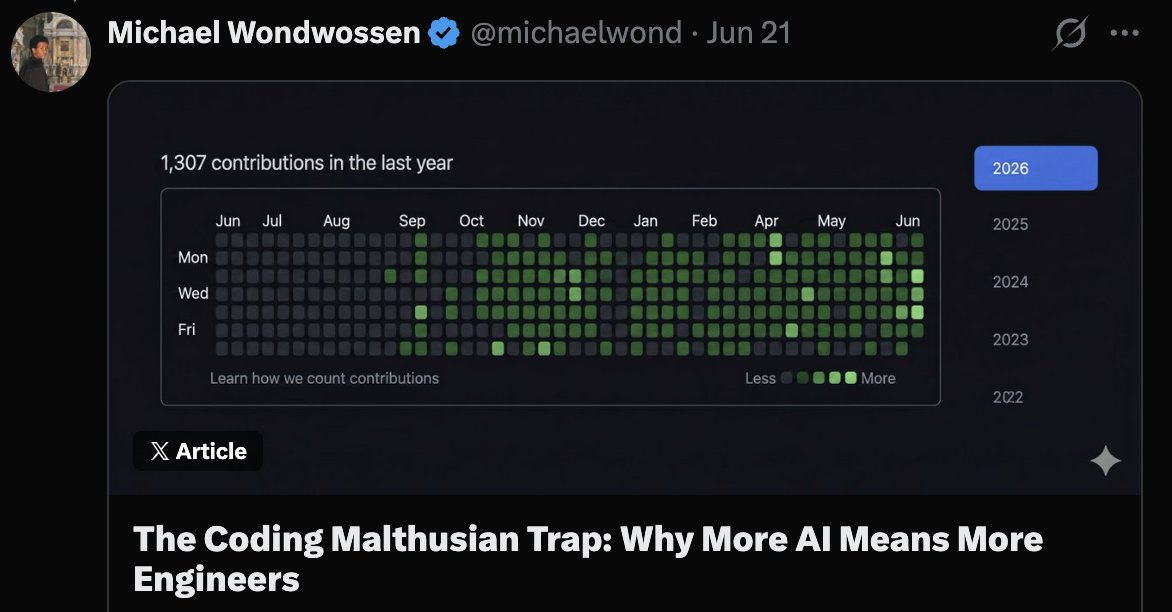
1- Signs point to more work, not less; more code, not less; more developers, not less.
That said, need to be wary of conflating employment growth among AI adopters as complete proof against wider labour-market displacement
We can finally say AI isn't killing jobs.
A new paper from me, @tryramp, and @RevelioLabs uses firm-level spend and workforce data across 21K U.S. businesses to measure AI's impact on jobs.
Firms that adopt AI heavily grow headcount 10% over two years following adoption. Low adopters see no statistically significant change.