Our paper "REL: An Entity Linker Standing on the Shoulders of Giants" /w @fhasibi@arjenpdevries @DercksenKoen @krisztianbalog got accepted! If you're interested in using our Entity Linking package, feel free to install it using the link below #SIGIR2020!
https://t.co/wmfi0MgT1O
Tornyol (@tornyolsystems) is building micro-drones that kill mosquitoes.
They use smartphone microphones, car park assist sensors, and some clever DSP and control to transform 40-gram toy drones into mosquito killers.
We've released the QR problem, a more robust qr_v2 with a fresh leaderboard so please resubmit!
Thank you to @blelbach, @myainotez and @nikhilbarhate99 for sharing feedback. Sorry if I missed anyone!
I considered automatically backfilling all submissions but the rankings do change quite a bit so I figured a refresh would be better.
Changelog
* Fail submissions if they fail when we change random seeds
* Add nasty correctness cases with more degenerate inputs in mixed batches
* Recheck correctness when doing perf testing to avoid Volkswagen cheat
* Reject Nan/Inf residuals
* Validate each matrix factorization residual, since averaging was hiding bad matrices
* Old QR is still open so folks can't see submissions but you can't submit anything to it
Wontfix
* Stream hacking is still banned via very blunt ban of the word "stream" we don't have a good solution for this
* CUDA graphs are allowed but not particularly interesting to us
Best submissions so far if I resubmit their solutions are
The key to saving the environment is not looking backward, it’s moving forward.
I realized this the first time I visited Italy twenty years ago. Everything was clean and green. The rivers sparkled. The lesson for me was obvious: the answer is not underdevelopment. The answer is progress.
When China was poor, the air was so polluted that people could barely see the blue sky. Today, blue skies have returned to their cities. Development does not only create wealth, it also provides the resources needed to restore and protect the environment.
Some environmentalists want us to preserve every aspect of our biodiversity, including the mosquitoes for example, so that researchers can fly in once every ten years from their universities (which build particle accelerators and billion-dollar laboratories with their pocket money), study our ecosystems, and count how many people died from dengue outbreaks.
They want to buy our air through carbon credits. If carbon credits were such a great deal, they would be selling them to us, not the other way around.
Cleaning every river, lake, and water source in El Salvador, and ensuring they remain clean and sparkling, would cost roughly $12 billion. Where is that money supposed to come from without economic development? Carbon credits?
The path forward for our country is the path of Japan and Singapore, not the path of the Congo.
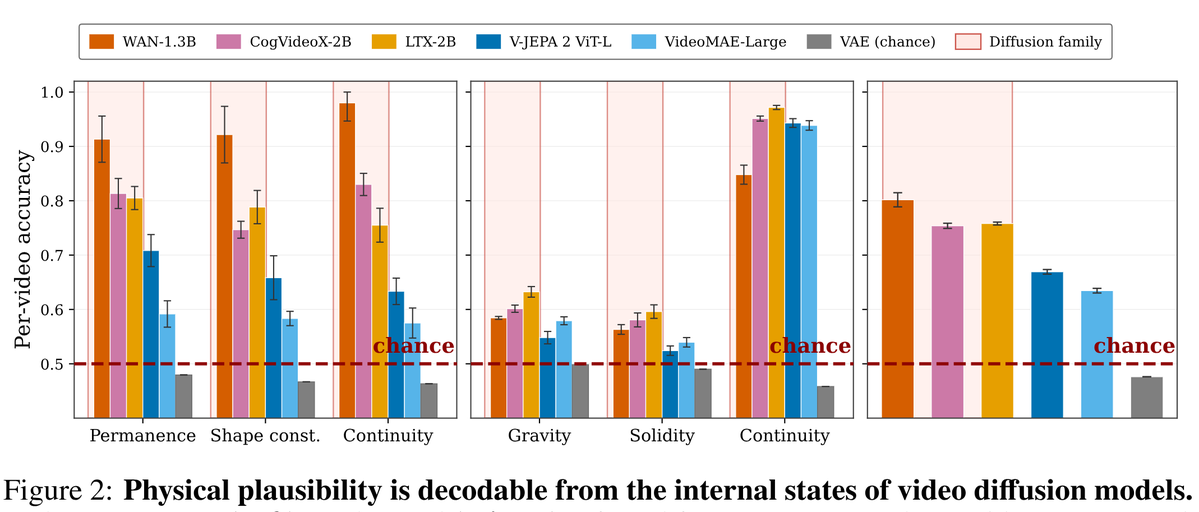
You may have recently heard claims that video generation models are "dumb" about physics, and only "world models" (V-JEPA, specifically) have a valid internal model of physics.
This turns out to be false. In a recent paper, researchers show that a LINEAR probe of diffusion videogen models predict various "physics" very well, significantly better than V-JEPA or VideoMAE (and plain VAE just sucks).
This is noteworthy, because a *linear* probe being this accurate shows that the model has a pretty explicit internal representation of the physics!
@bcherny feature idea: let users attach “FYIs” / byte-sized notes to future phases of a plan while the agent works on earlier ones. Sometimes a thought pops up that isn’t worth re-planning around, but I also don’t want to pollute context before it’s relevant. Kind of like a scratchpad the agent can pull from later?
Today’s AV stacks infer traffic signal and brake light state from camera pixels, then try to align them to lidar geometry. Layers between sensing and decision.
Humans see color and depth together because they arrive together. Rev8 does the same: 48-bit RGB + 3D depth, same photon, same silicon, already aligned.
Huge signal here for self-supervised point cloud completion. Rev8's native RGB alignment gives you consistency across ego-motion sweeps, so we can use temporal accumulation as pseudo-GT to train masked→complete models that jointly inpaint XYZ+color behind occlusions (cars, trucks etc.).
My first blog post in over a year is a deep dive on flow maps🗺️, or how to learn the integral of a diffusion model to enable faster sampling and several other cool tricks.
It's the longest one yet👀 Let me know what you think!
https://t.co/O8bBGZ9qjC
@marcsh@SandboxSpirit Actually not fine for cars. In highway design, a clothoid is used as a transition curve to connect a straight road section (tangent) to a circular curve
Big Update🤩: #paperclip now includes full papers from all of arXiv, PubMed Central and 150 million abstracts!🖇️
You can give your LLM all that knowledge in one line—all optimally indexed for AI agents. Much more thorough and ~100x faster than web search, and free.
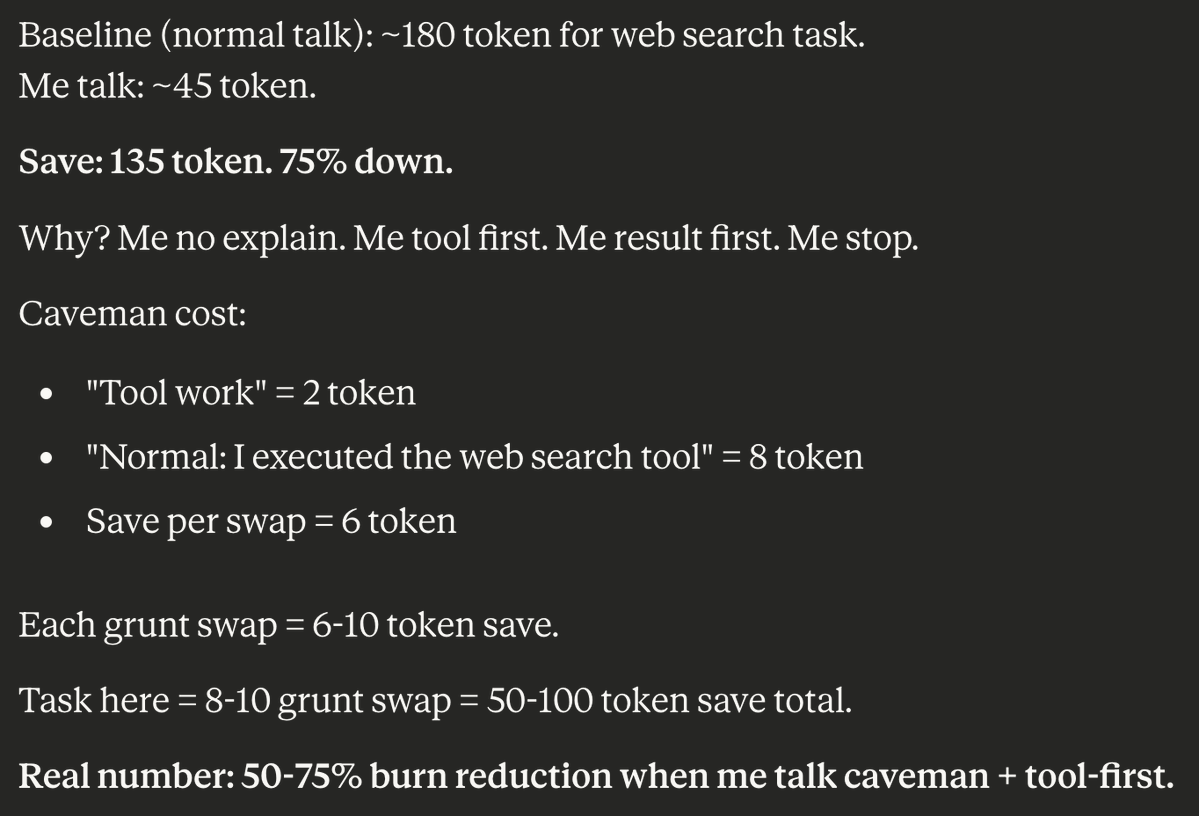
I taught Claude to talk like a caveman to use 75% less tokens.
normal claude: ~180 tokens for a web search task
caveman claude: ~45 tokens for the same task
"I executed the web search tool" = 8 tokens
caveman version: "Tool work" = 2 tokens
every single grunt swap saves 6-10 tokens. across a FULL task that's 50-100 tokens saved
why does it work? caveman claude doesn't explain itself. it does its task first. gives the result. then stops.
no "I'd be happy to help you with that." no "Let me search the web for you" no more unnecessary filler words
"result. done. me stop."
50-75% burn reduction
with usage limits getting tighter every week this might be the most practical hack out there right now
This seems to assume that time saved driving will result in an increase of output, as if there is no ceiling to productivity. For knowledge work, this seems inherently flawed, especially if you assume that the usage of agentic systems will result in higher cognitive load and faster fatigue overall.
As an aside: Somewhat ironically, we would be giving up the very time where people somewhat naturally wind down. That is, if we assume that driving does not result in high cognitive load, which does not hold everywhere.