Meet Qwen-Image-2.1, the most balanced and cost-effective image generation model in the Qwen-Image series! Now open weights! 🎨
A unified model for both generation and editing, delivering top-tier quality in a lightweight package.
Highlights: 👀
- Compact & exceptionally fast: A lightweight 7B architecture that outperforms most closed-source models, with drastically accelerated inference for multi-image inputs.
- Native transparency: Natively generates and edits RGBA layers, enabling seamless compositing and text editing within transparent images.
- Versatile, high-fidelity editing: Supports up to 10 reference images and precise local control while preserving strict fidelity for portraits and products.
- Broad coverage & stunning aesthetics: Excels at panoramas, infographics, and virtual try-ons, delivering realistic textures and elegant typography.
Start to create your next masterpiece with Qwen-Image-2.1! 🖼️
- Blog: https://t.co/tVntKOi7jy
- GitHub: https://t.co/cRj66wCrWr
- Model Scope: https://t.co/64d7Ix6YFR
- Hugging Face: https://t.co/njHSBXUbVS
Opening access for developers to build Muse connectors. You bring the API -- Muse brings the agent, the browser, and the context of what the person actually wants. People reach your service just by asking for it, and their agent takes it from there.
New connectors are live today. Come build with us. https://t.co/o6oTf1Sj9y
Through the VOICE trial, Terry is using his Neuralink implant to help fine-tune a brain-to-voice interface for himself and others who can’t speak. He trained the algorithm first by miming speech as best he could, then by simply thinking the words and hearing them come out in his own natural voice.
Powered by Grok Voice from @SpaceXAI
We’re also launching 26 partner-built plugins and 47 community plugins for legal work in ChatGPT.
Partners including @thomsonreuters, @harvey, @WeAreLegora, and @imanageinc connect specialist tools and knowledge. Community plugins built by lawyers and legal engineers give firms skills they can adapt and extend.
The plugins bring more ways to build with the tools, knowledge, and people firms already rely on.
BREAKING: OpenAI unveils "Astra for Law," combining its most powerful model with a legal search index covering >99.9% of published U.S. precedential case law.
Astra for Law: Frontier intelligence built for your practice.
A new offering powered by GPT-6 Astra with tools, settings, and context to support the expertise and judgment of lawyers and legal technology firms.
Introducing Reception, an AI receptionist platform for small businesses, built on ElevenAgents.
Every missed call could be a lost customer. Reception answers every call, answers questions, books the job, and texts confirmation.
Set up in minutes just by adding your website.
🙌 𝝠 Expo SDK 58 beta is out. Built for iOS 27 on React Native 0.88 RC, with 𝚎𝚡𝚙𝚘-𝚊𝚙𝚙-𝚒𝚗𝚝𝚎𝚗𝚝𝚜 for Siri, @𝚎𝚡𝚙𝚘/𝚊𝚐𝚎𝚗𝚝-𝚌𝚕𝚒 for coding agents, and Expo Modules 2.0 in beta....and tons more.
𝚗𝚙𝚡 𝚎𝚡𝚙𝚘 𝚒𝚗𝚜𝚝𝚊𝚕𝚕 𝚎𝚡𝚙𝚘@𝚗𝚎𝚡𝚝 --𝚏𝚒𝚡
Tons of delicious details in the changelog: https://t.co/lQ1TBDio5G
After co-inventing ChatGPT, I kept asking myself: why have superhuman chat models not led to AGI?
I’ve spent the last 2 years in stealth building a new way to train models (RLCD), and a new type of frontier AI model that we are releasing today: Jev
• 20-200x faster
• 40-400x cheaper (w/ output tokens free)
• Frontier composable intelligence optimized for decisions
AFAICT the shortest path to AI-based economic revolution
Introducing shadcn/lint. An agent-first linter for Tailwind design systems.
You define what’s allowed. When an agent breaks a rule, the error explains what’s wrong and how to fix it using your components, variants and theme.
There’s a lot you can do with this. Let me show you ↓
https://t.co/PMOkfk1jPB
Introducing Bolt Forge. Free until Oct 14th:
- Up to 50x more usage
- The new frontier: GLM, DeepSeek, Kimi
- Zero usage charges
Live now in your model picker on https://t.co/UH6gFfHvbp
And one more thing... 👇
The world deserves confidence that American companies developing increasingly capable AI will act responsibly, especially as the trajectory of progress has steepened. Every frontier lab must deliver on this, and there is no reason any of us should come to work if we cannot.
We welcome a federal framework that sets consistent safety requirements for frontier AI. But we do not believe we need to wait for an anti-trust exemption or legislation to begin the work of providing this confidence. Consistent rules to manage frontier risk so that we can maximize the benefits are a good idea (and we are excited by ideas like independent auditors).
Years ago, companies like ours developed things like Responsible Scaling Policies and Preparedness Frameworks. Those were good for that moment, and focused primarily on the deployment of completed models, not what happens during their development process.
Today's shift to focusing on safe development and evaluation will need new tools. For example, at OpenAI we now formulate explicit safety cases in advance of frontier reinforcement learning runs we expect to significantly increase capability, in addition to the safety work we have long done in advance of model releases.
We hope that other companies will learn from our approaches and propose their own; we think shared standards for misalignment, monitoring, and safety will lead to better outcomes. We look forward to collaborating with our colleagues across the industry to formulate the best version of these.
When we talk about “pacing”, we do not mean “stopping”. Progress has been rapid and will continue to be. But it should be slower than it otherwise could be; interventions like safety cases and monitoring have significant costs.
Pacing will be well worth this cost; no amount of American competitive pressure should justify recklessness, or let capabilities get ahead of alignment and monitoring.
Where we will need the help of our government is for international coordination. But first we should do what we can ourselves.
We Must Pace the Frontier: I’ve written a new essay on why the AI industry should slow down, with a three-part plan for doing so.
Anthropic is unilaterally committing to the first of these steps. We’ll provide third-party evaluators with permanent, employee-level access to our systems, so that they can verify adherence to our safety measures, report on incidents, and assess models’ alignment during training.
You can read the full post here: https://t.co/OGyPb7yaYt
ChatGPT can now do motion design in After Effects.
Introducing Higgsfield AI Motion Designer.
Our ChatGPT plugin understands animation principles, writes expressions, and retains context in your After Effects projects.
Try Higgsfield’s ChatGPT plugin now in After Effects.
Introducing Projects, a new way of working in Cursor.
Rather than creating a chat for every task, you work with a coordinator agent in a single, persistent thread.
Like @bot, your agent is always on, proactively manages work with subagents, and improves over time.
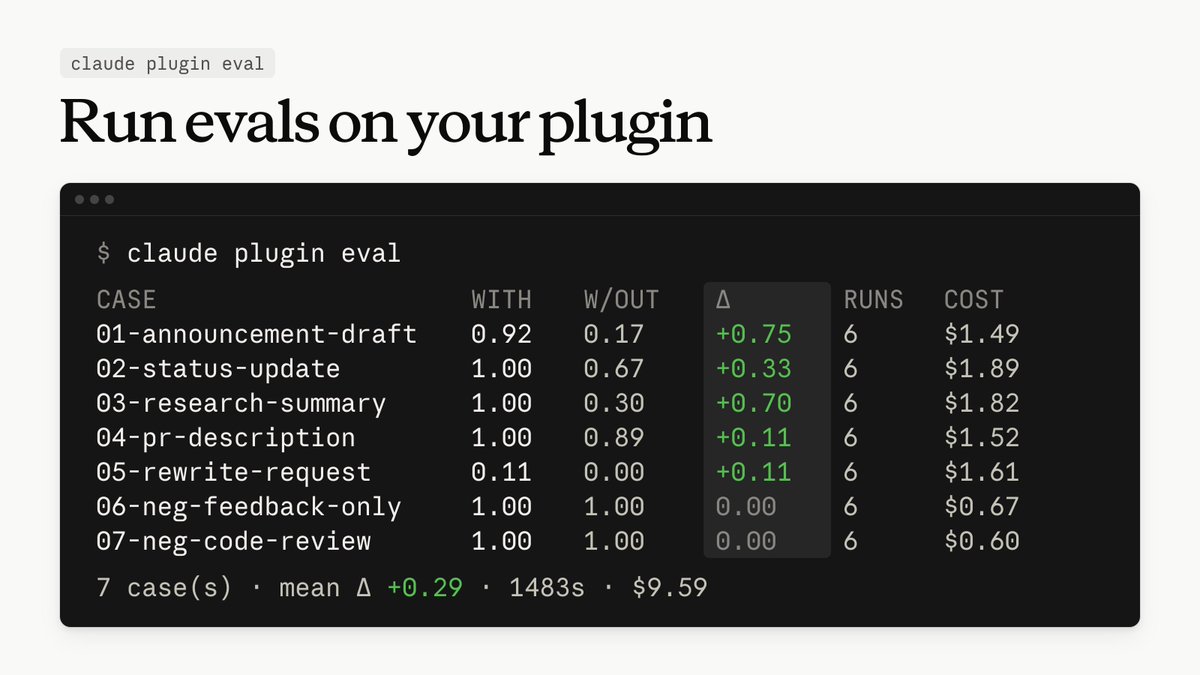
New in Claude Code: claude plugin eval
See what value your plugin is adding, or if it needs more work.
You can create test cases, run your plugin or skill against those test cases, score those runs, then run each case again without the plugin to see the differences.
BREAKING: Anthropic threat intelligence team published a report on everyone misusing Claude
"We believe we have a responsibility to disclose misuse of our services"
It’s insane, everybody should read it:
We're publishing our most detailed threat intelligence report to date.
It covers how people tried to misuse Claude—for cyberattacks, influence operations, surveillance, biology, and building weapons—and how we found and stopped them.
We disrupted every operation in the report, and used the lessons from them to strengthen our safeguards. Where appropriate, we also shared what we found with authorities and other AI companies.
These cases are not typical: we’re highlighting some of the most sophisticated misuse we’ve seen. But they’re especially important to discuss, because they show us where AI misuse is headed, where our safeguards work, and where they need to improve.
We’re publishing this report so others can spot the same activity on their own platforms, and so we can give the public a clearer view of how emerging threats develop.
Read the report: https://t.co/0EJUnYEgfz
Now available: ChatGPT for Financial Services.
This is a tailored ChatGPT Work experience that combines built-in financial data with GPT-6 Astra’s reasoning.
Teams can develop research, build financial models, and create customized client materials.
https://t.co/6WP5OJdnE8