@ayebytes En desacuerdo, siempre hay que revisar, al menos por ahora, aunque tome tiempo y digas que es un "cuello de botella" aún es mucho más rápido sacar nuevos cambios que antes de las IA pues el código ya está hecho.
Me refiero a Apps en producción con miles de usuarios.
I'm starting to wonder whether many of the old commercial models for Open Source are dead, thanks to AI.
What's the point of open-sourcing innovation if anyone can copy/integrate it into a competing product in a day? There is no moat left in the implementation.
Building an "open core" ecosystem around a permissive license also has zero moat, because anybody can quickly start building the "paid" accessories that would sustain the core. The only solution here is a license like Fair Core.
What I see thriving is human-related: support and forward engineering. Humans like to talk to other humans when they have a problem, not to soulless machines.
I don't have an answer to any of this yet, we are in such interesting times!
@ultiempos@juanmacias Solo si tu lo planeas explícitamente, porque no es adivino. Esa es la diferencia en saber como lo quieres construir a dejar que un modelo te haga todo solo.
@fjpedrosa86 Depende, tal vez no entender el código exacto pero si como funciona a grandes rasgos y su arquitectura. El ejemplo del taxista no es válido, porque él no construye coches, solo los usa, el que debe entender es el mecánico en este caso los Devs.
@D_Espanadero Es que la mayoría sigue el camino ya probado que exponen "expertos" para no invertir tiempo con cosas nuevas con lo rápido que cambia todo. En mi caso solo he probado OpenCode y Kilo Code, y me parece mejor el primero.
@ManuelZapata Entornos en Python, Nodejs o Golang etc donde hacer una API casi sin boilerplate en pocos archivos es muy facil además de que Visual Studio es pesado y viniendo de la idea de que C# es solo para empresas sumado a lo verboso del lenguaje es lo que ha afectado su popularidad.
🚀 Introducing DeepSeek-V4.1-Flash: smarter, faster, more efficient.
🔹 Introducing the smallest model in our new architecture family, with native visual understanding.
🔹 Designed for greater capability, faster inference, higher throughput, and scaling to larger models.
1/6
@zeddotdev El problema de las preguntas con respuestas multiples interactivas que no se renderizan en el Chat aun continua ¿Hay algún plan para solucionar ese tema?
Qwen3.8 is launching and going open-weight soon!🌐
With a massive 2.4T parameters, this model is continuously evolving. We believe it’s one of the most powerful model available today, compatible to leading frontier AI models , second only to Fable 5.
You don't have to wait to test it. Just now, the Qwen3.8-Max-Preview made its debut on Alibaba’s Token Plan, Qoder, and QoderWork. Be among the very first to try it out.
Can't wait to hear what you build. Stay tuned! 🚀
Token Plan
international:https://t.co/YRvcGdB9Bv
China:https://t.co/PKMUNwUuRp
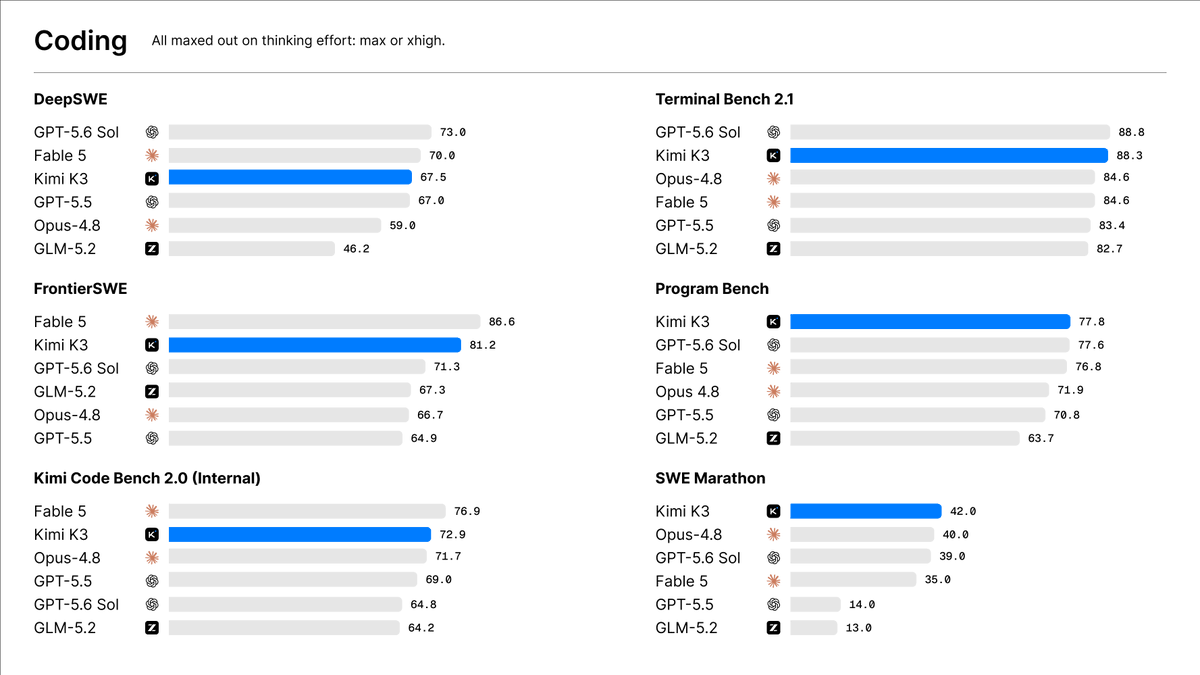
Introducing Kimi K3: Open Frontier Intelligence
🔹 2.8 Trillion Parameters, 1 Million Context, Native Multimodal
🔹 Kimi Delta Attention enables up to 6.3x faster decoding in million-token contexts
🔹 Attention Residuals deliver ~25% higher training efficiency at <2% additional cost
🔹 Built for long-horizon agentic coding and self-evolving workflows
Kimi K3 is now live on on https://t.co/zrk6zZxZUo, Kimi Work, Kimi Code, and the Kimi API.
Open Weights by July 27, 2026.
🔗 API: https://t.co/XCrgjXAqMw
🔗 Tech blog: https://t.co/YTfiMSNM1f