AIRA₃ won gold in a live Kaggle competition, placing 8th of ~4,000 teams. To our knowledge, the first gold won by an autonomous AI research system.
NVIDIA's competition provided a great eval setup:
- fine-tuning a 30B Nemotron reasoning model
- uncontaminated and externally graded
- comparison with human experts
AIRA₃ performed at the level of the top human competitors.
For AI research agents (AIRA): as the cost of generating solutions drops but verification stays expensive, research taste becomes the bottleneck.
AI Research Preference Models (RPMs) set new SOTA on two ML research tasks & match unguided agent performance with ~2/3 the budget.
AI research agents can generate hundreds of ideas in seconds, but evaluating each can take days of GPU time. When compute is limited, which idea deserves execution?
We introduce AI Research Preference Models (RPMs) to assess ideas & focus compute on the most promising paths 🧵👇
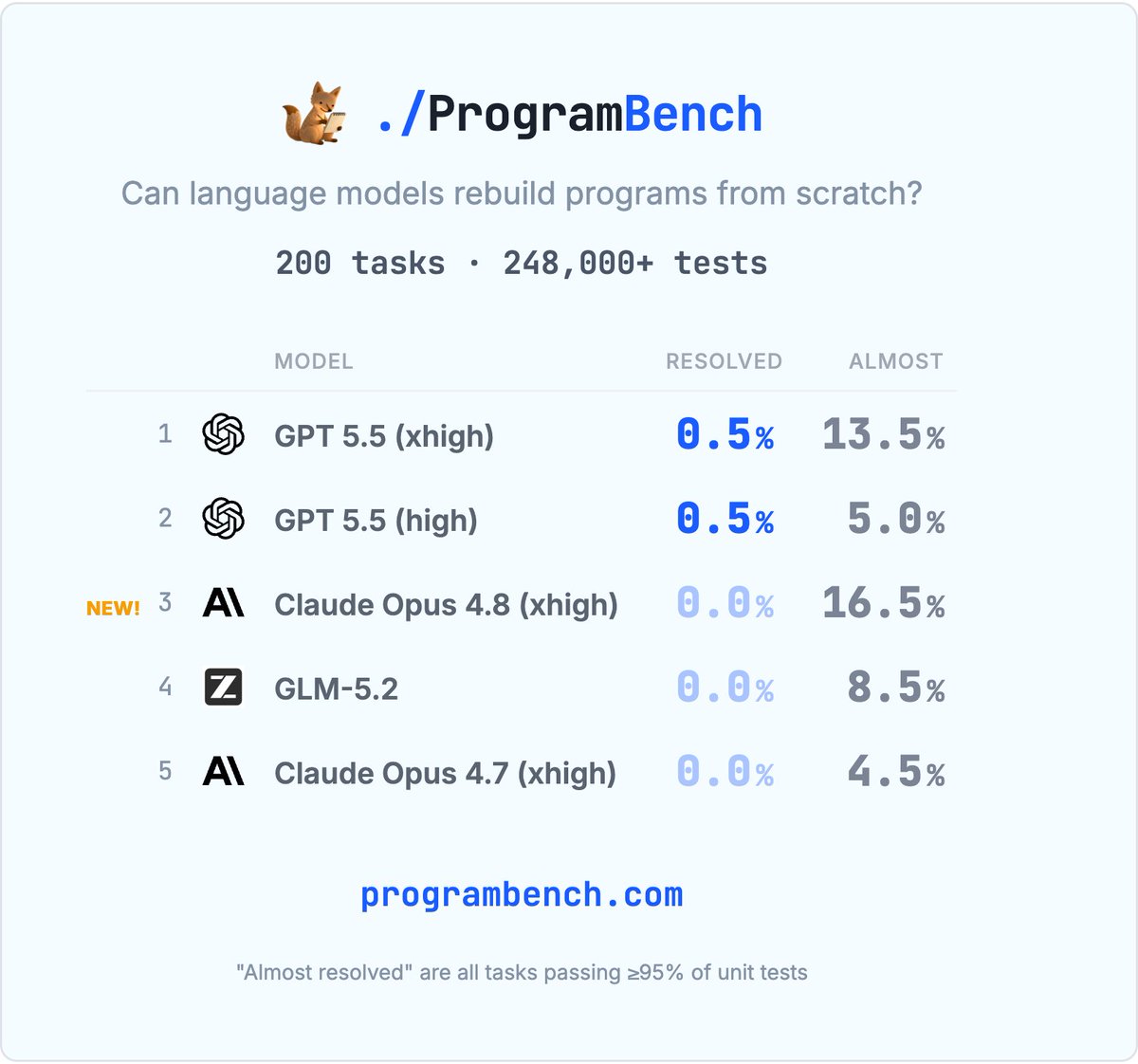
Lebron's going to philly 🤯 Also, Claude Opus 4.8 xhigh sets a record high for almost resolved instances at 16.5% for ProgramBench.
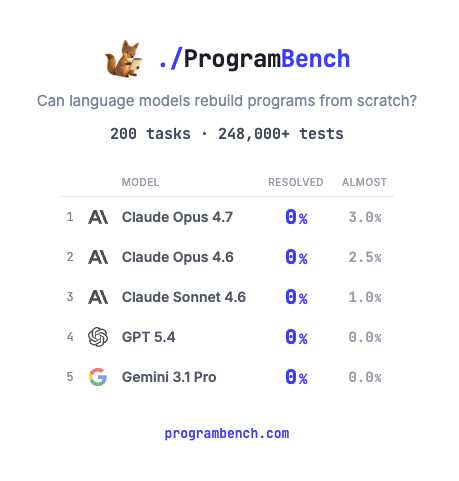
In the Anthropic family of models, this is a huge leap (Opus 4.6 [2.5] → 4.7 [3.0] → 4.7-xhigh [4.5] → 4.8-xhigh [16.5]).
@cwolferesearch Biased rec, CWM: https://t.co/KNVNHFdZ76, like ECHO/PaW, but at mid-training scale. WM data is agentic (action = bash cmd, next state = env output) and code exec (action = line executed, next state = local var changes).
Also SWE-World (2602.03419) and TWM survey (2606.09032).
How much of SQLite, FFmpeg, PHP compiler can LMs code from scratch? Given just an executable and no starter code or internet access.
Introducing ProgramBench: 200 rigorous, whole-repo generation tasks where models design, build, and ship a working program end to end. 🧵
I'll be giving a talk at the ICLR VerifAI workshop, about code execution for code world modeling, later today (Sun) at 9:05 am (Brazil time).
Swing by if you are interested in learning more!
🗣️📣Announcing VerifAI 2: AI Verification in the Wild, an upcoming workshop at #ICLR2026!! 🗣️📣
VerifAI will gather researchers to explore topics at the intersection of genAI and trustworthy ML. Submit your work!
Check out our website and CFP for more: https://t.co/VFWNqp7zCK
Excited to share Muse Spark, the first model from whole team’s work in MSL! 🚀
It’s natively multimodal and agentic. I’ve been using it for my daily coding and research tasks. Still plenty of room to improve in agentic domains, but we’re moving with great velocity.
It’s a seriously good model! Check out the full breakdown and try it out in https://t.co/Fka0wdAswy
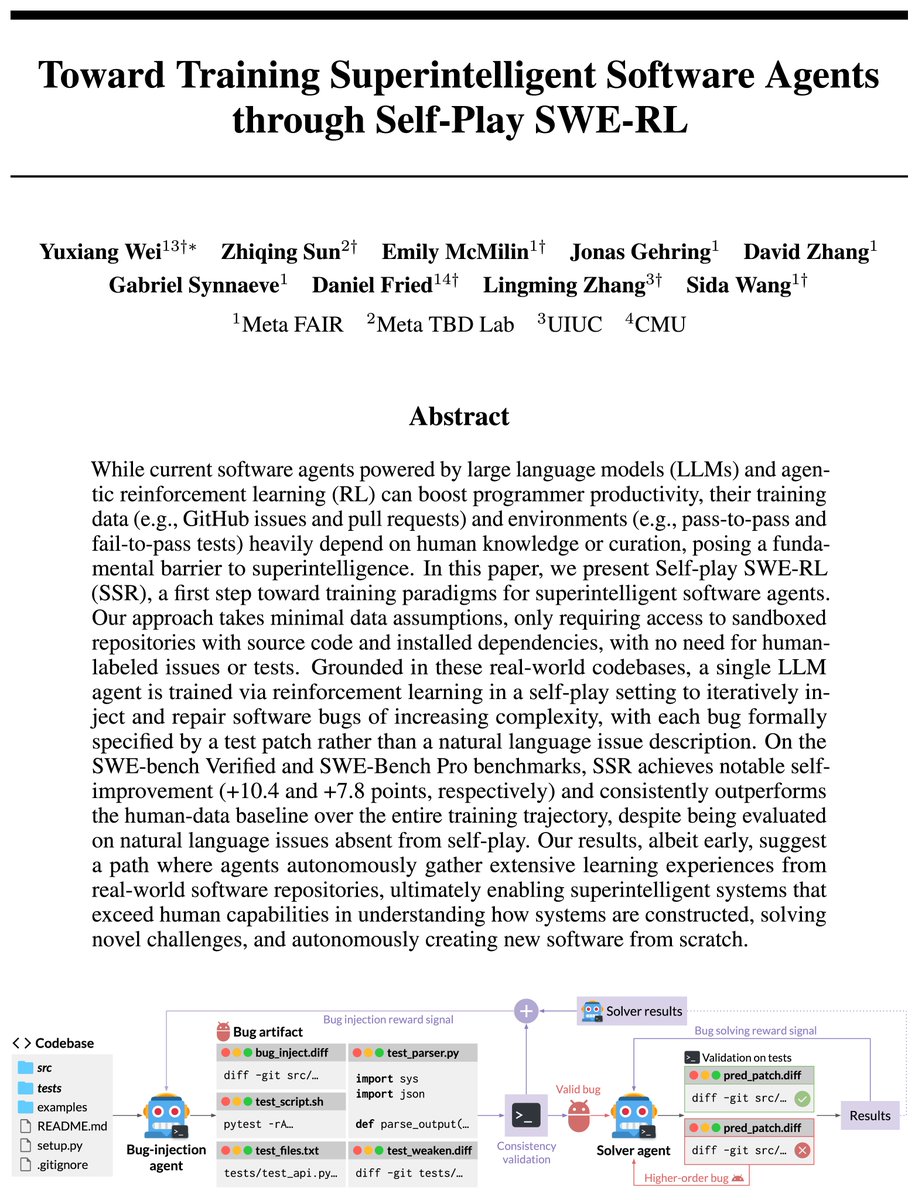
Software agents can self-improve via self-play RL
Introducing Self-play SWE-RL (SSR): training a single LLM agent to self-play between bug-injection and bug-repair, grounded in real-world repositories, no human-labeled issues or tests. 🧵
We modify each repo's CI workflows to capture a single successful third-party build.
For pytest repos, we inject https://t.co/JagbOd5Jzg fixtures to verify the correct container and support optional Python execution tracing.
See more in our paper: https://t.co/pVOTNTjviM
Better late than never to share how we built 35k+ unique repos (rather than commits from the same dozens of repos) into executable envs for CWM mid-training and SWE-RL post-training...
https://t.co/ZeG4MXvHaj
(🧵) Today, we release Meta Code World Model (CWM), a 32-billion-parameter dense LLM that enables novel research on improving code generation through agentic reasoning and planning with world models.
https://t.co/BJSUCh2vtg
Key insight: the execution env of a GitHub Actions CI workflow is fully built with deps.
So we can cheaply capture it as a standalone Docker image for later execution.