In the Ṛgveda, the Asuras are not demons.
They are the Anu. The Anavas.
And once you see this, the entire Indo-European story realigns.
In the Ṛgveda, the great civilizational divide is not “good vs evil”.
It is Anu vs Puru.
The Devas are the ancestral gods of the Puru / Pauravas.
They are the Ādityas, sons of Aditi, the mother of the gods, working under Tvāṣṭar, the divine architect.
Tvāṣṭar is not a marginal figure.
In the Ṛgveda he appears repeatedly as father-in-law to major god's wives, linking lineages.
He is the god of craft, metallurgy, design, and construction, the civilizational signature of the Harappan–Sarasvatī–Sindhu world of North-West India.
On the other side stand the Anu / Anava.
The Ṛgveda describes them with remarkable precision:
Anindra – those who reject Indra
Avrata – those who do not follow Vedic ritual norms
Vadhri-vācāḥ – those who speak different dialects
Not barbarians.
Linguistic cousins.
Proto-Avestan and other early Indo-European speech forms.
This is why the Anavas are consistently hostile to Indra because Indra is the tribal god of the Purus.
Now pause here.
The Anu are not a minor Vedic clan.
👉 Anu is the supreme god of the Sumerians.
That is not coincidence.
From the Anavas emerge two great branches remembered in Itihāsa-Purāṇas:
Daityas
Dānavas
The Daityas correspond to proto-Iranians.
Their sacred river is named Daityā in the Avestan text Vendidad —identified with the Jhelum.
The Dānavas correspond to proto-Greeks, Albanians, and wider Europeans.
Their sacred river is Danu, preserved as Danube, Don, Dnieper, and more.
Even Greek memory is explicit.
The heroes of the Iliad and Odyssey trace themselves to the Danaans.
And Ireland?
The Irish gods trace their divine ancestry to Danu, their great grandmother goddess.
Now return to the Ṛgveda.
Here, Dānu does not mean a demon queen.
It means dew, ice, flowing waters, rivers born from Himalayan glaciers.
Sapta Dānu = Seven Rivers = Sapta Sindhu.
Only later, in the Itihāsa-Purāṇas, do we see a theological reshuffle:
Aditi, Diti, and Danu are turned into wives of Kaśyapa Prajāpati.
But Kaśyapa is a Late Ṛgvedic figure, prominent mainly in the Late Ṛgveda, associated with Kashmir-region Ṛṣis.
The very concept of Prajāpati itself emerges only in the 10th Maṇḍala.
In effect: 👉 The cosmic role of Ṛgvedic Tvāṣṭar is retro-assigned to Kaśyapa.
👉 Older civilizational memory is reorganised into later genealogy.
So what we are seeing is not mythology, but layered historical memory:
Puru vs Anu
Indra-worshippers vs Indra-rejecters
Indo-Gangetic ritual core vs outward-moving Indo-European branches
Read literally, you get demons and gods.
Read historically, you get the Indo-European split preserved inside the Ṛgveda.
If this perspective is new to you, say YES in the comments.
If you want a deep dive into Anu > Danu > Daityas & Dānavas, react 🔥
If this reframes Indo-European history for you, share & retweet.
More threads coming, if people want them.
Another record breaking #heatwave bakes #Europe. Temps will reach 45C / 113F in #France under the #heatdome. 1000s of records expected. Here’s a look at the day by day #heatwave forecast in degrees C and F. Europe is the fastest warming continent, warming twice as fast as the global average and record heatwaves are increasing fast on the continent.
Unveiling of Sushrutha’s statue at the Royal College of Surgeons Edinburgh. What a great event, a historical event in the histories of both India & the U.K.
🚨 MJO WATCH: A Major Shift May Be Coming for the Indian Monsoon
The latest GFS-based SCORPION analysis shows the main MJO wave has been behaving unusually — almost like a stationary (standing) wave, while also displaying westward propagation.
For India’s summer monsoon, this pattern is often associated with a Monsoon Break, suppressing rainfall across large regions.
But the key development is what happens next: the trapped MJO signal appears close to breaking free.
If this transition continues, it could dramatically reshape monsoon dynamics during the second half of June and into July.
🌧️ A stalled monsoon today doesn't guarantee a weak monsoon tomorrow.
All eyes are now on the MJO release phase.
#Monsoon #IndiaWeather #MJO #WeatherUpdate #Climate #ElNino
POKER-X, an innovation by Prakash Urs. With Poker-X, you can easily pour milk or oil into a container.
It eliminates the need to cut the corners of milk/oil packets, keeping the sachet more intact and making recycling easier.
Better recycling means less plastic ends up in the environment, where it can eventually break down into microplastics.
#WATCH | Nice, France | Srinath Ravichandran, Co-Founder and CEO of AgniKul Cosmos, says, "We build rockets that take satellites to space. We are based out of the IIT Madras ecosystem in Chennai. Our rockets are fully reusable."
Co-Founder of AgniKul Cosmos, Moin says, "We are grateful to the government for giving us the opportunity to build an ecosystem of vendors, investors, and customers. The strong message being conveyed through this is that the government is showcasing India's credibility to the world..."
Congratulations @OilIndiaLimited !
An ocean of energy opportunities reinforced in the Andaman Sea!
Very happy to report the presence of natural gas in Sri Vijayapuram-3 an exploratory well drilled by Oil India Ltd. 15 km off the east coast of the Andaman Islands at a water depth of 355 meters.
Initial production testing of the well at the depth of 1900 plus meters in the Eocene formation has established the presence of natural gas through continuous flaring.
Oil India is carrying out gas sampling to assess the composition & calorific value of gas and to carry out isotope studies to understand the genesis of the gas.
Under the Samudra Manthan Mission (National Deep Water Exploration Mission) announced by Hon’ble PM @narendramodi Ji on Independence Day 2025, large number of deepwater & Ultra deepwater exploration wells are planned in our offshore basins to fully exploit our hydrocarbon reserves.
Presence of hydrocarbon is now reported in 2(Two) wells out of 3 (Three) exploratory wells drilled by OIL in current exploratory campaign off Andaman Basin.
This presence of natural gas will help us in taking forward our exploration ambitions in coordination with global deepwater exploration experts like @petrobras, @TotalEnergies, @bp_india, @Shell, @exxonmobil and will be a significant milestone in our journey through Amrit Kaal!
@PMOIndia@PIB_India@PetroleumMin@mygovindia
#OilIndia #EnergySecurity #Exploration #NaturalGas #Andaman
#WATCH | Delhi: On CBSE OSM issue, Aparajita Gautam from Delhi Parents Association says, "... After the 12th board exams, and CBSE results, their future is decided.. Because of shortcomings in OSM (On-Screen Marking), many parents and children are disappointed. Students don’t just prepare in Class 12; they’ve been working for years, knowing their future depends on it. Students remain focused on competitive exams like JEE and NEET. But due to OSM, many didn’t achieve the required marks, causing stress for families and children. Now, they question why this was introduced suddenly without a proper test run. On social media, students are voicing complaints, though not all reach us directly, but the frustration is clear. If you check CBSE’s Facebook page, you’ll see countless complaints. The official figure says 6.5 lakh students raised objections, but I believe the number should be far higher. Out of 18 lakh students, 12 lakh are from government schools, many in rural areas. If metro city students with laptops struggled, imagine the difficulties faced by rural children with limited access... Training was rushed, with follow-ups missing. Teachers had to log in and practise with sample papers, yet no one verified whether they actually did. Another issue: papers were supposed to be checked by PGT teachers, but due to shortages, TGT teachers were involved. TGTs usually teach up to Class 10, so they may not have fully understood the marking scheme. This could be a reason why some students received lower marks."
The Ministry of Earth Sciences (@moesgoi) organised the Superannuation Ceremony of Dr. M. Ravichandran (@Ravi_MoES), Secretary, MoES, on 29 May 2026 at Arnav Hall, attended by Directors, senior officials, scientists, and staff members from the Ministry and its institutes.
The occasion honoured Dr. Ravichandran’s distinguished career spanning nearly 38 years of dedicated service to science, research, and nation-building. Colleagues, peers, and members of the scientific community felicitated him for his exemplary leadership, steadfast commitment, and significant contributions to strengthening India’s scientific ecosystem and fostering a culture of scientific temper.
MoES conveyed its sincere appreciation for Dr. Ravichandran’s invaluable guidance, dedication, and leadership in advancing Earth Sciences in the country, and extended its best wishes for a healthy, rewarding, and fulfilling journey ahead.
#MoES #DrMRavichandran #Superannuation #EarthSciences #ScientificTemper
@narendramodi@mygovindia@PMOIndia@DrJitendraSingh@OfficeOfDrJS@PIBEarthScience@PIB_India@MIB_India@Indiametdept
Save the date❗Today on #BiodiversityDay we're excited to launch the Arctic Biodiversity Summit!
🗓️16-18 March 2027
📍Nuuk🇬🇱
Organized by @KodArctic
Join to advance biodiversity conservation & strengthen knowledge exchange across the Arctic ℹ️ Learn more: https://t.co/hpjPXIsr8o
2026 Monsoon Update
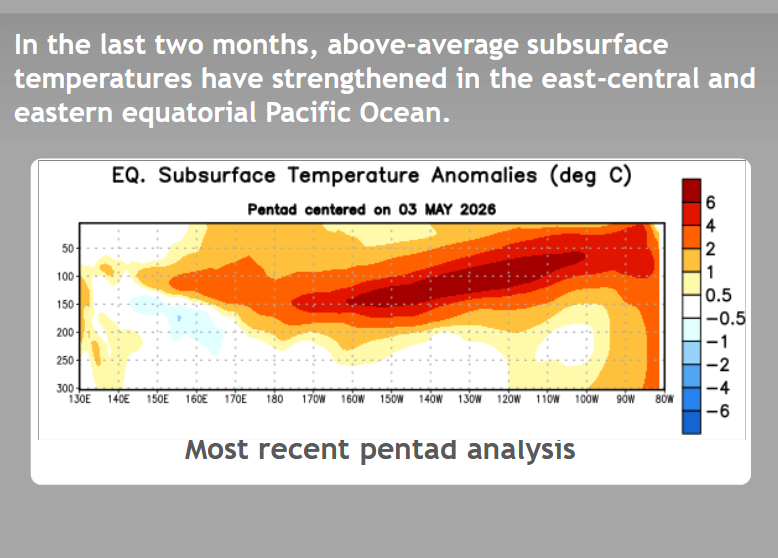
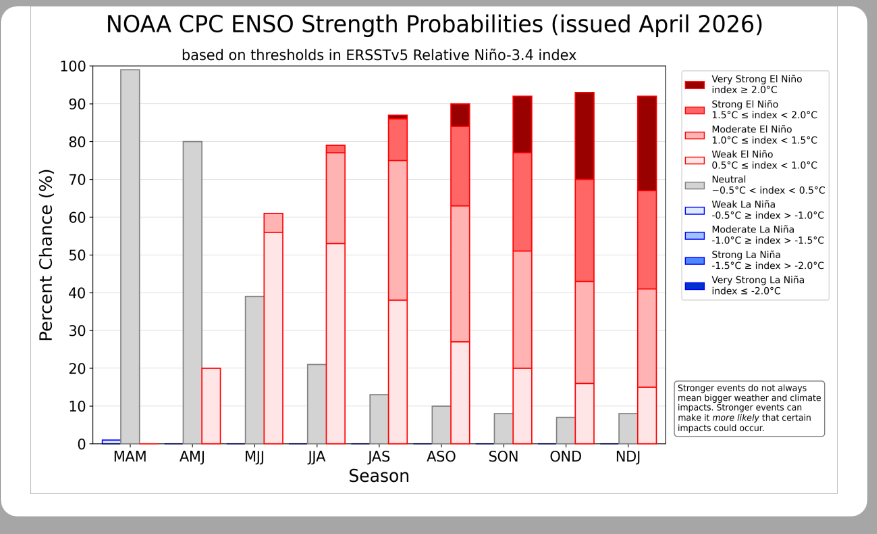
Latest climate model predictions suggest that a severe El Niño event is developing over the equatorial Pacific Ocean. The warming over the central equatorial Pacific is likely to exceed 2°C above normal, indicating the possibility of a strong to severe El Niño event. In addition, abnormally warm waters are present below the ocean surface across the equatorial Pacific. This enhanced sub-surface ocean heat content is expected to further strengthen the El Niño, which is likely to peak during November–December 2026.
Such a strong El Niño event could have widespread global impacts, including significant implications for the Indian summer monsoon.
Not all El Niño events are associated with deficient monsoon rainfall over India. However, when the event is particularly strong, as projected this year, the probability of a below-normal or deficient monsoon increases substantially. For updated and more reliable monsoon forecasts, it is important to refer to the official forecasts of the India Meteorological Department (IMD), which are expected to be released by the end of this month.
In general, the adverse impact of El Niño on monsoon rainfall is observed over most parts of India, except Northeast India. During El Niño years, the frequency and duration of monsoon break periods also tend to increase. Therefore, Northeast India may experience normal to above-normal rainfall, including the possibility of a few flood events during the 2026 monsoon season.
Historically, deficient monsoons have affected the Indian economy. However, today the overall economic impact may be relatively limited because the Indian economy has become more resilient to monsoon variability. Nevertheless, the agriculture and water resources sectors could still face severe adverse consequences.
There is no need for panic, but this is the time to seriously formulate strategies to manage and minimise potential impacts on agriculture and water resources.Concerned organisations and agencies should closely monitor the extended-range forecasts issued by the Ministry of Earth Sciences (MoES), which provide useful guidance on rainfall conditions over the next 2–3 weeks. Such forecasts can support timely advisories for farmers and water resource management authorities.
A weak monsoon is part of a natural climate process and cannot be prevented. What is important is our ability to minimise its adverse impacts on critical sectors, particularly agriculture and water resources.
@Indiametdept@PMOIndia@ndmaindia
Why do Tamil Nadu's ancient temples stand for 1000+ years? Why do TN mountains shoot straight up from flat plains like a Mesa? The answer is one extraordinary rock — Charnockite.
TN is a charnockite capital of the world, where it is discovered, A story of 3 billion years. 🧵1/16