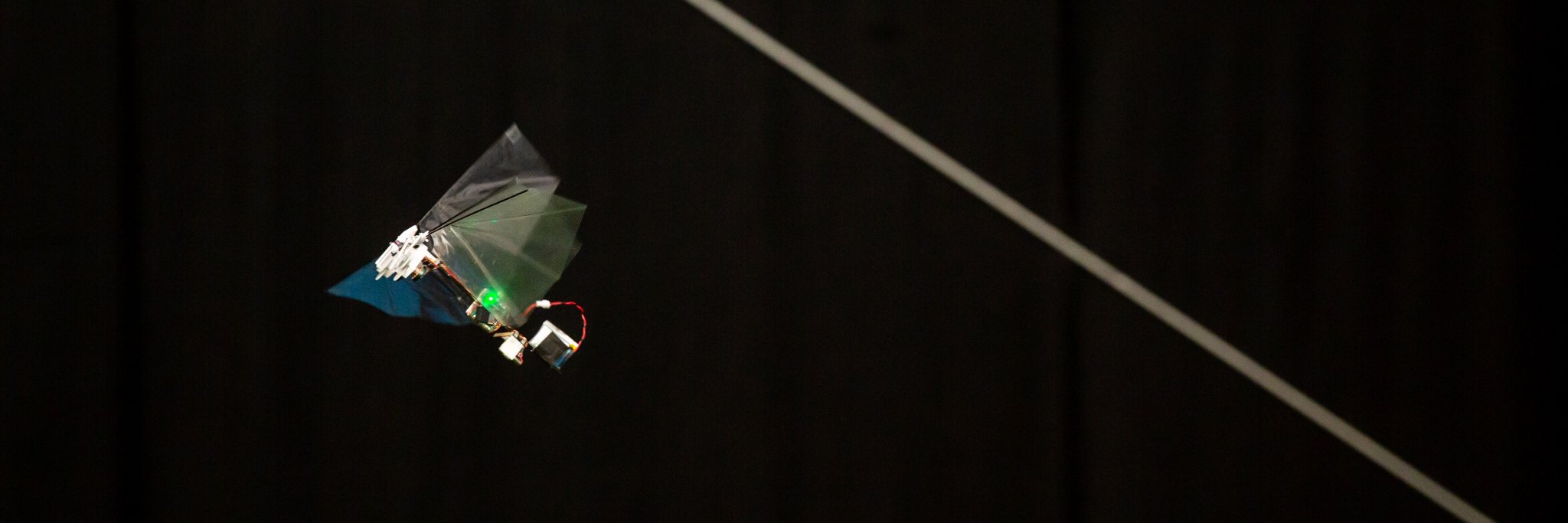
Researchers propose an insect-inspired strategy for robotic visual route-following to #navigate long distances. @tudelft
Learn more in Science #Robotics: https://t.co/lJipvbn6yu
💡#aetudelft drone-researchers felt inspired by biological findings on how ants visually recognize their environment and combine it with counting their steps in order to get safely back home. They have published their findings in @SciRobotics: https://t.co/IlbvBXaroC
Ever wondered how flying insects control their attitude without using accelerometers? In our latest @Nature paper, we show that this can be done by combining visual motion sensing with a model of their ego-motion. This is an important step toward insect-sized drones!
1/2
This year's International Micro Air Vehicle Conference IMAV is organised by the Micro Air Vehicle Lab at @tudelft. Pre-registration is already open at https://t.co/j9WEPn9kb6
This year, we challenge research teams with 3 drone competitions. More on https://t.co/pGz2FueAIF
@TUDelft@microuav integrated their AED drone in the C2C Command and Control station developed by @NormalizedSystems. The system integration was verified to successfully operate in simulation and will be tested in-flight next week at #unmannedvalley in the Netherlands. #H2020
We are proud to introduce @BDuisterhof as #BestGraduate 2021 of @AETUDelft!
Bart developed a fully autonomous swarm of tiny drones able to detect & localize gas leaks in unknown, cluttered environments. Read more: https://t.co/WdIcvTthFF
#ArtificialIntelligence#AI#tudelft
Drone racing for AI - read our new Challenge Accepted article by the winning team @microuav of the 2019 AlphaPilot challenge. https://t.co/t2YD7JIvqY (Free view-only pdf https://t.co/S9ZgTUc25x)
#Metropolis2, another #USpace project led by SAFIR-Med partner @TUDelft will organize an interesting workshop on the 8th of October presenting 3 concepts to achieve safe and efficient urban aerial operations. You can register using the following link: https://t.co/Rfr9sP1kSi
#MAVLab@TUDelft@microuav made great progress with the software integration and flight tests of their AED drone in the SAFIR-Med project. The tactical avoidance algorithm, telemetry and control API’s are being integrated together with @NormalizedSys. #H2020#SESARJU#UAM#UTM
By looking closely at nature, @microuav has succeeded in developing a swarm of drones that can smell and localize gas. The small #drones us a new 'insect algorithm' for navigation called 'Sniffy Bug'. #robotics#TUDelftAI#tudelft 👉https://t.co/gShccAbqYc
We created the first fully autonomous drone swarm that can locate gas leaks in unknown, cluttered environments thanks to bio-inspired #AI. Check it out!
Paper: https://t.co/8NDpAzDutM
Video: https://t.co/ryGkFFYDWw
Code: https://t.co/KyFWR2KV2l
@tudelft@Harvard@UniBarcelona
Interview with our founder, Matěj Karásek, about advantages of flapping wings and the aerodynamic research behind it, carried out at @microuav@AETUDelft@tudelft
Check it out!👇
TU Delft, one of the @SafirMedEU partners, is also working on other UTM related research projects. TU Delft recently started coordinating the Metropolis 2 (https://t.co/ZrWOTdNDJR) project. The project is mainly focused on safe drone operations in high density airspace. #SESARJU
The MAVLab @microuav of @tudelft is focusing on the safe operation of drones in urban airspace by implementing tools for drone operators to perform tactical deconfliction manoeuvres. TU Delft will also demonstrate their medical AED drone as part of @SAFIRmedEU.
#H2020#UAM
Whereas flying #insects control their flight successfully with optical flow, roboticists have had a hard time achieving the same with #drones. @microuav and @WHPresse present an #AI-based learning process that solves these problems, in @NatMachIntell: https://t.co/GGL2lsHtb8
Researchers at TU Delft @microuav together with @kon_marine and @Kustwacht_nl developed a hydrogen-powered drone that is capable of vertical take-off and landing whilst also being able to fly horizontally efficiently for several hours. 💧🚁
#drones#sustainableaviation#vtol