No, the ultimate limiting factor is the procurement timeline for power generation.
Even if data center expansion slows down slightly because of memory constraints, the electrical infrastructure required to power and cool the existing footprints must be massively upgraded. This will keep the orders full for $VRT, $MOD, $GEV, and $ETN.
If AI growth paused entirely tomorrow, three government-mandated national security megatrends will still have the order books overflowing... grid modernization ($PWR), reshoring manufacturing ($ASML, $TSM), and the nuclear renaissance ($BWXT, $CCJ, $CEG).
We're transitioning from the digital realm back into the laws of thermodynamics.
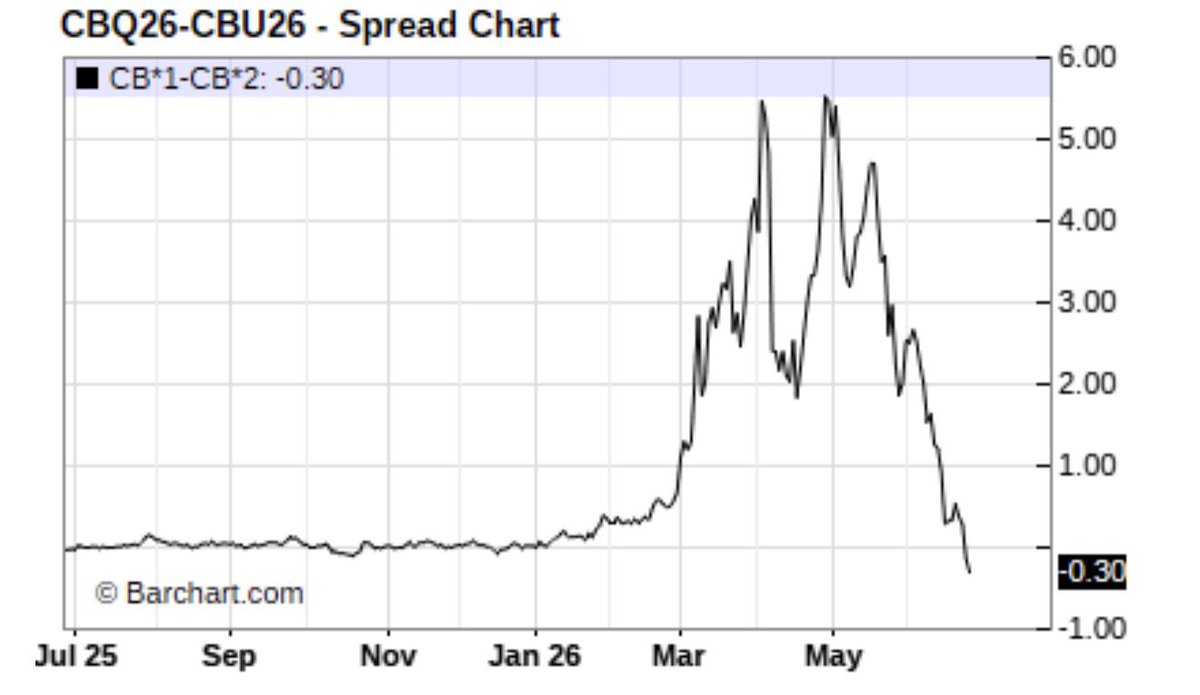
Just so everyone knows, this has never happened in the oil market.
Cracks are back to the highs, and crude timespreads are in contango.
Never happened.
Not in 08, not in 18, 19, 20, 22, never.
Never ever happened.
BREAKING: $STRC hits another all time low today.
$MSTR is also down -9.20%, hitting a new 28 month low.
This comes right as Rosen Law Firm has opened an investigation into Strategy.
The firm is investigating potential securities claims on behalf of shareholders, covering $MSTR, $STRF, $STRC, $STRK, and $STRD.
The allegation: Strategy may have issued materially misleading business information to the investing public.
The most underappreciated data point on MU’s earnings call was that the number of five-year SCAs increased from one last quarter to seven this quarter. That’s significant because it suggests customers expect this buildout to last for at least five years and want greater pricing visibility over that time frame.
In the old USSR, people could be arrested for photographing bridges, tunnels, etc. A repressive and paranoid regime assumed the photographers must be spies and saboteurs. Americans laughed at such petty tyranny. Nothing like that could happen in their free country! Until now.
⭕️ OIL: Energy markets expert Dan Dicker told Bloomberg that oil prices have remained artificially low because they are being driven by traders rather than underlying physical shortages.
🔹 Dicker said traders have repeatedly been burned after buying oil on supply concerns, only for President Donald Trump to announce prospective agreements that send prices sharply lower, even as those negotiations fail to open the Strait of Hormuz.
🔹 He warned that unless oil flows through the Strait of Hormuz resume fully and inventories are rebuilt, the physical shortage will eventually overwhelm financial markets, driving oil prices from about $75 a barrel today to $135 within a month.
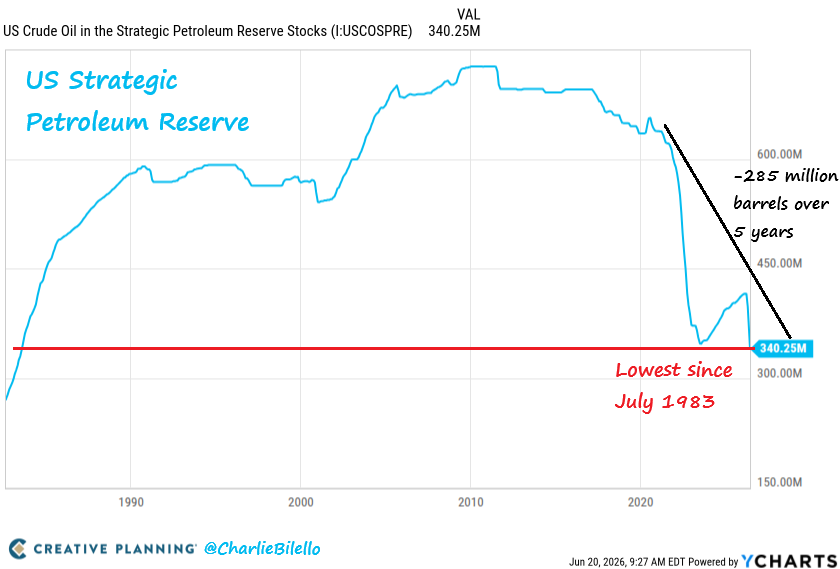
The US Strategic Petroleum Reserve is now at its lowest level since July 1983. Over the past 5 years we've seen a drawdown of 285 million barrels (46% decline).
BREAKING: $STRC just hit at $85.32, its lowest level ever.
It could force Strategy to sell more Bitcoin.
STRC is Strategy's preferred stock that pays an 11.5% annual dividend. When it trades below its $100 par value, the market is signaling that the yield is not high enough.
To bring STRC back to its peg, Strategy would need to raise that dividend rate.
But raising the dividend rate means a higher annual cash obligation. Strategy is currently funding that cash by selling MSTR shares.
The problem is MSTR's NAV premium has compressed close to 1x, meaning there is almost no room left to dilute further.
That could force them to look at this option. SELL BITCOIN.
Strategy also responded directly to these concerns. According to their latest 8-K filed June 15, their $55 billion Bitcoin reserve covers $1.7 billion in annual dividends and interest expenses for 32 years. Bitcoin only needs to appreciate 3.1% per year for them to break even on that obligation.
On paper, the cushion looks significant. But STRC is still trading at $86, $14 below its $100 par value. The market is not convinced yet.
When Strategy sold just $2 million worth of Bitcoin last time, the price dropped 20%. If Strategy is forced into becoming a consistent seller, the impact on Bitcoin would be significant.
Strategy has been the single largest institutional Bitcoin buyer in the world. The data says they have 32 years of runway. The market is still pricing STRC at a discount.
The Medallia numbers are in.
Thoma Bravo: entire $2.5bn equity stake gone. Refused to put in more.
Creditors: wrote loans down 40%+, $1bn+ in paper losses.
Lenders (Blackstone, Apollo, FSK/KKR) take the company.
A 40% lender writedown is ugly. It's also better than most BSL software paper will do.
🦔SpaceX signed a deal to acquire Cursor for $60 billion in all-stock on Tuesday, four days after its Nasdaq IPO at over $2 trillion. Cursor makes roughly $4 billion a year in revenue. Microsoft looked at the deal. OpenAI tried to buy Cursor twice and got turned down.
My Take
SpaceX went public on Friday and signed a $60 billion acquisition by Tuesday. A company that converts its stock into a deal that size before the first full trading week ends knows the price won't hold.
Cursor is a good product but it doesn't own the AI it runs on. It works because it plugs into Claude and GPT. If those companies change their pricing or build a direct competitor, the $60 billion product has a dependency it can't control. Microsoft already owns GitHub Copilot and could have absorbed Cursor into VS Code tomorrow. Microsoft passed. When the company with the most to gain walks away from a deal, the price was probably wrong. SpaceX paid it anyway, in stock that Morningstar valued at less than half the IPO price. Go public and spend the stock before the market figures out what it's worth.
Hedgie🤗
You have noticed it. ChatGPT feels dumber than it used to. Your prompts that worked six months ago produce worse results now. The writing sounds flatter. The ideas sound safer. The internet itself feels like it is shrinking. Every article reads the same. Every email sounds the same. Every answer sounds like it was written by the same voice.
You thought it was you. It is not you.
Researchers at Oxford and Cambridge published a paper in Nature proving what is happening. They call it Model Collapse.
Here is the mechanism in one sentence. AI trained on AI-generated data gets dumber every generation until it forgets what real human data looked like.
The internet is filling with AI-generated content. Blog posts. Articles. Reviews. Comments. Social media. AI companies scrape the internet to train the next generation of models. Which means the next generation of AI is being trained on the output of the current generation.
Each cycle loses information. Not randomly. It loses the rarest, most unusual, most creative parts first. The researchers call these the "tails of the distribution." The weird ideas. The unexpected perspectives. The things that made the internet feel human. Those disappear first.
What remains is the average. The safe. The expected. The bland.
Then the next generation trains on that. And loses more. And the next generation trains on that. And loses more. The researchers proved this is not a slow decline. Major degradation happens within just a few iterations. Even when some of the original human data is preserved.
They tested it on large language models. On image generators. On statistical models. The pattern was the same every time. The output converges toward a narrow, flattened version of reality that looks nothing like the original data.
The lead researcher put it plainly. "Large language models are like fire. A useful tool. But one that pollutes the environment."
The pollution is invisible. You cannot see which sentence on the internet was written by a human and which was written by AI. Neither can the AI that is about to train on it. And once the tails are gone, they do not come back. The damage is irreversible.
This is not a prediction anymore. It is a diagnosis.
The internet you grew up on was built by humans writing things no algorithm would have written. Strange, personal, imperfect, alive. That internet is being diluted. One generation of AI at a time. And the models trained on what remains are learning a smaller and smaller version of the world.
Model Collapse is not a technical problem. It is a cultural one. The thing that made the internet worth reading is the thing that disappears first.
This chart paints both the hope and fear of tech capex. Oracle's spending has risen exponentially, far beyond its (& investor) expectations. As every tech company tries to force their ballooning capex plans into the market's pipes, we're starting to see indigestion.
The credit cycle has turned. Easy returns are giving way to greater dispersion, where careful selection and a focus on quality can make a real difference.
Our latest Secular Outlook looks at what a more differentiated credit cycle means longer term and why evaluating quality, structure, and liquidity is key.
Available Now: https://t.co/UTKBhhPS1q