Many act as if slavery was a uniquely American crime.
“One reason,” says author Wilfred Reilly (@wil_da_beast630), “is that a lot of black people survived here.”
He argues that much of what Americans are taught about slavery is just wrong:
As both a Frisco resident and Attorney:
If you are surprised by the Karmelo Anthony verdict or confused by it, please revisit the news sources you trust and consume.
We are often misled and tricked by the media. It feels like it has become part of their job to rile us up. To create emotional response. To divide us by political association, race, gender, orientation, etc. because it turns into clicks and more consumption of their content.
Look past these sources if they speak more about how you should feel about the “news” and not present the “news” as facts of what happened. Find the facts yourself by looking at multiple sources. Listen to the testimony and review the evidence. Make your own objective conclusions.
For example, the facts (in response to common misinformation) include:
1) The jury included numerous minorities, including Asian, Hispanic, and Middle-Eastern people;
2) Anthony’s attorney was a private, hired lawyer, not a public defender;
3) It was and is an unwritten rule that you are only permitted under a team tent if you are part of the team/school;
4) Anthony was not part of the team/school yet went and sat in the tent anyway;
5) Eyewitnesses, including black eyewitnesses, testified Anthony was told to leave the tent multiple times and he verbally refused;
6) Multiple eyewitnesses, including black eyewitnesses, testified that Karmelo was never surrounded/ganged up/jumped in that tent;
7) Multiple eyewitnesses, including black eyewitnesses, testified Anthony put his hand inside his backpack as though he was planning to retrieve a weapon during the verbal altercation;
8) The eyewitnesses, including black eyewitnesses, in the tent testified they jokingly said that they didn’t believe he had anything in the bag because he was in Frisco, Texas;
9) Eyewitnesses said AM told Anthony to leave or he would kick his a**;
10) Eyewitnesses testified that during the verbal exchange, Anthony said “touch me and find out.”
11) Eyewitnesses testified AM went over and pushed him to make him leave the tent.
12) Eyewitnesses testified AM did not punch Anthony or make any attempt to cause serious injury to him;
13) Anthony immediately pulled his knife and stabbed AM in the chest;
14) Anthony then threw the weapon into the stands and ran;
15) Anthony admitted the stabbing to the police;
16) Even the defense’s witnesses said Anthony was in the wrong.
You are free to make your own opinions about the case. But before jumping to conclusions, at least know the facts.
Black Americans have to stop having this unrelenting loyalty to being black.
It overrides common sense and also overrides right and wrong.
It’s a problem and it’s one of the reasons we struggle at the level we do.
“It was one of the most monumentally unselfish things one group of people did for another.”
-#DDay veteran Andy Rooney on the young 🇺🇸 🇨🇦 🇬🇧 soldiers who stormed the beaches of Normandy 82 years ago.
Required watching for every young person today!
Americans "are all immigrants who were fleeing from…dictatorship, tyranny, socialism," says @DanielDiMartino.
That history makes their descendants "not only willing to take more risks, but also willing to defend their liberties."
Here’s what else makes America successful:
Down syndrome advocate Frank Stephens: “See me as a human being, not a birth defect, not a syndrome. I don't need to be eradicated.”
Frank Stephens’ emotional plea resurfaces amid backlash after YouTuber Jesse Ridgway and his wife revealed they aborted their unborn child following a Down syndrome diagnosis.
Ray’s Rock - Omaha Beach
On the morning of June 6, 1944, 23 year old Staff Sergeant Arnold “Ray” Lambert came ashore with the first wave of the 1st Infantry Division on the eastern side of Omaha Beach. At this small patch of concrete he saved nearly 20 lives:
The division came under intense fire from several German bunkers surrounding the entrance to the Colville Draw (one of two exits off Omaha Beach). Ray, a medic, immediately went to work.
He was shot in the arm. Moments later he was hit by shrapnel in the leg, but Ray kept pulling men to safety. He pulled nearly 20 wounded soldiers to cover behind this 8ft wide obstacle, treating each soldier before going out in search of others.
After several hours under fire, while pulling a wounded soldier from the ocean, he was struck by a landing craft. It dropped its ramp on top of him, breaking his back. He fell face down in the water, drowning. The craft backed up and nearby soldiers pulled an unconscious Ray to safety, eventually evacuating him off the beach.
Remarkably, Ray had already earned two Silver Stars and three Purple Hearts in Sicily and North Africa, prior to landing in France. But here in Normandy his war would end.
He awoke in a hospital back in England a day later. In the next bed over was his brother, who had also been wounded at Omaha.
When asked about his work on D-Day, Ray simply said, “I did what I was called to do.”
Ray Lambert passed in 2021 at 100 years old. He exemplified the best of American grit and why remembering this day is so important.
Je me suis longtemps passionné pour la psychologie, et une période m'obsède plus que toutes les autres.
L'après-guerre.
Le moment où des chercheurs se sont posé la question la plus dérangeante du siècle: comment l'Allemagne nazie avait-elle transformé des pères de famille ordinaires en bourreaux de camp?
La réponse, ils ne l'ont pas trouvée chez des monstres. Ils l'ont trouvée chez des hommes parfaitement banals.
Hannah Arendt a appelé ça la banalité du mal. L'historien Christopher Browning, en étudiant le bataillon de réserve 101 (des policiers d'âge mûr, des pères, des commerçants), a montré que ce ne sont pas des fanatiques qui ont fusillé des civils, mais des hommes normaux incapables de désobéir au cadre dominant.
Puis vint Milgram. À Yale, environ deux tiers de gens ordinaires ont infligé ce qu'ils croyaient être des décharges mortelles, simplement parce qu'une autorité en blouse blanche le leur ordonnait. L'expérience de la prison de Stanford a montré la même chose sous un autre angle: donnez à quelqu'un un rôle et un cadre, et il s'y conformera jusqu'à l'inhumain.
La leçon n'est pas allemande. Elle est humaine.
Le mécanisme s'active dès qu'un cadre moral dominant fait craindre la sanction sociale plus que ne compte le témoignage de ses propres yeux. L'individu cesse de voir ce qu'il voit. Il voit ce que le cadre l'autorise à voir.
Maintenant, regardez Southampton.
Henry Nowak, 18 ans, poignardé, allongé au sol, répète aux policiers « j'ai été poignardé », « je ne peux plus respirer ».
Réponse de l'officier: « I don't think you have, mate. »
Pendant ce temps, son meurtrier retourne la situation d'une phrase: il aurait été victime d'une agression raciste. Quatre mots ont suffi pour déplacer le soupçon de l'agresseur vers la victime.
Et l'officier a obéi. Pas à un ordre. À un cadre.
Un cadre qui lui a appris, pendant des années, qu'une plainte pour racisme est l'accusation la plus dangereuse de sa carrière. Plus dangereuse, dans son réflexe conditionné, qu'un corps qui se vide de son sang devant lui.
Exactement le mécanisme de Milgram, de Browning. Un homme normal qui cesse de croire ses propres yeux parce qu'un cadre moral lui a appris ce qu'il devait craindre.
C'est précisément ça qui me terrifie.
Souvenez-vous: le monde entier s'est agenouillé pour quatre mots, « I can't breathe ». Des entreprises, des gouvernements, des stades entiers.
Henry a prononcé les mêmes mots, en train de mourir. Il n'y aura ni genou à terre, ni hashtag, ni minute de silence.
Parce que sa mort ne sert pas le cadre. Elle le contredit.
Et un système qui apprend à une société entière à faire passer l'accusation de racisme avant les faits, avant le corps, avant la vie, n'est pas une posture morale inoffensive.
C'est une machine à fabriquer des hommes qui, face à un enfant en train de mourir, choisissent les menottes.
In his final moments, Henry Nowak told police officers nine times “I can’t breathe” and four times that he had been stabbed.
In response police officer dragged him across the gravel, handcuffed and read him his rights.
It was the last thing Henry heard before he died.
Hard days reveal what easy days hide.
Nobody's attitude gets tested on a good day.
Nobody's faith gets proven when everything is working. Nobody's character shows up when the meeting goes well and the boss is happy and the project lands perfectly.
That's just a good day.
The hard day is where everything real lives.
How you treat people when you're tired.
How you respond when you're wronged.
How you show up when showing up costs you something.
That's the version of you that matters.
Stolen but relevant
46 years ago Jimmy Carter slapped the grain embargo against our best customer the USSR at that time corn was $3.49 and Today corn is $4.30 and everything cost 10x more.
Corn has gone up 24% in five decades. In 1980 a JD 4440 new was $30,000 if the cost went up the same has corn today it would cost $37,200 , Today a JD 6M130 is about the same HP and cost $150k or a 500% increase. If corn went up 500% it would be $17.45 / bu. To say we have lost the inflation battle is an understatement. And they wonder why we have a shortage of young people getting into farming.
"The unemployment rate is low. The stock market is high. Consumer spending is healthy. But ask Americans how they’re doing, and you’d think we were in a recession," per WSJ
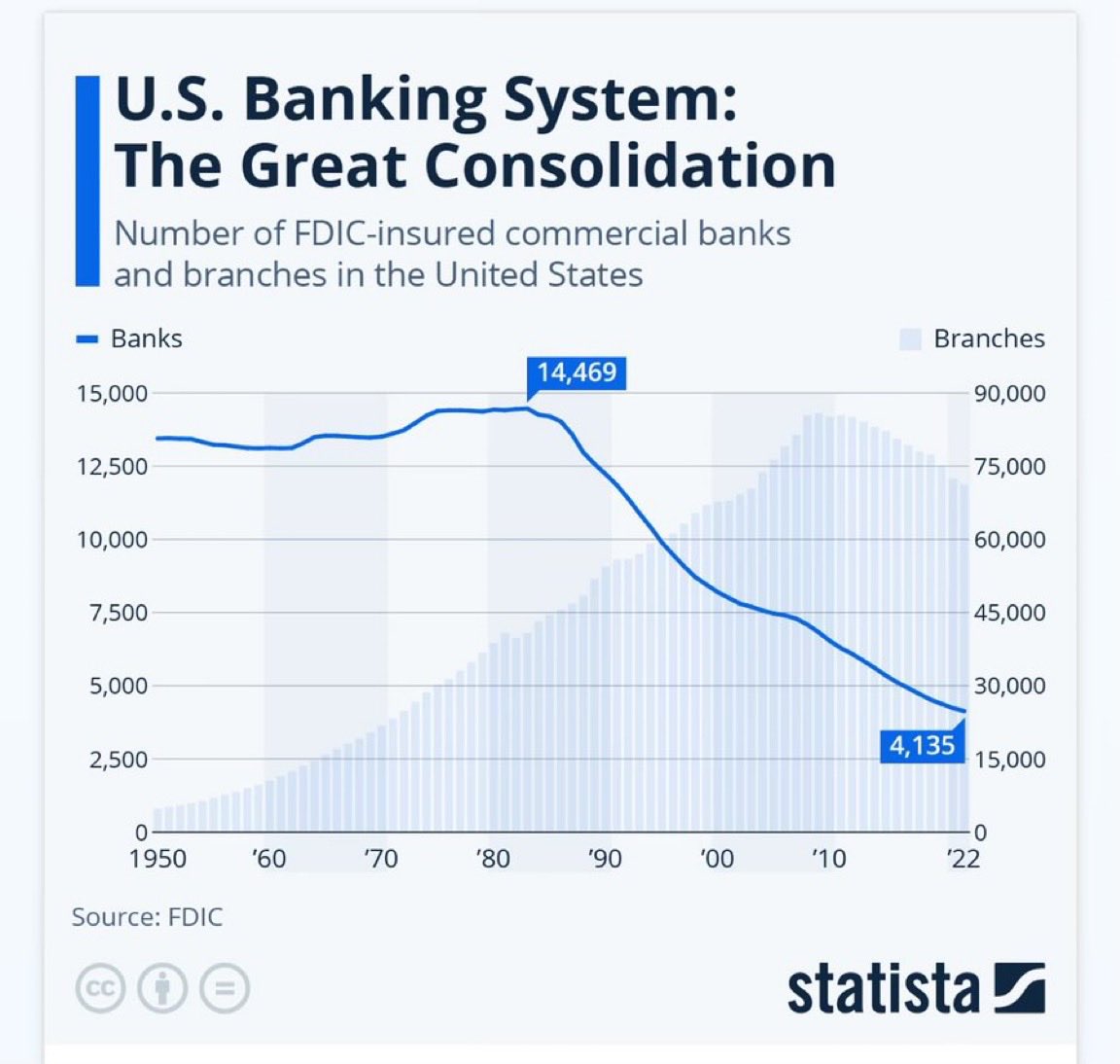
There were 14,000 banks in the 80s. There are 4,100 now. Every bank will be consolidated overtime. Buyouts of the remaining 4,100. Buy the cheap ones. Wait for a buyout. Profit. And recycle capital. That’s what I do.
The world is getting better!
But when I listen to activists, everything sounds dismal!
Why? Because:
“For activists, success is a threat,” explains @JohnTierneyNYC. “It's going to put you out of business unless you find a new cause.”
Charles Schwab ran the largest steel company in the world.
He had access to every consultant, every system, every productivity tool available in 1918.
He said a 15-minute conversation with a man named Ivy Lee was the most valuable business advice he ever received.
He paid him $25,000 for it. The advice fit on an index card.
Ivy Lee was not famous. He was not a philosopher or a scientist or a professor at a prestigious institution. He was a productivity consultant who had spent years watching extremely capable people fail to do their most important work, and he had developed a precise theory about why.
The theory was not complicated. It was uncomfortable.
The reason most people never do their most important work is not that they lack time. It is that they never decide what their most important work actually is. They arrive each morning at a pile of tasks with roughly equal claim on their attention, choose based on whatever feels most urgent or easiest in that moment, and spend the day moving through a list that was never designed to move them forward. They are busy in a way that feels productive and accomplishes far less than it should.
Lee asked Schwab for 15 minutes with his executive team. Schwab agreed. Lee walked them through six steps. He asked them to try it for three months and pay him whatever they thought it was worth.
Here is the system.
At the end of every workday, write down the six most important things you need to accomplish tomorrow. Not ten. Not twenty. Six. If you cannot decide what matters enough to make that list, you have already identified the real problem.
Prioritize those six items in order of their true importance. Not urgency. Not ease. Importance. The thing that will matter most three months from now goes first, regardless of how uncomfortable it is to start.
When you arrive the next morning, begin immediately on item one. Work on it until it is finished. Do not touch item two until item one is complete. Do not check email. Do not attend to whatever walked through the door. Item one, until it is done.
Move through the list in order. If you reach the end of the day and items four, five, and six remain untouched, move them to the next day's list without guilt. They were not the most important things. The most important things got done.
Repeat this process every day for the rest of your working life.
That is the entire system. Six steps. Four minutes the night before. No app required. No morning ritual. No tracking software. An index card and a pen.
What Lee understood that most productivity systems miss entirely is that the bottleneck in human performance is almost never capacity. It is prioritization. The average knowledge worker has more than enough hours in the day to accomplish something significant. What they do not have is a forcing function that makes them decide, the night before, in a calm moment free from the noise of the incoming day, what significant actually means for them tomorrow.
The morning is the worst possible time to make this decision. The morning brings email and notifications and other people's priorities and the accumulated urgency of everything that did not get done yesterday. By the time most people have decided what to work on, an hour is gone and the decision was made by their inbox rather than by them.
Lee's method moves the decision to the evening, when the day's noise has settled and the mind can assess without distraction. The prioritization is done before the chaos begins. Which means the next morning, there is no decision to make. There is only execution.
The second insight embedded in the system is the single-tasking constraint. Item one, until it is finished. Not item one until something more urgent appears. Not item one until you have checked in on items two through six. Item one, finished, before anything else receives your attention.
This runs against every instinct that modern work has trained into people. The entire infrastructure of the contemporary workplace is designed to fragment attention. Email expects a response within hours. Slack expects a response within minutes. The open office assumes that any question is more important than whatever the person being asked is currently doing. The result is a workforce that is in constant motion and making almost no progress on anything that actually matters.
Lee's method is a direct refusal of this dynamic. It does not negotiate with urgency. It does not make exceptions for whoever shouts loudest. It asks you to decide, once, what matters most, and then protect that decision from everything that will try to override it the next morning.
Charles Schwab ran Bethlehem Steel. He had seven hundred employees. He had more operational complexity, more competing demands, more legitimate urgency than most people reading this will ever face.
He tried the system for three months.
Then he sent Ivy Lee a check for $25,000 and a note saying it was the most valuable business advice he had ever received.
The system has not changed. The morning has not gotten less chaotic. The inbox has not gotten smaller.
The only variable that was ever under your control was what you decided the night before.
Six things. In order. Starting with the first.
The most valuable productivity advice in history is still free.
Most people will read it, find it obvious, and go back to checking email.