📣 Available for pre-order now Migration and Mobility in the European Union @Palgrave_ to be published on April 26 2020. @migrpolcentre @LeilaHadjAbdou @LeizaBrumat @RobSchuCentre @migprosp All the details at this link: https://t.co/wgIXPGzoj3
In our latest #SchumanShelf, @AndrewPGeddes presents his new book 'Governing Migration Beyond the State' comparing & analysing the drivers of #migration governance across different geographical areas
@EUI_EU@MPC_EUI
🎥Watch now! ⬇️
New working paper from @MPC_EUI Hanspeter Kriesi and @NenaOana look at Asylum policy preferences among the European publics : conflict configurations at the transnational and domestic level https://t.co/snCnwtJPbh
Post COVID economic recovery & labour market shortages in 🇮🇹 mean govt plans to double work permits issued in 2022 to 60-70k (were 100k in 2010). Support from business and unions, but likely opposition from right in government (Salvini) & outside (Meloni)
https://t.co/nopVPNbOI3
In seguito alla crisi dei rifugiati, città medio-piccole e aree rurali sono diventate nuove frontiere dell’integrazione: che futuro ha questo modello? L'articolo di @CaponioTiziana e @AndreaPettrach
https://t.co/HE4Dxlzicd
The European Commission has introduced new measures for processing asylum applications due to the ‘emergency situation’ affecting Poland, Latvia and Lithuania
Excellent overview of the politicisation of migration by @LeilaHadjAbdou from @MPC_EUI in the @EUI_Schuman video shorts series & lots of helpful links to follow if you want to follow up 📖
🧵If you are looking for recent critical, empirical, evidence-based research on migrant smuggling & irregular migration facilitation processes that go beyond "transnational crime" & "business model" tropes, this is some of the research & scholars whose work you must check out.
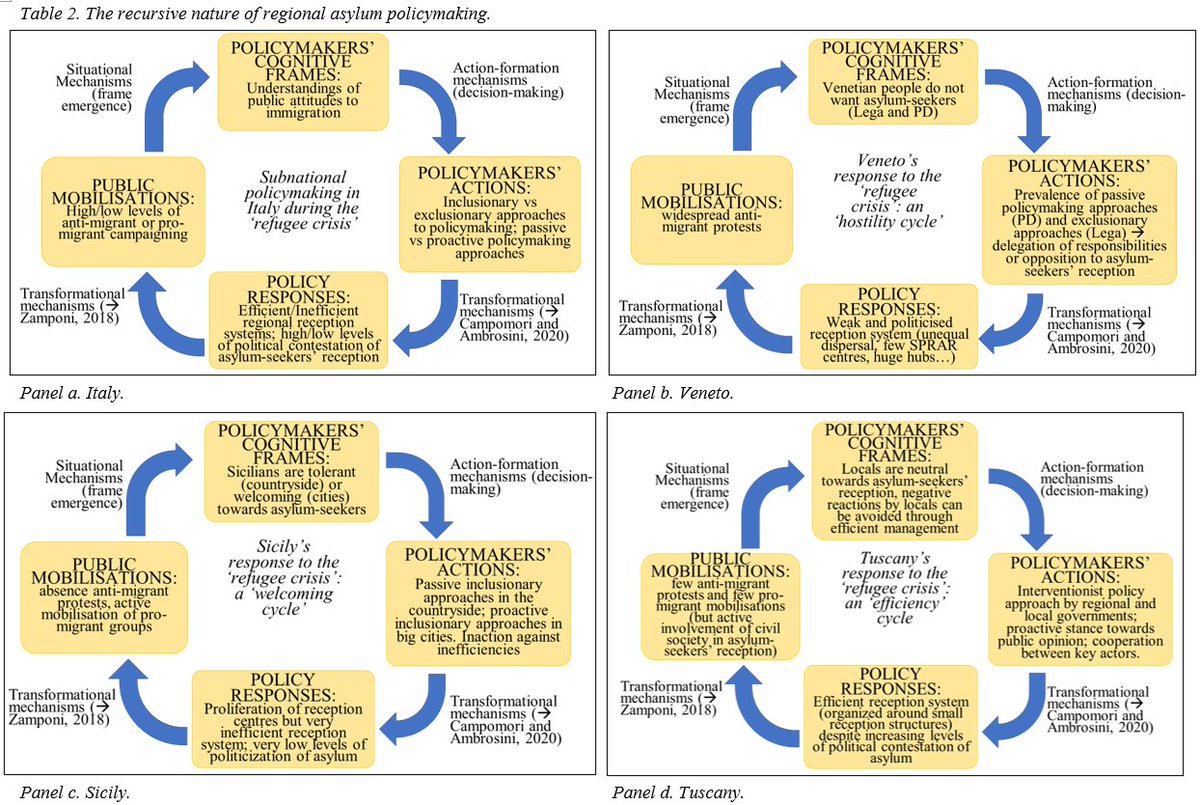
...but these mobilisations, scholars argued, were largely generated by the inefficiencies of reception systems (resulting from actors'actions/policies). Conclusion: policymaking had a powerfully self-referential circular nature, being both cause & effect of the 'crisis' itself...
Just out! ‘Responding to the ‘Refugee Crisis’ or Shaping the ‘Refugee Crisis’? Subnational Migration Policymaking as a Cause and Effect of Turbulence’. This article includes findings from my PhD and research conducted at @mpc@migprosp🧵https://t.co/uQ0B1i1UA9
This is an interesting map and important point. The numbers of people who are affected by international migration, e.g. family members who have migrated or migration as part of family history, is a much bigger number.
New @MPC_EUI working paper by @nikolaj_broberg and @lars_ludolph looks at effects of EU free movement on local authority spending in England - free movement (now migration) helped alleviate pressure on social care expenditure.
new blog by @JamesRDennison and me looks at how and why the EU's growing reliance on neighbouring states e.g. 🇧🇾🇹🇷🇱🇾 means that there's a fragility at the core of EU border and migration politics https://t.co/ranoEIg8gv
Tomorrow Wednesday 24th, webinar by PI @AndrewPGeddes on the Repertoires of #migration#governance and #EU responses to the #Afghan displacement crisis, with insights of his latest @migprosp book ‘Governing Migration Beyond the State’ registration 👇
The #COVID19 pandemic has certainly exacerbated the exclusion of certain groups of immigrants from public services, but some governments have adopted innovative measures to broaden social inclusion.
Read full post on the @MPC_EUI blog.
https://t.co/bpykUev7DP
More evidence on how “migrants” and “smugglers” are not two mutually exclusive categories, but are "co-constitutive, and produced by violent borders"" by @hcarrapico @augustovak @J_Obradovic_W
https://t.co/J5byapIHqS
How to achieve more effective common policies on asylum & #refugee protection? EU member states remain deeply divided on migration.
In view of #CoFoE, we take a closer look to this defining question for the #EU with @AndrewPGeddes & @MartinRuhs
📌 https://t.co/L0abvFHUCS