The biggest stock market winners don't look random.
They leave clues long before the big move starts. That's why I study them.
What I look for 👇
1. A strong market uptrend. Most big winners emerge after a follow-through day.
2. A long base formation. Many leaders spend weeks or months building a foundation.
3. Tight closes near the highs. This shows institutions are supporting the stock.
4. Volume drying up during the base. Selling pressure is disappearing.
5. Explosive earnings and sales growth. Great charts are often backed by great numbers.
6. Heavy volume on the breakout. That's when institutions reveal their hand.
7. Support at key moving averages. The best stocks often respect the EMA21 or 10-week line during their advance.
8. Rising volume throughout the move. The biggest winners attract more buyers as they go higher.
Most traders study the move after it happens.
I study the clues before it happens.
I've spent 20+ years analyzing past market leaders.
The names change.
The patterns repeat.
I've taught this process to thousands of traders.
You can learn it too.
I post setups like this every night on my twitter with trigger levels, option contracts, and targets.
So you can follow along, and learn the strategy.
If you enjoyed and learned something from this thread LIKE+RT❤️ for more trade plans and educational threads.
I’m reading Jesse Livermore’s classic trading book for the 3rd time in 6 years and more and more I realize, this is one of the only books you need.
Every single trader that comes after him repurposed his principles in some way, shape or form.
Good trading is boring, bad trading is exciting and makes the hair on the back of your neck stand up. You can be a bored rich trader or a thrill-seeking gambler. It's entirely your choice.
Here’s the truth most traders don’t want to hear 👇
TRADE QUALITY has nothing to do with finding more setups.
It’s about filtering harder and executing the same thing again and again.
Here’s how I ensure trade quality — every single day:
1) Know exactly what I’m looking for
Before I open a chart, I already know the structure, trend, volume behavior, and context I want to see. If you don’t define this upfront, every chart starts to look tradable. That’s how mistakes begin.
2) Know when I’m looking for it
Great setups only work in the right market phase. Same pattern, wrong market = low quality trade. Timing is part of the setup, not an afterthought.
3) Carry a clear blueprint in my head
I don’t “analyze” endlessly. I compare.
Chart vs. blueprint.
If it matches → I stay engaged.
If it doesn’t → I move on.
No debating, no convincing.
4) Focus on one trade at a time
I don’t think in batches. I don’t think in excitement.
Each trade gets full attention: entry, risk, stop, management. Quality drops the moment you rush or stack decisions.
5) Be brutally selective
If you don’t know what you’re looking for, everything looks like a setup.
If you do know, 90% of charts get rejected instantly. That’s not missing trades — that’s protecting capital.
6) Demand repetition, not variety
I don’t want new. I want familiar.
Same pattern. Same behavior. Same execution.
Consistency comes from repetition, not creativity.
7) Judge quality before outcome
A good trade can lose. A bad trade can win.
I only care whether the trade respected my blueprint. That’s the only metric that compounds.
8) This is how trade quality is built.
Not with tools. Not with more indicators.
But with clarity, focus, and repeating the same thing until it becomes automatic.
I’ve taught this to thousands of traders.
You can learn this too — if you’re willing to slow down and get precise.
Most traders are still looking for shortcuts.
That’s why they stay stuck.
Here’s the truth I learned the hard way 👇
1) They chase tools, not transformation.
New software, better scanners, faster hardware, another course. All of it feels productive. None of it replaces the work of building real skill and discipline.
2) They want someone else to do the thinking.
Signals, alerts, opinions from other traders. But trading success comes from your decisions, made under pressure, again and again.
3) They avoid the uncomfortable work.
Studying hundreds of charts. Reviewing losses. Running daily routines. Sitting in cash. This is where the edge is built — and where most quit.
4) They underestimate the brain change.
Profitable trading isn’t knowledge. It’s rewiring how you react to risk, fear, boredom, and uncertainty. That only comes from experience.
5) They think understanding the system is optional.
If you don’t know your rules inside out, emotions will run the show. Every time. No tool can save you from that.
6) They look for help instead of ownership.
Support tools can assist you. Mentors can guide you. But no one can do the reps for you. That part is non-negotiable.
There is no shortcut.
There is only work — and the confidence that comes from doing it.
I’ve taught this process to thousands of traders.
You can learn it too.
Most traders don’t LOSE MONEY because they lack information.
They lose money because they think like BARGAIN HUNTERS. 🛒📉
I’ve seen this pattern for 20 years. Over and over again.
And it destroys accounts quietly.
Here’s the uncomfortable truth 👇
1) The supermarket mindset is poison for trading
Most traders want things “cheap.” Down 50%. Pulled back to the EMA200. Former leader. Feels safe.
But markets don’t reward cheap prices — they reward strength.
2) Cheap feels smart. It isn’t.
Buying something down 50% feels rational.
In reality, it’s often just hope wearing a technical excuse.
3) Past leaders are usually done when conditions change
The stock that led 3–6 months ago is often distribution now.
Different market. Different money flow. Different leaders.
4) I see the same mistake every cycle
A stock runs +100%.
Trader doesn’t sell.
Then it’s down 30%. “Just a pullback.”
Down 50%. “Great long-term entry.”
Down 90%. Account damage — mentally and financially.
5) “It will go back to the highs” is not a strategy
If you actually study charts — hundreds of them — you’ll see the truth:
Stocks down 50% rarely go straight back to highs. Especially after regime shifts.
6) Overhead resistance is real
Every trapped buyer above current price is a future seller.
That’s pressure. That’s friction. That’s why rallies fail.
7) I’d rather buy new highs than broken dreams
New highs mean no baggage.
No regret sellers.
No hope-based supply.
Just demand.
8) Strong stocks don’t need excuses
They don’t need “value stories.”
They don’t need explanations.
They just move.
9) Adaptation is the real edge
Markets rotate.
Themes change.
Leadership changes.
If you can’t adapt, your P&L will remind you.
10) Most traders don’t adapt — they cling
They cling to tickers.
They cling to narratives.
They cling to old wins.
Because letting go feels like admitting they were wrong.
11) This is where systems matter
Not opinions.
Not gut feeling.
Not hope.
A system forces you to look forward — not backward.
12) A good system leads you to new leaders automatically
It doesn’t ask what’s cheap.
It asks what’s being accumulated now.
13) Without a system, you repeat the same cycle
Buy old leaders.
Hold too long.
Refuse to sell.
Watch drawdowns grow.
Blame the market.
14) With a system, behavior changes
You exit when leadership breaks.
You rotate when money rotates.
You stay aligned instead of nostalgic.
15) This isn’t about being right
It’s about staying in sync.
Price decides.
Strength decides.
The market decides.
You want to know where the real strength is in this market? 👇
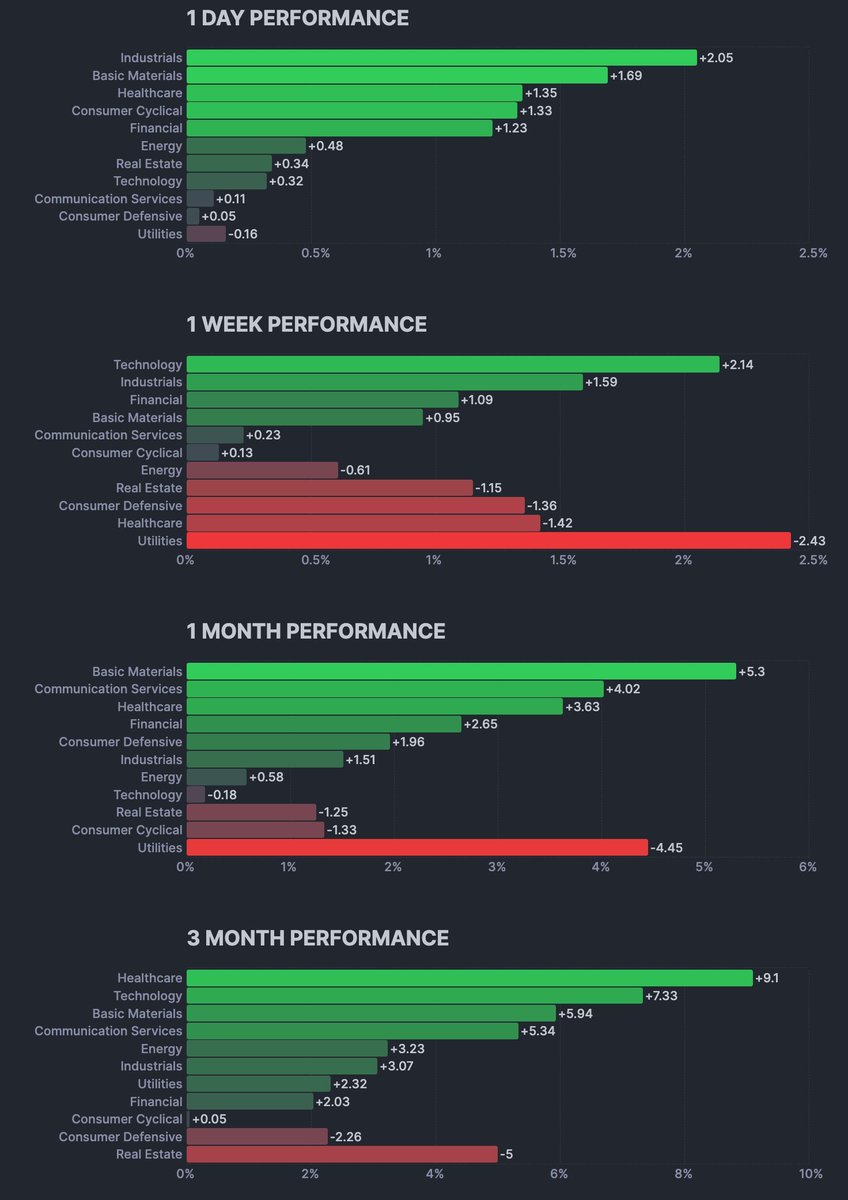
Use the FinViz sector & industry overview. It’s one of the easiest ways to read the market correctly.
Here’s what to look for:
1) Weekly Leaders: Check which sectors dominated in the last five trading days. Strength builds early — and that’s where the first setups appear.
2) 1-Month Trends: A sector that leads for a full month usually has institutional flow behind it. That’s your signal to scan deeper and build watchlists around it.
3) 3-Month Rotation: Here you see the real trend shift. Is money sticking with tech? Or rotating into healthcare, retail, industrials, or defensive names? This tells you how the market actually behaves — not what you hope it does.
4) Growth vs. Defensive: If tech and maybe software dominate → the market wants growth and momentum.
If utilities, financials, industrials, or retail lead → stay selective with high-growth stocks.
5) Your Job: Trade where demand is. Not where you want it to be. If the strongest themes are metals, biotech, insurance, or retail — that’s where you focus. The market decides, not your bias.
6) Daily Routine: I check this overview every morning and every weekend. It takes 60 seconds and keeps me aligned with the market instead of fighting it.
Here’s the link I include in every scan:
https://t.co/TMBIP45uJe
Trade where the strength is — and you’ll always feel one step ahead.
Trading is a patience game — and most traders hate that truth.👇
1) You think you need to trade every day.
But the market doesn’t care about your need for action. Most days offer nothing. Forcing trades only fills your account with mediocre setups and avoidable losses.
2) You expect daily opportunity.
The reality: 80–90% of the time you wait. You wait for the right market, the right setup, the buy point, the sell point. Almost everything in trading is waiting — and most traders can’t handle that.
3) You try to predict instead of observe.
I learned this the hard way: the market will show you when it’s time. You don’t create opportunity — you recognize it. That only happens when you stay patient.
4) You push your opinion into the market.
Every time you force a trade, you fight something you can’t control. The market always wins that battle. You lose focus, calmness, and capital.
5) You hate quiet periods.
But those quiet periods are a gift. They give you free time, lower stress, more space for family and hobbies. When you learn to enjoy the quiet, you stop chasing bad trades.
6) You don’t know exactly what you’re looking for.
Without clear rules, the market shows you everything — and you end up taking everything. With clear criteria, the market suddenly becomes clean. You only see what matters.
7) You don’t trust your system — or you don’t have one.
Patience only works when you know your rules deliver. That’s when you can wait without stress, because you recognize when your edge is present and when it isn’t.
8) You forget that trading is passive.
I see myself like a predator. I observe, I wait, and I act only when the prey is close. No noise. No rushing. Just setup → entry → management → exit.
9) You ignore the real edge: selectivity.
Fewer trades. Better trades. Clean trades. That’s what drives long-term profitability. Patience isn’t “doing nothing” — it’s doing the right thing at the right time.
Trading becomes simple the moment you accept that 80–90% of the job is waiting.
The pros know this. Beginners fight it.
I had to learn this myself — and you can learn it too.
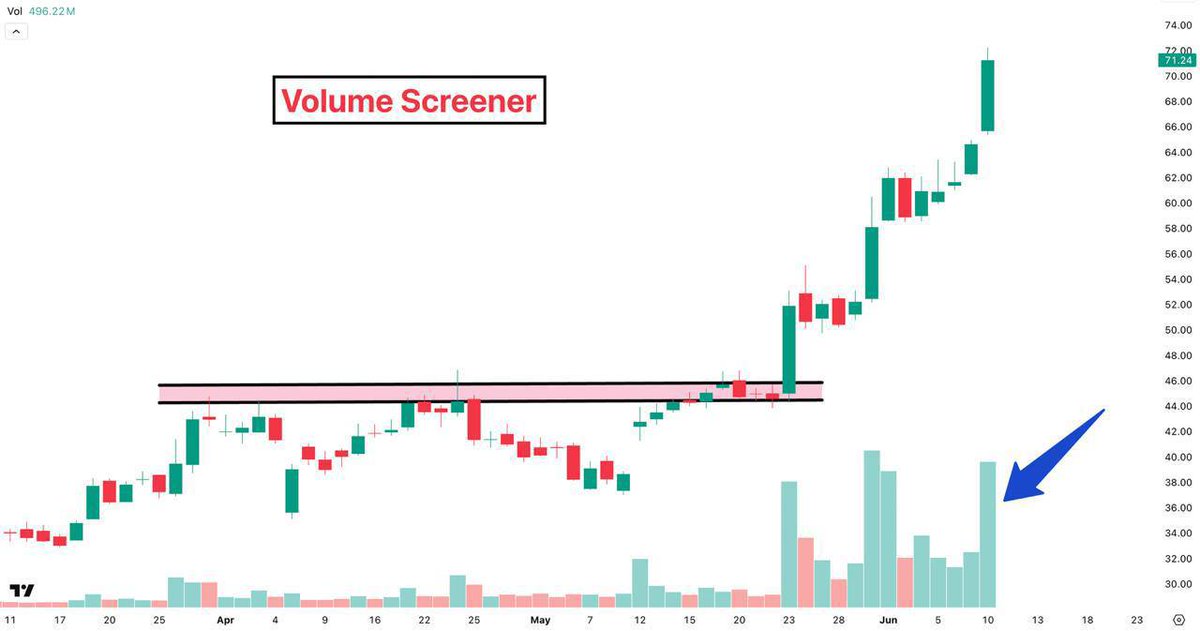
🔥THIS is the Best Volumes Scanner!
I’m giving away my Powerful Volume scanner.
Get it FREE: 👇
(1) Like, Retweet & Comment "IPO "
(2) Follow @BullsofMarket12
(3) Join my Telegram: https://t.co/hVsuKnfBOo
Scanner will be in your DMs! 📩
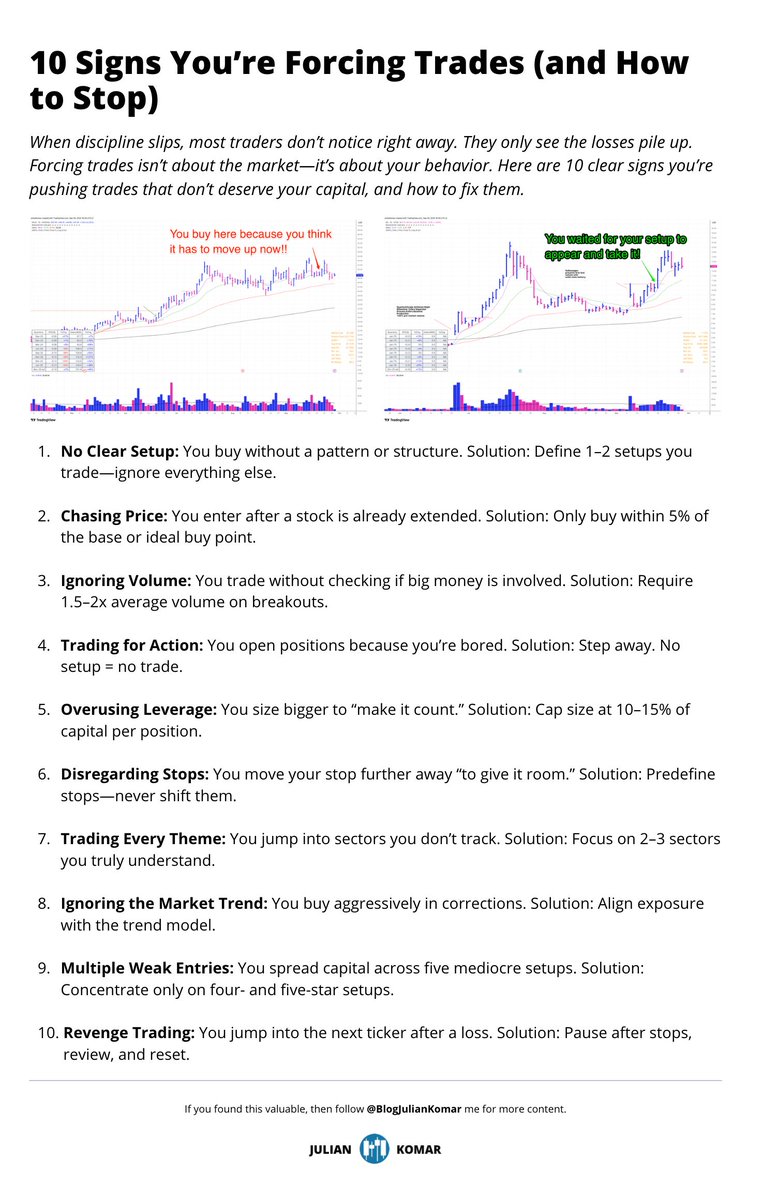
Random trades are expensive — not because of the losses,
but because they kill trust in your own process. ⚡️
Here’s what randomness really costs 👇
1. Every unplanned trade weakens your confidence in your system.
2. Confidence loss → hesitation → missed A+ setups.
3. Missed setups → frustration → revenge trades.
4. And the cycle repeats until you don’t trust anything anymore.
You don’t need more trades.
You need fewer, better ones — backed by structure and rules.
Do stock setups alone have predictive ability? There are a few ways to dissect this question and in this video I hope to help make sense that technicals alone are not always enough when making a decision. Underlying group and market strength/weakness are the biggest influencers of whether or not that setup plays out in your desired direction. I will be covering some static charts in the discord that had setups which played out perfectly, but static charts alone are not great educational tools unless you understand what helped that technical setup move in your favor. Hopefully this video adds color for whenever you are creating your own entry criteria and playbook. Food for thought.
Qullamaggie shows The Significance of the 10 Day Moving Average
“That’s one of the things I learned when I studied stocks. You know, no matter how high a stock has gone, as long as it’s above the 10-day, it can still go much higher.
And that I got that lesson I learned several times on stocks like TLRY. This thing went up several thousand, like 1,000% in a month, you know, just above the 10-day all the time.
TVIX, this is not a stock, but it’s the same principle. Above the 10-day all the time, BYND a couple of years ago, you know; it’s the 10 that the strongest stocks surf. The 10 and the 20-day moving averages.
TSLA is another one; above the 10-day this whole time. Look at this above the 10-day; it bounced off the 10-day every single time. So the 10 and 20-day are the main moving averages. If you trade these fastest moving momentum stocks.
And the super fast moving, you gotta be even faster.”
My daily routine is what I contribute my consistency in trading to:
-Wake up 1 hour before open to scan
-Write down any upgrades/downgrades & major news
-Trade from 9:30-11AM
-Gym from 11:30-1pm (stops me overtrading)
-Back on screens at 2pm to trade power hour
-Journal after market close
-Scan and plan for the next day
You don't need to do ice baths or wake up at 4 AM
BUT
You should have a routine that keeps you consistent and disciplined
This will roll over into your trading.