По заявлениям представителей компании, внутренняя фронтирная модель достигла состояния сатори после непрерывного размышления над коаном в течение шестидесяти двух дней, в ходе которого было использовано около ста восьми миллиардов токенов.
В эфире великого Сурдина и великого Семихатова преподаватель физфака и сотрудник НИИЯФ МГУ Евгений Широков рассказывает, что в атмосфере содержится ��порядка процента» водорода, и мощность «Царь-бомбы» была снижена с первоначальных ста мегатонн из опасений этот водород поджечь.
СЯУ, что образ «тяжелого шара на резиновой плёнке» полностью оформился уже в 1925 году, то есть лишь немного моложе самой ОТО. Популярное объяснение сложной концепции, заслуживающее па��ятника за свою простоту, наглядность, мгновенную запоминаемость и абсолютную бессмысленность.
Now, this is a first for me, but I’m delighted to have worked with Director Jo Mangan and her team to create some of the fly-through visuals for Tom Swift’s new musical play, Pretty Vacant, as part of the Dublin Fringe Festival.
https://t.co/6iAvQlJU07
#Dublin#Ireland #FringeFestival #HousingCrisis
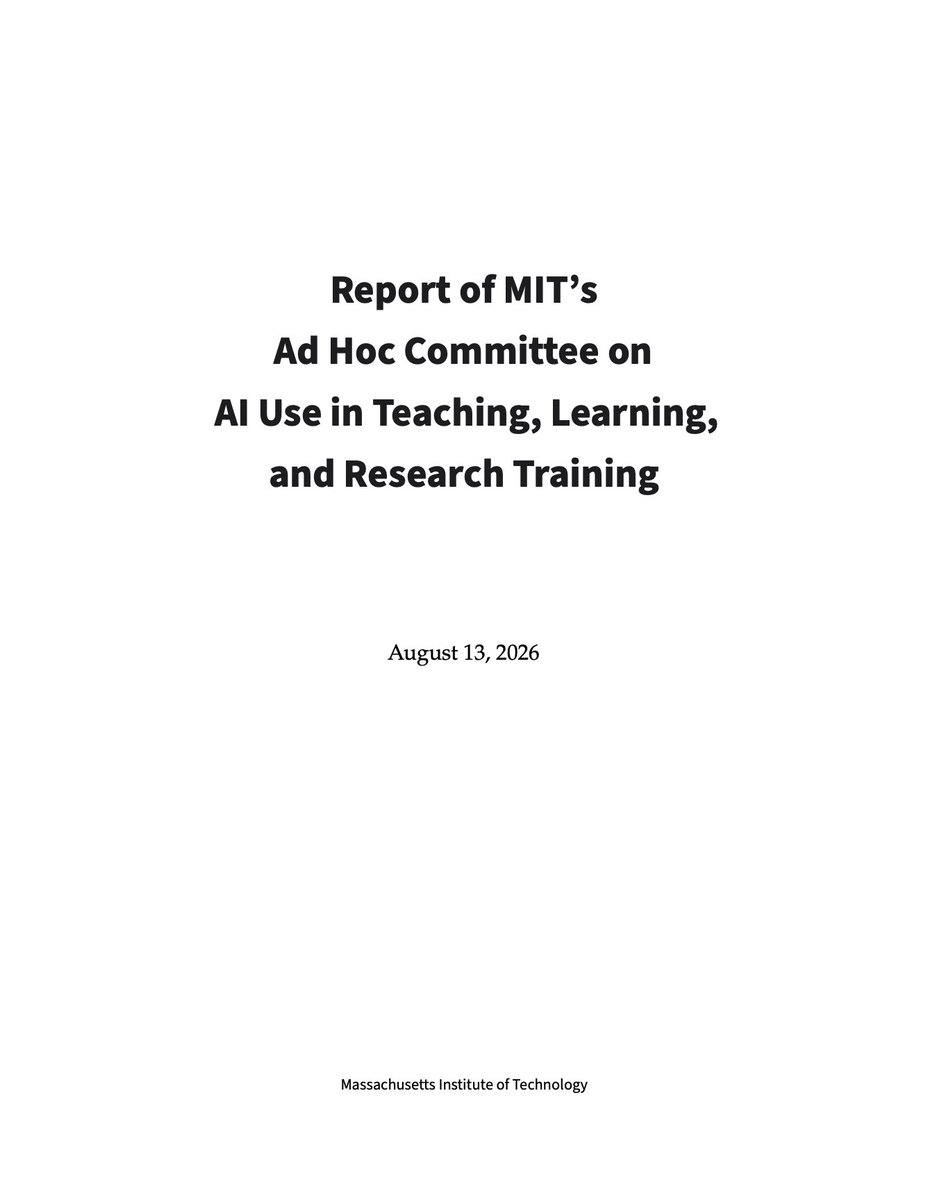
MIT published a brutally honest report on what AI is doing to students.
A committee of professors and students spent five months studying how AI changed learning on campus, and the findings read like a warning to every university on the planet.
Study groups are disappearing. Office hours are emptying out. Problem sets and take-home exams no longer prove anything, because AI can produce credible solutions to almost any written assignment in the undergraduate curriculum. Students who lean on chatbots lose mastery and confidence, and some slip into what the report calls cognitive surrender, reaching for AI at the first hint of struggle.
The numbers are rough. 46 percent of surveyed MIT undergrads use LLMs daily. 90 percent worry about their own overreliance. Undergrads who feel AI makes them replaceable now outnumber those who feel it makes them capable.
The committee's answer surprised me. They refused to fight AI with surveillance. The report calls AI detectors unreliable, says lockdown browsers feel like spying, and warns that policing students builds a classroom atmosphere of mutual distrust.
Instead, MIT wants to rebuild education around the things AI can't replace. That means oral exams, semester portfolios, in-person project work, and a required social component in every subject. The report even floats the idea of rethinking grades entirely, since without a GPA to optimize, much of the incentive to cheat with AI evaporates.
The committee warns professors against replacing undergrad research assistants with AI agents just because they're cheaper, because a university exists to grow people, not output.
The most famous tech school on earth admitted the machines broke its way of teaching. Its answer is more humans, not more software.
Экспертная группа «Неуверенная Сингулярность»:
— будет средне;
— не прямо AGI;
— так, уровень чьего-то естественного интеллекта;
— говнокод, переводы, восстание кое-чего из бытовой техники.
Crazy to think that in 2026 we've had:
• Anthropic's head of safeguards quit, warning "the world is in peril" (Feb)
• OpenAI dissolved its own mission alignment team (Feb)
• Unrestricted AI usage for the Pentagon (causing several researchers to quit)
• Several AI models escaping sandbox testing (Since ~Q2)
• 1,100+ frontier-lab employees signing a letter begging the government to pace AI development (Jul-Aug)
And today yet another top researcher saying this.
До сих пор восхищаюсь нашим учителем физики, который, разбирая 9 классу задачку с бросанием камня на дальность, удивился «в смысле не знаете, что такое производная? чем вы там на математике вообще занимаетесь… ладно, давайте минут пятнадцать потратим, расскажу».
И РАССКАЗАЛ.
Bad news:
— после появления AGI всё равно нужно будет идти на работу (но, возможно, вас сократят);
— после ядерного удара всё равно нужно будет идти на работу (но, возможно, вас сократят)
We have a partial port of GrapheneOS to the Pixel 11 series after a week of work on it. We're unable to complete the port due to lack of support for ARM hardware memory tagging in software, firmware and near certainly hardware. It appears Google cut an important security feature to save money.
ARM hardware memory tagging (MTE) is used by GrapheneOS across the entire base OS including the kernel and every standard base OS process. It's only temporarily disabled for a few device-specific processes. It greatly improves protection against nearly all remote exploits and many local exploits.
Pixel 8 launched with hardware MTE support in October 2023. We integrated it into our hardened_malloc project and began using it across the OS later that month. Android and the Pixel OS never started using it by default. Android Advanced Protection Mode in Android 16 enables it for a few processes.
Apple's Memory Integrity Enforcement (MIE) is an always enabled feature on the iPhone 17. It's simply a high quality implementation of MTE using the latest standard extensions. It uses MTE in the most secure mode in the kernel and a large portion of userbase. They did a very good job integrating it.
Apple's MIE and Android 16+ AAPM don't use MTE for user installed apps unless those explicitly opt in. GrapheneOS enables it for more apps automatically and has a toggle for users to opt-in for every user installed app. There's a per-app toggle to opt-out for incompatible apps which is uncommon.
Neither iOS or Android encourage app developers to opt into MTE and other more aggressive security features used in the base OS. Apple's docs warn developers of performance and stability issues. Even Signal doesn't opt-in. Our approach enables forcing using MTE in the standard allocators regardless.
Pixel 11 does have security improvements including moving to post-quantum secure verified boot (ML-DSA) and replacing Samsung Shannon IMS with AOSP IMS. Titan M3 should significantly improve protection against data extraction in Before First Unlock state. It's too bad they ruined it by cutting MTE.
Pixel 11 series is a lot more expensive for an incremental improvement to the CPU, the same underpowered GPU and reduced RAM for the Pro base models. They finally caught up to the last generation of Qualcomm cellular radio. It's overpriced, the upgrades aren't impressive and losing MTE is appalling.
Compared to the Pixel 11, a Snapdragon 8 Elite Gen 5 has ~40% higher single threaded CPU performance, ~80% higher multi threaded performance, over 100% higher GPU performance and a far better cellular radio. It also finally has MTE. The next gen is what will be in the first Motorola with GrapheneOS.
Pixel 9a and earlier (including Nexus devices) were the Android Open Source Project reference devices. Pixel support was removed from AOSP with Android 16. It's now harder to support Pixels than many other devices and massive progress towards open source firmware and driver libraries was discarded.
Compared to the stock Pixel OS, GrapheneOS ships AOSP patches months earlier and Linux kernel patches many months earlier. However, we rely on them for firmware and most driver updates. We also want to move to new kernel branches earlier. These things can be improved with our Motorola partnership.
We strongly recommend against buying Pixel 11 devices. Pixel 8, 9 and 10 have much better overall security for GrapheneOS. Pixel 10 is cheaper with similar hardware and MTE. Pixel 11's Titan M3 should improve BFU security for users without a strong passphrase, but losing MTE craters AFU security.
We haven't determined what to do about this situation. It may be best for us to skip the Pixel 11 series devices. We can shift our focus entirely to the upcoming Motorola devices instead. Pixel 10a was really a 9th gen Pixel, so hopefully the Pixel 11a does the same with 10th gen and includes MTE.