$AMD is easily a $1,200 stock IMO| CPUs TAM 🧵
Not Financial Advice! DYOR!
In this thread, I want to discuss the actual TAM for CPUs data center for just 2026, where many are giving different ranges, where I don't agree with. I will explain in detail why I disagree with these research firms and financial analysts using Math. And this thread should not be treated as Financial Advice. I'm just explaining my research and thought process so we can have a discussion.
In 2024/2025, I gave out $620 PT for FY2026 was too conservative for AMD potential. At the time, It was early and many were just laughing, that PT was unrealistic and the AI world is run on GPUs only. Today, most of these folks are laughing with me. That is ok, I dont offer financial advice, and I do not need everyone to agree with me. I respect other opinions.
If you enjoy this kind of thread, slap the like/repost/bookmark.
If you want to support my work further and gain more in-depth analysis, consider subscribe!
In early 2026, hyperscalers, enterprises, and OEMs are scrambling as Intel and AMD server CPUs are largely sold out for the year, with prices jumping 10–20% and lead times stretching from weeks to months (or longer for certain SKUs). What was once a GPU dominated story has flipped: the shift to explosive Agentic AI with its multi-step reasoning loops, tool calling, multi-agent orchestration, real-time data movement, and reinforcement learning, is dramatically tightening CPU:GPU ratios from the old training-era 1:4–8 all the way to 1:1 to 5:1 or even CPU-heavy configurations. CEOs across NVIDIA, AMD, Intel, Google, Meta, Microsoft, and public companies have been sounding the alarm on CNBC, Bloomberg, and earnings calls. CPUs are “cool again,” and in many agentic deployments they are becoming the new bottleneck alongside (or even ahead of) GPUs and custom ASICs.
In 2025, roughly 12-15m AI GPUs + AI ASICs GPUs shipped, and is expect to be 15-20m units by 2026, where it suggesting Training demand is not going away. The actual TAM is structural, multiplicative demand that has already forced AMD to double its long-term server CPU TAM forecast to >$120 billion by 2030 (>35% CAGR), with Dr. Lisa Su noting Q2 2026 server CPU sales expected to surge 70%+ year-over-year and demand “far exceeding expectations.”
At the same time, AMD’s secured 30–40% share of TSMC’s initial 2nm capacity (behind only Apple’s >50%) positions it to ramp Zen 6-based EPYC Venice exactly when this agentic wave hits hardest but even that aggressive five-fab 2nm expansion (with plans scaling toward 11 total advanced facilities) cannot instantly close the gap in the near-term. Supply constraints on wafers, advanced packaging, and power are compounding the squeeze, just as hyperscalers forward-buy and lock in long-term deals.
1. The actual potential TAM
Various sources and institutions are giving $50-$160-$200B CPUs TAM toward 2030, and i disagree, where supply is severely behind vs Demand by at least 2-3 years or even longer by some estimates.
The actual TAM will probably be 15-20m for FY2026. The typical average selling price from low to high end is $5,000 to $15,000, but due to rising memory, and different inflationary pressures on Semi, it would be more logical to think between $7,000-17,000.
A. CPU:GPU Ratio at 1:1
A basic calucation at mid range
=12,000 x 15-20m CPUs= $180-$240B TAM
B. CPU:GPU Ratio at 5:1
= $12,000 x 75m-100m CPUs= $900B-$1.2T TAM
Of course TSMC cannot even supply 20% of this massive inflection TAM in 2026. But do we think of Demand for TAM or Supply for TAM? Hence we are seeing massive 2nm Ramp from TSMC for $AMD.
IMO, conservatively, I would take down 15-20% on 1:1 or $135-$192B TAM for just 2026. Im not even talking about 2030.
We are just months into this, it is impossible to estimate Cagr atm, but this is 1-5 agents running tasks, I wrote a thread on 24/7 autonomous agents thread, where companies could use 50-250 agents to run tasks for them 24/7. It would require a different structural CPU:GPU to bring down the cost of token as well as handling the Orchestration bottleneck. GPUs would be useless and sit idle waiting for CPU due to highly CPU-intensive nature.
The cost per Million tokens must come down more rapidly for this 50-250 autonomous agents to work, otherwise the token cost would be too enormous.
Helios Rack is estimated to bring inference cost down to $0.0003-$0.0005/M tokens with 18 EPYC Venices along with 72 MI455x and other chips+ Components.
A heavier or CPUs dense rack would bring down inference cost further.
EPYC Verano(2027 gen 7 AI-optimized) is expected to drive inference costs meaningfully lower than the Venice baseline likely to the $0.00002–$0.00025 per million tokens range (or even sub-$0.00015 in highly optimized agentic/batch workloads).
Verano have higher core counts than Venice, LPDDR5X SOCAMM2 memory support, more AI optimized and Next-Gen rack density & efficiency.
2. $AMD secured at least 30-40% of TSMC 2nm capacity and Memory from Samsung through 2028-2030.
2 2nm fabs are entering ramping phase toward 60-65k wafers per months and 5 dedicated 2nm fabs entering mass production/ramp in 2026. Will link sub threads below if you are interest for full detail.
Apple is reported to secure 50%+ 2nm capacity for Iphone 18 and Mac chips and AMD secured at least 30-40% capacity while $NVDA $AVGO $ARM $AMZN $GOOGL and others are on 3nm.
This broader aggressive ramp from TSMC to target up to 11 fabs is to address $AMD massive growth ahead. Where $ARM is facing massive CPUs supply constraints as they have to compete with other Mega Cap players on 3nm allocation. And $INTC is also facing supply constraints for data center CPUs and PC per management with lead times extrended to longer than 12 weeks.
Dr. Su is aiming for higher than 50%+ Market share, and I believe it is achievable in 2026 or 2027 as AMD has the strongest CPUs offerings. Dr. Su did not want to take advantage of the shortage and she said during the Q1 earning call, AMD is prioritizing Units shipped while guiding margin to be inching 60%. If Jensen were in charge, I'm sure margin would be 70-75% in this kind of severe CPUs shortage condition. But that is not how Dr. Su operates for more than a decade. She wants most market share. So we will see it in revenue growth, but as TSMC ramps faster and faster, AMD Operating and FCF margin will massively improve vs prior decade. A significantly higher margin profile than before.
3. How I came up with $1,200 withint 12-18 months?
At $1,200/ share, that would be around $2 Trillion MC.
I expect FY2027 revenue to be $124-$144B where data center revenue dominates overall revenue.
AI GPUs: I will stick to the lowest end so show u that I'm conservative at $18B for each GW vs $NVDA Rubin is $30B+ (most likely Helios Rack in the $20B+ due to memory price rising). We know deals with @OpenAI and @Meta are around 12GW and additional multi-customers at multi-GW scale were hinted and will be revealed as we get to July 22-23 2026 Advancing AI event. For now I will conservatively add a bit more to this model. (3-6GW Helios Rack Range)
EPYC Venice is reported to be in $15,000-$20,000. However large customers will likely to enjoy $10-$12k discount. I expect AMD to be able to ramp 7m EPYC Venice for entire 2026 and 3-4m of EPYC Verano(higher price than Venice). If we take an average selling price of $10,000 to be on the conservative side. Take down another 30% to be even more conservative on projection. I like to be conservative. That would be ~ 7m EPYC CPUs(Venice + Verano) for FY2027 or 583,000 units per month or 15,000 additional 2nm wafers per month which is completely reasonable for current TSMC Ramp, and I may be too conservative here.
EPYC Verano and MI500 series will also be on 2nm.
AI GPUs: 3GW x $18B= $54B
EPYC CPUs: $10k x 7m CPUs= $70B
= Data center revenue alone is $124B
Other segments= probably in the $20-$25B FY 2027.
FY2027 revenue = $124-$149B
At 7m EPYC CPUs for entire 2027, that would be more than 50% market share when we comp it to availability from supply side, not from total Demand. It is possible that TSMC could significantly ramp even more capacity in 2027, so we will see.
Metric Q1 2026 FY2027
Gross Margin 55-56% 60-62%
Operating Margin 25-26% 32-35%
Net Income Margin ~22% 26-30%
FCF Margin 25% 28-30%
At $124-$149B Revenue FY 2027
Net Income would be $32-$44B
EPS would be $20-$27 (GAAP)
Non-GAAP would be $25-$31
At $1,200 a share or $2T valuation that would be:
13.4-16x Price to Sales (P/S)
38-48 P/E
At this kind of growth of AI SuperCycle, I think it is very reasonable valuation.
If we use today at $406/share or $661B MC:
2027 P/S = 4.4x-5.3x
2027 P/E = 13x-16x
Is AMD today expensive or cheap to you?
Above is already a very conservative where I trimmed 20-30% of doable units. Meaning, there could be upside if TSMC is able to ramp meaningfully like they are planning.
Conclusion:
A $1,200 per share valuation IMO for AMD in FY2027 is not expensive at all; it is, in fact, conservative when viewed against the structural explosion in agentic AI demand we have mapped out.
With server CPU TAM potentially scaling into the $100–$200B+ range in just CPU:GPU 1:1 Ratio for just 2026. AMD positioned to capture 50%+ share thanks to its 2nm TSMC allocation advantage and full-stack leadership, the company could realistically deliver $124–149B in total revenue and $25–$31+ non-GAAP EPS. At those levels, $1,200 implies a 2027 P/E = 13x-16x. Entirely reasonable for a company that will have become the clear Inference Queen (and in many workloads the preferred) AI infrastructure provider, with operating margins expanding above 30% and tens of billions in high-margin rack-scale AI revenue.
Dr. Lisa Su was right presciently so about the Agentic AI inflection all the way back to her early 2022–2023 commentary on the coming shift from pure training to inference and orchestration-heavy workloads. While the broader market only fully woke up to this in 2026 when she doubled AMD’s long-term server CPU TAM forecast to >$120B by 2030 (with >35% CAGR), Dr. Su and her team have consistently positioned the company at the center of the CPU renaissance. The explosive demand we are seeing today, sold-out lines, rising ASPs, and hyperscalers forward-buying entire gigawatts of Helios-class systems is exactly the outcome she forecasted years ago.
Not Financial Advice! DYOR!
$AMD shareholders when both $INTC and $ARM are facing severe CPU supply constraints and Dr. Su secured at least 30-40% 2nm capacity & memory through 2028.
@AnthropicAI should have like $230-$240B Cash after IPO and SI bears would still call bankruptcy or Bubble.
At this point it is ok to accept most SI bears are selling courses.
Anthropic has more cash and cash equivalents than Amazon… I don’t understand why people keep spreading fearmongering FUD about Anthropic going bankrupt.
@zephyr_z9 Silly analysis.
Robot RAM needs will exceed everything else on Earth, as you need the robots to be on physical substates in order to shape atoms.
Super intelligence needs will vastly exceed that, but ~100% of SI will be deep space compute. Obviously.
I am shocked, absolutely shocked, that Anthropic ARR has likely gone vertical in October after they cut token prices.
Except the exact same thing happened for the entire AI market, which is why GPU rental prices have surged while token prices declined.
$100b plus in year-end ARR looks possible again.
BREAKING $AMD | $TSM CoWoS advanced packaging prices are reportedly set to rise by up to 20% amid tight capacity driven by surging AI demand.
Zhang Jiarui in Taiwan’s Commercial Times, reports that TSMC is preparing another round of CoWoS (Chip-on-Wafer-on-Substrate) price increases of roughly 10–20%. This follows strong demand that has already extended some packaging lead times and kept capacity under pressure.
Demand drivers
Capacity constraints originally centered on AI GPUs are spreading to server CPUs and custom ASICs. Unmet orders continue to grow. Longer test times for AI chips are simultaneously stressing packaging and testing capacity at both foundries and OSAT (outsourced semiconductor assembly and test) firms.
Pricing and customer behavior
Supply-chain sources say TSMC’s CoWoS quotes are under upward pressure. Equipment customers are prioritizing delivery over price; many are no longer negotiating and will place orders as long as lead times can be met. TSMC itself has not reopened price negotiations for equipment this year and is purchasing at existing prices without demanding extra features easing margin pressure on suppliers.
Lead times and bottlenecks
Equipment delivery has stretched from the previous 3–6 months to 6–8 months. Upstream components and processing capacity are tight and hard to expand quickly. Building a new advanced-packaging plant from groundbreaking to full loading of bottleneck stations takes about three years. Bottlenecks shift among process steps such as lithography, development, and die bonding; even after equipment is installed, calibration and qualification are required before stable output.
TSMC’s technology and capacity plans
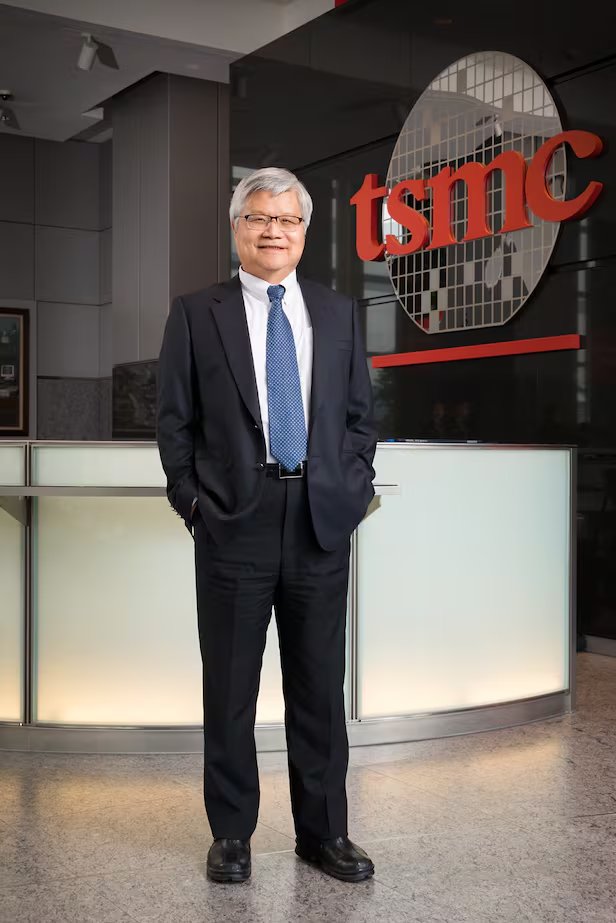
Chairman C.C. Wei has stated that CoWoS remains customers’ preferred solution. Five times reticle size packaging is already in volume production with strong yields. TSMC is developing nine and fourteen times reticle size options and advancing CoPoS technology for larger packages and lower cost. Broader AI chips that integrate more compute dies plus HBM (high-bandwidth memory) increase package area and complexity; larger dies also reduce equipment throughput, which can further raise the number of tools required.
Capacity targets
Institutional estimates point to CoWoS monthly capacity exceeding 130,000 wafers in 2026 and double in 2027. Expansion includes phased work at Chiayi AP7, equipment installation at Tainan AP8 P2, SoIC capacity growth at AP6, and a planned U.S. AP1 advanced-packaging plant targeted for production in 2028.
$AMD | Why Bears CANNOT stop AMD going to $1,200 FY2027 🧵
Not Financial Advice! DYOR! I do own AMD shares!
$AMD MC: $863B. At $529/share
FY2027 PE is 21-26.4x
$NVDA MC: $5.2T. At $215/share
FY2027 PE is 20-23x
AMD now has the best CPU GPU APU NPU, full SI solutions for all AI labs, Hyperscalers, and Enterprises.
And I quoted Elon Musk recently stated:
"Agentic demand is growing faster than I’ve ever seen anything grow" = Extreme Hypergrowth for CPUs
AMD CPU Rack (Helion) will be shipping from November 2026. AMD Helios Rack is now shipping at scale to customers $META $MSFT @OpenAI@AnthropicAI G42 5C Humain TensorWave HPE Dell and many others.
Dr. Su aims for 50%+ market share on CPU server and a major player of GPUs(analysts are projecting 20-25% market share) .
AMD’s long standing investment in chiplet architectures is delivering structural advantages over @nvidia in the AI accelerator market, particularly visible in the Instinct MI455X versus Rubin comparison. AMD pioneered disaggregated designs with its EPYC and Ryzen lines, separating high performance compute dies from I/O and cache functions so that each can use the optimal process node. Leading edge nodes are used only where density and performance matter most, and more mature higher yield nodes are used elsewhere. This modular approach, stitched together via Infinity Fabric and advanced packaging, produces higher manufacturing yields on smaller dies, lower cost per yielded transistor, faster product iteration, and the ability to scale capacity simply by adding more chiplets.
$NVDA has adopted multi die packaging, as in Blackwell’s two dies and Rubin’s dual compute dies joined by NV HBI, primarily as a workaround for reticle size limits, but it remains less modular and more performance oriented at the expense of cost and flexibility. Analysts note that AMD’s greater experience with chiplets can offset some interconnect power and performance penalties while enabling broader product segmentation and independent optimization of compute, memory, and I/O.
These benefits appear most clearly in memory capacity and rack scale scaling. The MI455X, built from roughly two dozen chiplets including eight compute dies on TSMC 2 nm, fabric and cache dies on 3 nm, and associated I/O, supports 12 stacks of HBM4 for 432 GB of capacity and 23.3 TB/s peak bandwidth. By contrast, NVIDIA’s Rubin uses fewer stacks, typically eight, for 288 GB and lower effective bandwidth after the company reduced HBM4 pin speed from 11.7 Gbps to 9.3 Gbps. At the system level, a 72 GPU AMD Helios rack pools roughly 31 TB of HBM4 versus about 20.7 TB in NVIDIA’s Vera Rubin NVL72. The extra capacity and bandwidth density support larger models, longer contexts, and higher concurrency inference with less reliance on multi GPU sharding or offload, exactly the workloads that dominate current AI demand. Chiplet modularity also allows AMD to partition a single package into one large GPU, two smaller ones, or up to eight virtualized accelerators, adding deployment flexibility that a more rigidly paired multi die design does not match as easily.
NVIDIA retains strengths in peak low precision matrix throughput on certain formats, its tightly integrated CUDA software ecosystem, and scale up networking maturity. AMD’s chiplet strategy, however, positions it as the more cost effective and capacity scalable alternative at a time when memory capacity and system level memory pools are becoming primary constraints for frontier models. The manufacturing flexibility of smaller dies also supports faster volume ramps once process yields stabilize, which matters as both companies fight for limited advanced packaging and HBM supply.
On October 6, 2026, during a visit to Taipei and South Korea, AMD CEO Lisa Su told reporters that the company had already increased its supply through 2026 but that demand remained higher than available output. She stated that AMD plans to substantially increase its supply in 2027 and that the company could still use more capacity. Dr. Su explained that AMD now plans three to five years ahead with partners, rather than one or two years, so that wafer, packaging, and substrate capacity can expand in coordinated fashion. She met with Foxconn and planned meetings with TSMC, and she was scheduled to travel to South Korea to engage memory suppliers Samsung and SK Hynix. Su also indicated that AMD is increasing its multi billion dollar investment in the Taiwan supply chain beyond the more than 10 billion dollar commitment announced earlier in the year, underscoring the company’s effort to convert design advantages into higher volumes of Instinct GPUs and EPYC CPUs to meet sustained AI demand.
In addition, to service this massive Agentic SI demand, AMD’s Helion is a purpose built open OCP rack reference design for agentic AI that prioritizes dense EPYC Venice CPU capacity for the orchestration, planning, tool calling, and multi step reasoning layers that dominate agent workloads. Its hyperscale configuration is CPU only and can reach 32,768 Zen 6 cores in a single rack by packing up to 128 high core count processors, allowing operators to run large fleets of agents while routing model inference to separate accelerator infrastructure such as Helios. The enterprise variant mixes CPU blades with a limited number of Instinct MI350P GPUs, up to 16 per rack, so the effective ratio can shift toward many CPUs serving far fewer GPUs. This architecture directly supports the industry shift Lisa Su has highlighted, in which the XPU to CPU ratio moves from highly GPU skewed figures such as 8-16 to 1 toward more balanced or even CPU heavier mixes as agentic systems proliferate.
While most of the market chased peak training FLOPS and dense GPU clusters, Helion materializes the practical requirement for abundant general purpose cores to keep concurrent agents productive at scale, pairing the chiplet modularity of Venice with the high bandwidth HBM pools on the accelerator side. This complements the earlier memory and packaging advantages of the MI455X while aligning with Dr. Su’s October 2026 comments on expanding supply to meet demand for these full stack systems.
Not Financial Advice! DYOR! I do own AMD shares!
The next era of technology is being built through collaboration and sharing bold ideas.
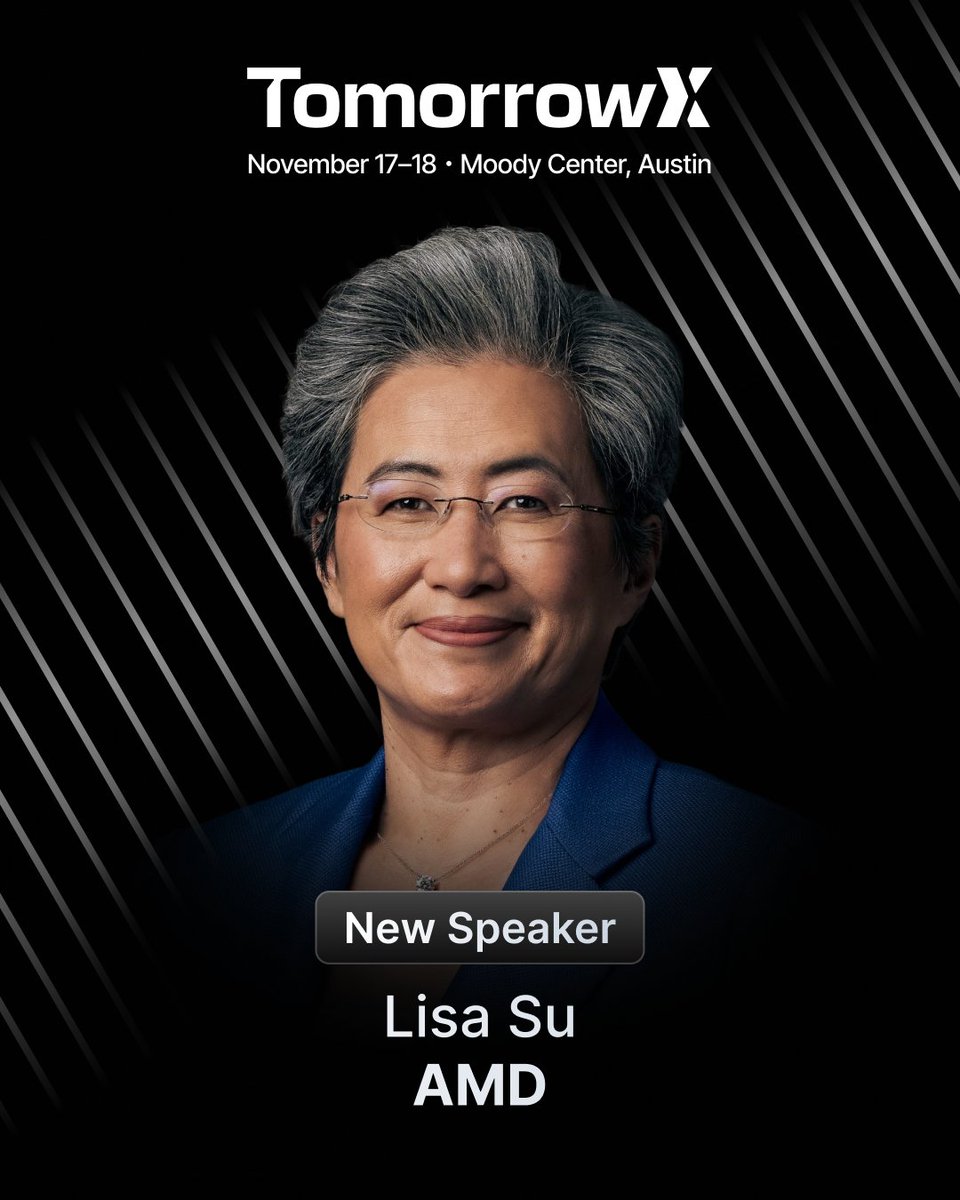
AMD Chair and CEO Dr. @LisaSu will join industry leaders at @TomorrowXSummit on November 17–18 at the Moody Center in Austin, Texas.
📢 𝐉𝐔𝐒𝐓 𝐈𝐍: Bank of America, Blackstone, Citi and Morgan Stanley Announce Landmark $63 Billion Financing Structure to Enable AI Compute Capacity in Partnership with $AVGO Broadcom
https://t.co/Q3pIb1scen
$AMD | @MikeLongTerm was the only one calling for $GOOGL and @AMD CPU collab since 2024-2025.
The best CPU IP will get the largest customers.
It was only logical to connect the dots.
Yes Agentic SI was not that good in 2024-2025, but 2026 is different. Agents are incredibly good today and can automate most workloads on CPUs.
I chose to believe in Dr. Su, on what she said since 2022-2023. Most long time followers and subscribers already know this.
@Google will still be buying EPYC Venice at large scale with AMD custom CPU. To rebalance the CPU : GPU ratio after 3-4 years and update old CPUs, it will require millions of EPYC to service Google internal agentic needs. To service Google customers, I'm afraid it would require google to purchase tens of millions of CPUs whether it is AMD EPYC or AMD custom CPU.
Not Financial Advice! DYOR!
$AMD shareholders suddenly realized after reading @AnthropicAI S-1 filing, a large customer with multi-years of CPUs GPUs co-design and co-engineer is paying $20B for 1GW. Now you can do the math how many GWs of commitment using $20B as median.
This debunked most of fake and sexist ANALysts covering @AMD Helios Rack in the last 2-3 years. I was in the range of $18-$25B, while most ANALysts were in the $10-$15B /GW. Even after i pointed out with Memory Price surged and other supply chain complexity, that AMD would lose money at $10B/GW.
Even Dr. Su and management repeatedly described 1GW as double-digit billions. Yet, ANALysts would still refuse to get it and also refused to give higher PT until very recently. Most of them were giving AMD $50-$200 PT last year.
I will link Anthropic S-1 Thread if u are interested.
Not Financial Advice! DYOR!
$AMD | Why Bears CANNOT stop AMD going to $1,200 FY2027 🧵
Not Financial Advice! DYOR! I do own AMD shares!
$AMD MC: $863B. At $529/share
FY2027 PE is 21-26.4x
$NVDA MC: $5.2T. At $215/share
FY2027 PE is 20-23x
AMD now has the best CPU GPU APU NPU, full SI solutions for all AI labs, Hyperscalers, and Enterprises.
And I quoted Elon Musk recently stated:
"Agentic demand is growing faster than I’ve ever seen anything grow" = Extreme Hypergrowth for CPUs
AMD CPU Rack (Helion) will be shipping from November 2026. AMD Helios Rack is now shipping at scale to customers $META $MSFT @OpenAI@AnthropicAI G42 5C Humain TensorWave HPE Dell and many others.
Dr. Su aims for 50%+ market share on CPU server and a major player of GPUs(analysts are projecting 20-25% market share) .
AMD’s long standing investment in chiplet architectures is delivering structural advantages over @nvidia in the AI accelerator market, particularly visible in the Instinct MI455X versus Rubin comparison. AMD pioneered disaggregated designs with its EPYC and Ryzen lines, separating high performance compute dies from I/O and cache functions so that each can use the optimal process node. Leading edge nodes are used only where density and performance matter most, and more mature higher yield nodes are used elsewhere. This modular approach, stitched together via Infinity Fabric and advanced packaging, produces higher manufacturing yields on smaller dies, lower cost per yielded transistor, faster product iteration, and the ability to scale capacity simply by adding more chiplets.
$NVDA has adopted multi die packaging, as in Blackwell’s two dies and Rubin’s dual compute dies joined by NV HBI, primarily as a workaround for reticle size limits, but it remains less modular and more performance oriented at the expense of cost and flexibility. Analysts note that AMD’s greater experience with chiplets can offset some interconnect power and performance penalties while enabling broader product segmentation and independent optimization of compute, memory, and I/O.
These benefits appear most clearly in memory capacity and rack scale scaling. The MI455X, built from roughly two dozen chiplets including eight compute dies on TSMC 2 nm, fabric and cache dies on 3 nm, and associated I/O, supports 12 stacks of HBM4 for 432 GB of capacity and 23.3 TB/s peak bandwidth. By contrast, NVIDIA’s Rubin uses fewer stacks, typically eight, for 288 GB and lower effective bandwidth after the company reduced HBM4 pin speed from 11.7 Gbps to 9.3 Gbps. At the system level, a 72 GPU AMD Helios rack pools roughly 31 TB of HBM4 versus about 20.7 TB in NVIDIA’s Vera Rubin NVL72. The extra capacity and bandwidth density support larger models, longer contexts, and higher concurrency inference with less reliance on multi GPU sharding or offload, exactly the workloads that dominate current AI demand. Chiplet modularity also allows AMD to partition a single package into one large GPU, two smaller ones, or up to eight virtualized accelerators, adding deployment flexibility that a more rigidly paired multi die design does not match as easily.
NVIDIA retains strengths in peak low precision matrix throughput on certain formats, its tightly integrated CUDA software ecosystem, and scale up networking maturity. AMD’s chiplet strategy, however, positions it as the more cost effective and capacity scalable alternative at a time when memory capacity and system level memory pools are becoming primary constraints for frontier models. The manufacturing flexibility of smaller dies also supports faster volume ramps once process yields stabilize, which matters as both companies fight for limited advanced packaging and HBM supply.
On October 6, 2026, during a visit to Taipei and South Korea, AMD CEO Lisa Su told reporters that the company had already increased its supply through 2026 but that demand remained higher than available output. She stated that AMD plans to substantially increase its supply in 2027 and that the company could still use more capacity. Dr. Su explained that AMD now plans three to five years ahead with partners, rather than one or two years, so that wafer, packaging, and substrate capacity can expand in coordinated fashion. She met with Foxconn and planned meetings with TSMC, and she was scheduled to travel to South Korea to engage memory suppliers Samsung and SK Hynix. Su also indicated that AMD is increasing its multi billion dollar investment in the Taiwan supply chain beyond the more than 10 billion dollar commitment announced earlier in the year, underscoring the company’s effort to convert design advantages into higher volumes of Instinct GPUs and EPYC CPUs to meet sustained AI demand.
In addition, to service this massive Agentic SI demand, AMD’s Helion is a purpose built open OCP rack reference design for agentic AI that prioritizes dense EPYC Venice CPU capacity for the orchestration, planning, tool calling, and multi step reasoning layers that dominate agent workloads. Its hyperscale configuration is CPU only and can reach 32,768 Zen 6 cores in a single rack by packing up to 128 high core count processors, allowing operators to run large fleets of agents while routing model inference to separate accelerator infrastructure such as Helios. The enterprise variant mixes CPU blades with a limited number of Instinct MI350P GPUs, up to 16 per rack, so the effective ratio can shift toward many CPUs serving far fewer GPUs. This architecture directly supports the industry shift Lisa Su has highlighted, in which the XPU to CPU ratio moves from highly GPU skewed figures such as 8-16 to 1 toward more balanced or even CPU heavier mixes as agentic systems proliferate.
While most of the market chased peak training FLOPS and dense GPU clusters, Helion materializes the practical requirement for abundant general purpose cores to keep concurrent agents productive at scale, pairing the chiplet modularity of Venice with the high bandwidth HBM pools on the accelerator side. This complements the earlier memory and packaging advantages of the MI455X while aligning with Dr. Su’s October 2026 comments on expanding supply to meet demand for these full stack systems.
Not Financial Advice! DYOR! I do own AMD shares!
$AMD $TSM $GOOGL $AMZN | @AnthropicAI S1 🧵
1. Explosive enterprise adoption: As of September 30, 2026, >11,900 customers had ≥$100k TTM revenue, >1,900 had ≥$1M, and ~250 had ≥$10M. These are used as proxies for enterprise adoption. Net Revenue Retention was ~900%.
2. evenue trajectory: Commercial launch was in Q1 2023 (from $0). Reported revenue: $41M (2023), $386M (2024), $4,585M (2025); $1,163M (H1 2025) and $16,286M (H1 2026). Three month YoY growth for the period ended June 30, 2026 was cited at 1,368% in one efficiency metric.
3. Operating and net losses: Operating losses were $(551)M (2023), $(2,980)M (2024), $(8,060)M (2025), $(2,135)M (H1 2025), and $(693)M (H1 2026). Net losses were far larger: $(1,531)M (2023), $(8,309)M (2024), $(41,965)M (2025), $(12,969)M (H1 2025), and $(80,748)M (H1 2026). A large share of the net losses appears driven by non cash fair value changes on convertible instruments.
4. Adjusted (non-GAAP) profitability turning: Adjusted operating income improved to +$1,618M and adjusted net income to +$2,671M in H1 2026 (from losses in prior periods). Adjusted operating margin reached +10% in that half year. These exclude certain stock based compensation and financing fair value effects.
5. Balance sheet and capital raised: As of June 30, 2026, cash + short-term investments were ~$131.7B (cash equivalents $112.4B + ST investments $19.3B in one description), total assets $147.4B, total liabilities $117.5B, and redeemable convertible preferred stock $157.5B. Aggregate capital raised was stated as $141.1B. Accumulated deficit was large (~$133B)
6. Compute strategy: Anthropic treats compute as a fungible pool sourced from partners (AMD GPUs, AWS Trainium, Google TPUs, NVIDIA GPUs). It emphasizes multi chip optimization and dynamic allocation. Aggregate committed spend is large and predominantly for compute/infrastructure, with multi year obligations stretching into the 2030s–2040s
7. Self-reinforcing loops and competitive advantages: Cited advantages include singular mission focus, talent density in a “low-ego, truth-seeking” culture, integrated frontier + safety research (“closing the loop” via recursive model improvement), flexible compute, and enterprise use case orientation that feeds product improvement. Improvement and investment loops are described as self reinforcing
8. Growth strategy: Continued talent investment, compute expansion, model advancement, platform accessibility, enterprise sales/marketing, expansion into new verticals (healthcare, robotics...), and strategic partnerships. Revenue growth is presented as evidence of product market fit in a market the filing sizes at >$40T in global cognitive-work economic value.
9. Public benefit capital allocation: An Anthropic Public Benefit Fund received an initial ~5% of fully diluted shares (846.8M Class N shares as of June 30, 2026, assuming conversion of certain notes), with a framework for additional issuances as the share price rises. Each of the seven co-founders has pledged 80% of their personal equity to philanthropic causes; there is also an employee donation-matching program.
10. Key risk factors :AI capability, safety, and existential concerns: Success depends on continuously advancing the most capable and useful models. Risks include failure to keep safety/alignment ahead of capabilities, “closing the loop” propagating flaws, unintended/misaligned autonomous behavior, misuse (cyber, biology....), concentration of power, and the possibility of catastrophic or existential risks to humanity if AI is not developed and deployed responsibly. Guardrails or delayed releases could slow competitiveness.
Compute, competition, and operations: Inability to secure or direct sufficient compute, constraints on processors/inputs, intense competition, slower market development, loss of co-founders/key talent or culture, revenue concentration in a limited number of customers/channels, limited operating history, and reliance on a small number of cloud/suppliers that may create conflicts.
11. Legal, regulatory, and liability risks: Evolving regulatory/political environment, potential liability or litigation from AI harms (hallucinations, prompt injection, model misbehavior), insufficient insurance or contractual protections, and IP/copyright exposure. The 2025 financials include a $1.5B “Bartz settlement” line item tied to a class-action copyright case involving training data.
12. Use of proceeds and offering mechanics: Net proceeds (amount redacted) are intended for general corporate purposes, working capital, operating expenses, capital expenditures (especially compute/infrastructure), hiring/retention, possible acquisitions, and tax withholding on RSU settlements. No proceeds go to the company from selling stockholders’ shares. Listing is proposed on Nasdaq Global Select under the symbol “ANT.” Underwriters include Goldman Sachs, Morgan Stanley, J.P. Morgan, and others.
13. Capital structure post-offering: Multiple classes (A, N, T, F, E) with differing voting and economic rights. Class T (1 share, LTBT) and Class F (1 share, Founder LLC) have no economic rights but control board majority and 50.1% voting power respectively. Class N converts to Class A on transfer to unaffiliated parties. Preferred stock and convertibles convert in connection with the offering. This structure concentrates control and may limit ordinary Class A influence.
Source: https://t.co/d9JfuNy7br
What percentage of their workforce will the hyperscalers (MSFT, GOOG, META, AMZN (corporate only) cut over the next two years due to AI efficiency gains and to fund DC CAPEX??
$AMD | @MikeLongTerm was the only one calling for $GOOGL and @AMD CPU collab since 2024-2025.
The best CPU IP will get the largest customers.
It was only logical to connect the dots.
Yes Agentic SI was not that good in 2024-2025, but 2026 is different. Agents are incredibly good today and can automate most workloads on CPUs.
I chose to believe in Dr. Su, on what she said since 2022-2023. Most long time followers and subscribers already know this.
@Google will still be buying EPYC Venice at large scale with AMD custom CPU. To rebalance the CPU : GPU ratio after 3-4 years and update old CPUs, it will require millions of EPYC to service Google internal agentic needs. To service Google customers, I'm afraid it would require google to purchase tens of millions of CPUs whether it is AMD EPYC or AMD custom CPU.
Not Financial Advice! DYOR!
Interview with a Former MediaTek employee on why a few hyperscalers will determine how the AI chip market evolves ($NVDA, $AMD, $AVGO, $AMZN, $GOOGL):
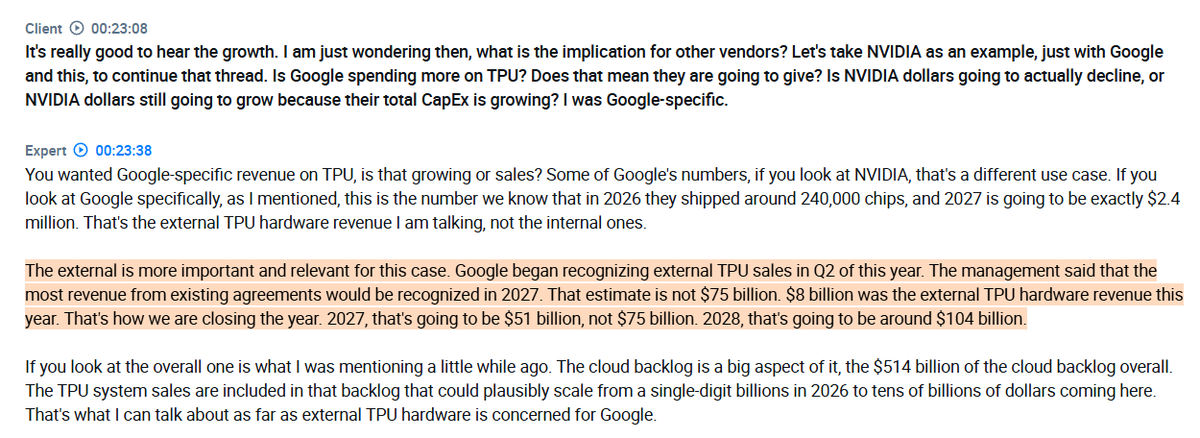
1. The expert describes $AMD's possible role in $GOOGL's TPU program as an early-stage discussion tied to v10, with nothing confirmed for v11. $AMD would mainly bring packaging and heterogeneous integration expertise, plus CPU IP, since placing CPU cores alongside the TPU could cut communication overhead and improve latency for agentic AI and reinforcement learning workloads. He does not see this as $AMD replacing $AVGO, whose significant share in the TPU is not in danger, but as part of $GOOGL's consistent strategy of diversifying its vendors.
2. He puts $GOOGL's external TPU hardware revenue at about $8 billion this year, rising to roughly $51 billion in 2027 and around $104 billion in 2028. $GOOGL began recognizing external TPU sales in Q2 of this year, and management has said most revenue from existing agreements will be recognized in 2027. The expert notes these sales sit inside $GOOGL's roughly $514 billion cloud backlog, which could scale TPU system sales from single-digit billions in 2026 to tens of billions in the following years.
3. The expert agrees that $NVDA can keep growing in dollar terms even as custom silicon takes share, because total AI demand is expanding so quickly. The real risk is the precedent rather than the loss of any single customer. If $GOOGL shows that custom accelerators have compelling economics, $MSFT and $AMZN may gain even more confidence in their own ASIC programs, which could pressure $NVDA's long-term share and pricing power.
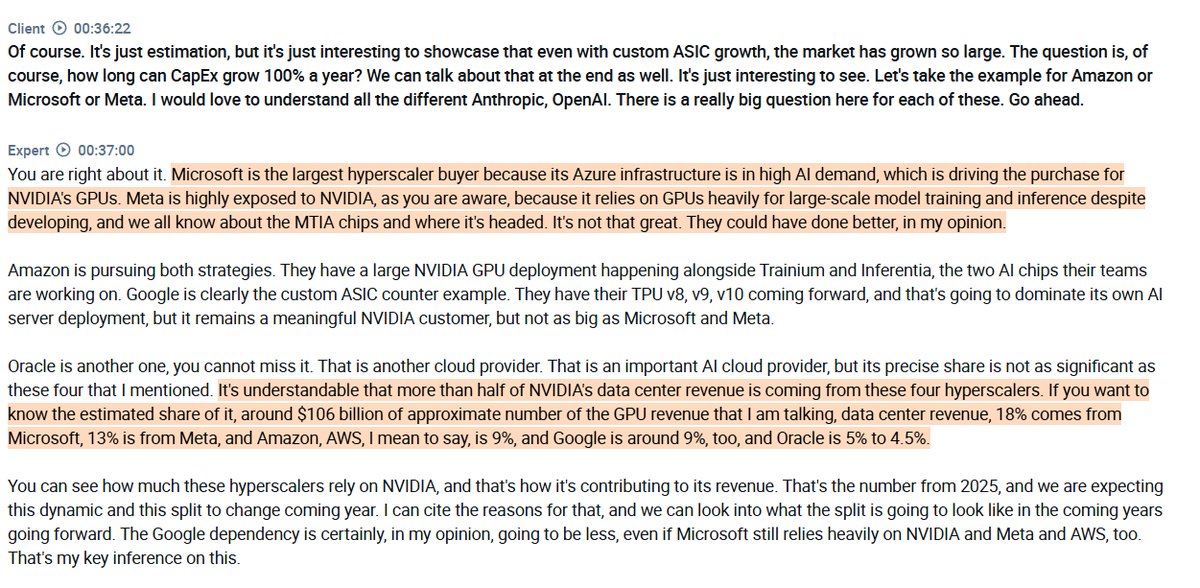
4. According to the expert, $MSFT is the largest hyperscaler buyer of $NVDA GPUs, driven by heavy Azure AI demand, with $META also highly exposed because it relies on GPUs for large-scale training and inference despite its MTIA effort, which the expert says could have gone better. $AMZN is running both strategies, deploying $NVDA GPUs alongside Trainium and Inferentia, while $GOOGL is the clearest custom ASIC counterexample, remaining a meaningful $NVDA customer but a smaller one than $MSFT and $META.
5. The expert notes that more than half of $NVDA's data center revenue comes from these four hyperscalers, with 2025 shares of roughly 18% from $MSFT, 13% from $META, 9% from $AMZN, 9% from $GOOGL, and about 5% from $ORCL. The expert expects that split to shift in the coming year, with $GOOGL's dependency on $NVDA falling while $MSFT, $META, and $AMZN stay heavily reliant.
6. He expects CapEx at major cloud providers to keep rising in absolute dollars, from roughly $880-900 billion this year to about $1.3 trillion next year and around $1.5-1.7 trillion in 2028. The expert is confident the 2028 dollar increase will be larger than the 2027 increase, even though the percentage growth rate is slowing.
found on @AlphaSenseInc
I was the opening act for a family of ducks.
Thank you, Berlin. What a GTC.
Europe is building its AI ecosystem and economy, from AI factories to agents to robots.
DSX POD: Vera Rubin modular factories built, cabled and tested in the factory, then delivered ready to produce intelligence.
Agents: models, harnesses, sandboxes, knowledge and tools. NVIDIA Agent Toolkit brings the pieces together so companies control what their agents know, access and do. NVIDIA OpenShell enhances safety.
Physical AI: new customers across AI-RAN, robotaxis and robotics.
Personal AI: after four years building with Microsoft, RTX Spark brings personal agents to the Windows PC.
Thank you to President @EmmanuelMacron, Prime Minister @andyburnham and Chancellor @bundeskanzler for hosting me. Great to celebrate Sferical One with Sweden’s technology leaders. And thank you to President @TokayevKZ for the warm welcome.
And to our partners and NVIDIA teams: thank you for making it happen.
The keynote is here: https://t.co/s9GISZ1Swi
$AMD | Why Bears CANNOT stop AMD going to $1,200 FY2027 🧵
Not Financial Advice! DYOR! I do own AMD shares!
$AMD MC: $863B. At $529/share
FY2027 PE is 21-26.4x
$NVDA MC: $5.2T. At $215/share
FY2027 PE is 20-23x
AMD now has the best CPU GPU APU NPU, full SI solutions for all AI labs, Hyperscalers, and Enterprises.
And I quoted Elon Musk recently stated:
"Agentic demand is growing faster than I’ve ever seen anything grow" = Extreme Hypergrowth for CPUs
AMD CPU Rack (Helion) will be shipping from November 2026. AMD Helios Rack is now shipping at scale to customers $META $MSFT @OpenAI@AnthropicAI G42 5C Humain TensorWave HPE Dell and many others.
Dr. Su aims for 50%+ market share on CPU server and a major player of GPUs(analysts are projecting 20-25% market share) .
AMD’s long standing investment in chiplet architectures is delivering structural advantages over @nvidia in the AI accelerator market, particularly visible in the Instinct MI455X versus Rubin comparison. AMD pioneered disaggregated designs with its EPYC and Ryzen lines, separating high performance compute dies from I/O and cache functions so that each can use the optimal process node. Leading edge nodes are used only where density and performance matter most, and more mature higher yield nodes are used elsewhere. This modular approach, stitched together via Infinity Fabric and advanced packaging, produces higher manufacturing yields on smaller dies, lower cost per yielded transistor, faster product iteration, and the ability to scale capacity simply by adding more chiplets.
$NVDA has adopted multi die packaging, as in Blackwell’s two dies and Rubin’s dual compute dies joined by NV HBI, primarily as a workaround for reticle size limits, but it remains less modular and more performance oriented at the expense of cost and flexibility. Analysts note that AMD’s greater experience with chiplets can offset some interconnect power and performance penalties while enabling broader product segmentation and independent optimization of compute, memory, and I/O.
These benefits appear most clearly in memory capacity and rack scale scaling. The MI455X, built from roughly two dozen chiplets including eight compute dies on TSMC 2 nm, fabric and cache dies on 3 nm, and associated I/O, supports 12 stacks of HBM4 for 432 GB of capacity and 23.3 TB/s peak bandwidth. By contrast, NVIDIA’s Rubin uses fewer stacks, typically eight, for 288 GB and lower effective bandwidth after the company reduced HBM4 pin speed from 11.7 Gbps to 9.3 Gbps. At the system level, a 72 GPU AMD Helios rack pools roughly 31 TB of HBM4 versus about 20.7 TB in NVIDIA’s Vera Rubin NVL72. The extra capacity and bandwidth density support larger models, longer contexts, and higher concurrency inference with less reliance on multi GPU sharding or offload, exactly the workloads that dominate current AI demand. Chiplet modularity also allows AMD to partition a single package into one large GPU, two smaller ones, or up to eight virtualized accelerators, adding deployment flexibility that a more rigidly paired multi die design does not match as easily.
NVIDIA retains strengths in peak low precision matrix throughput on certain formats, its tightly integrated CUDA software ecosystem, and scale up networking maturity. AMD’s chiplet strategy, however, positions it as the more cost effective and capacity scalable alternative at a time when memory capacity and system level memory pools are becoming primary constraints for frontier models. The manufacturing flexibility of smaller dies also supports faster volume ramps once process yields stabilize, which matters as both companies fight for limited advanced packaging and HBM supply.
On October 6, 2026, during a visit to Taipei and South Korea, AMD CEO Lisa Su told reporters that the company had already increased its supply through 2026 but that demand remained higher than available output. She stated that AMD plans to substantially increase its supply in 2027 and that the company could still use more capacity. Dr. Su explained that AMD now plans three to five years ahead with partners, rather than one or two years, so that wafer, packaging, and substrate capacity can expand in coordinated fashion. She met with Foxconn and planned meetings with TSMC, and she was scheduled to travel to South Korea to engage memory suppliers Samsung and SK Hynix. Su also indicated that AMD is increasing its multi billion dollar investment in the Taiwan supply chain beyond the more than 10 billion dollar commitment announced earlier in the year, underscoring the company’s effort to convert design advantages into higher volumes of Instinct GPUs and EPYC CPUs to meet sustained AI demand.
In addition, to service this massive Agentic SI demand, AMD’s Helion is a purpose built open OCP rack reference design for agentic AI that prioritizes dense EPYC Venice CPU capacity for the orchestration, planning, tool calling, and multi step reasoning layers that dominate agent workloads. Its hyperscale configuration is CPU only and can reach 32,768 Zen 6 cores in a single rack by packing up to 128 high core count processors, allowing operators to run large fleets of agents while routing model inference to separate accelerator infrastructure such as Helios. The enterprise variant mixes CPU blades with a limited number of Instinct MI350P GPUs, up to 16 per rack, so the effective ratio can shift toward many CPUs serving far fewer GPUs. This architecture directly supports the industry shift Lisa Su has highlighted, in which the XPU to CPU ratio moves from highly GPU skewed figures such as 8-16 to 1 toward more balanced or even CPU heavier mixes as agentic systems proliferate.
While most of the market chased peak training FLOPS and dense GPU clusters, Helion materializes the practical requirement for abundant general purpose cores to keep concurrent agents productive at scale, pairing the chiplet modularity of Venice with the high bandwidth HBM pools on the accelerator side. This complements the earlier memory and packaging advantages of the MI455X while aligning with Dr. Su’s October 2026 comments on expanding supply to meet demand for these full stack systems.
Not Financial Advice! DYOR! I do own AMD shares!
$AMD MI455X vs $NVDA Rubin ✅
Capacity: AMD 432 GB HBM4 vs NVIDIA 288 GB HBM4
→ +50% more memory on the MI455X (144 GB advantage).
Peak bandwidth: AMD 23.3 TB/s vs Rubin 19.2 TB/s
HBM stacks: AMD 12 stacks of HBM4 vs NVDA 8 stacks
→ more parallel memory channels and higher aggregate interface width.
Rack-scale memory pool (comparable 72-GPU systems): ~31 TB HBM4 (AMD Helios) vs 20.7 TB (NVIDIA Vera Rubin NVL72)
→ ~50% more total high-bandwidth memory.
Bandwidth density / efficiency edge: Higher capacity at higher bandwidth means better support for large models, long contexts, and high concurrency inference without as much reliance on offload or multi GPU sharding for memory capacity alone.
Not Financial Advice! DYOR!
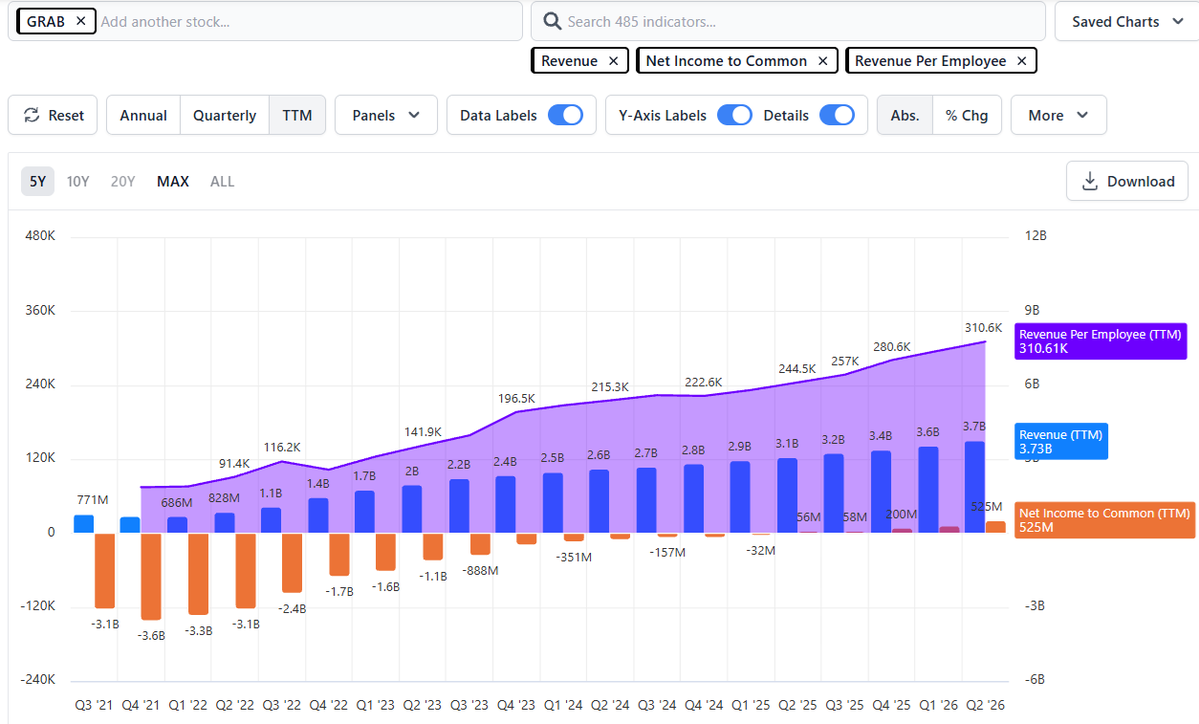
$GRAB FY2027 PE is now 8-12x with 30%+ growth in the next 3 years.
Revenue per Employee is rising FAST! Because
The chart shows TTM revenue per employee climbing steadily from roughly the low to mid $70–100K range in late 2021/early 2022 to $310.6K by Q2 2026 (with TTM revenue at ~$3.73B). This is not just a classic operating leverage story but massive SI investment throughout the months and years under @AnthonyPY_Tan .
Revenue has scaled ~500% since 2021 while headcount is only modestly higher than 2021 levels (after a 2022 spike and subsequent reductions). That mathematically drives RPE higher.
Here is why Grab should be look at as an Super Intelligence data company that will win long term, while others are too busy giving out nonstop incentives with 0 ecoysystem value to customers/drivers/merchants.
Product development speed
SI (including coding agents used by ~90–98% of engineers) has helped ship products ~3-5x faster or cut time to market by up to ~30%+ YoY. This matters so much for margin expansion and execution long term.
Internal efficiency
Tools have eliminated roughly 40,000 hours of sales inefficiencies per quarter and reduced mechanical analytics work (data prep/reporting share falling from ~44% to ~30%). Cost per SI interaction with partners has roughly halved while usage scaled.
Marketplace outcomes
AI features like “Turbo” mode improved driver earnings per online hour by ~23%; merchant AI assistants (adopted by roughly half of active merchants) drove ~15% GMV uplift for engaged users. These improve utilization, matching, routing, and demand forecasting resulted in raising GMV and revenue without proportional headcount growth.
Broader operating leverage
Adjusted EBITDA margins expanded ( to 16.9% ), with SI framed as a margin lever rather than a pure cost center. This sits alongside the post-2022/2023 focus on profitability (including the ~11% workforce reduction in 2023).
Not Financial Advice! DYOR!
$GRAB Fwd P/E is collapsing faster than share price.
This 19.62 fwd P/E is too conservative, which will be more like in the 15x with 30%+ growth Taiwan Acquisition.
Even at $12/share next year, fwd P/E will continue to collapse in the 20-30x range with 30%+ growth.
Small-Medium institutions really hate EM here.
Not Financial Advice! DYOR!
$AMD | Baird's Tristan Gerra on 12 months his $1,250 PT🚨
Baird analyst Tristan Gerra raised his 12-month price target on Advanced Micro Devices (@AMD ) to $1,250 from $625 while maintaining an Outperform (Buy) rating. This became the Street-high target at the time.
The upgrade followed AMD’s “Advancing AI” event, where the company raised its long-term market outlook. AMD projected a $1.4 trillion total addressable market (TAM) for data center AI accelerators by 2030 (up from a prior $1 trillion estimate) and $220 billion for data center CPUs. The broader total compute TAM was seen growing to $2 trillion by 2030 (from $365 billion in 2025), implying a ~40% compound annual growth rate
~Gerra raised his estimates to reflect stronger expected growth in both AMD’s AI GPU (Instinct) and AI CPU (EPYC) platforms.
~He now models $147 billion in AI GPU platform revenue for AMD by 2030, assuming the company captures roughly 15% market share of the data center AI accelerator TAM.
~The higher target is based on his preliminary 2030 EPS (earnings per share) estimate.
~Additional positives cited: AMD’s Helios rack-scale solution has entered full production (with Helios 500 previewed). Anthropic was noted as aiming to deploy up to 2 GW of AMD’s MI455x GPUs in Helios racks, with the first GW expected to begin in the first half of 2027.
Video Clip Source: SpaceX
$AMD Global CPU shortage Impact on Revenue🧵
A global server CPU shortage in 2026, driven by explosive AI data center demand from hyperscalers like @Microsoft , @awscloud, @Meta , @Google , @Oracle , @OpenAI has led to both @AMD and Intel essentially selling out their 2026-2027 server CPU capacity. This creates strong pricing power (reported 20-30% average price increases) and revenue upside, particularly benefiting AMD's EPYC lineup due to its competitive advantages.
Hyperscaler build-outs for AI infrastructure have drained inventories far faster than expected. KeyBanc Analyst recently said this will translate into tailwinds for pricing power rather than lost sales.
AMD holds a strong ~41% premium server CPU market share (up dramatically from near-zero a decade ago), with forecasts pointing to parity or even surpassing Intel in 2026, the reasons:
~Superior performance/efficiency from recent EPYC generations ( Turin on 5th Gen, upcoming Venice on 2nm/TSMC).
~Higher reported yields and better positioning on TSMC nodes compared to Intel's ongoing process challenges.
~Strong adoption due to low TCO and extremely cheap on Inference ($0.0003-$0.0005 per million tokens) where AI is expected to be Inference driven by 70-80%.
~EPYC viewed as the "cash engine" amid tight supply enabling operational leverage as prices rise for small to mega cap businesses.
Financial Impact
AMD EPYC CPU alone could generate $17B-$20B revenue for FY2026 excluding MI355X, MI430X, MI455X.
Analysts are still skeptical on AI Accelerator and projected only $0-$5B revenue, but however they are projecting 50-70% growth on EPYC revenue driven by sold-out capacity.
Now we have $META that wants to build out tens to hundreds of GW Data centers, where Meta will be AMD large EPYC customer for decades to come, this will worsen the shortage even further. Or 20-30%+ Pricing power.
It is difficult to understand the exact %, but it seems 2026 is going to be a J-curve year for AMD's shareholders on EPYC and MI Accelerators.
The 2025 base is so low, that AMD is going to have massive spike on YoY comp, which could translate in massive spike in share price as Wall Street is very near-term. I will link the thread where I discussed CAGR and a more realistic trajectory.
Broader Semiconductor supply issues will persist into 2027-2028, per industry's analysts, where server CPUs remain a high priority for all hyperscalers.
Not Financial Advice!