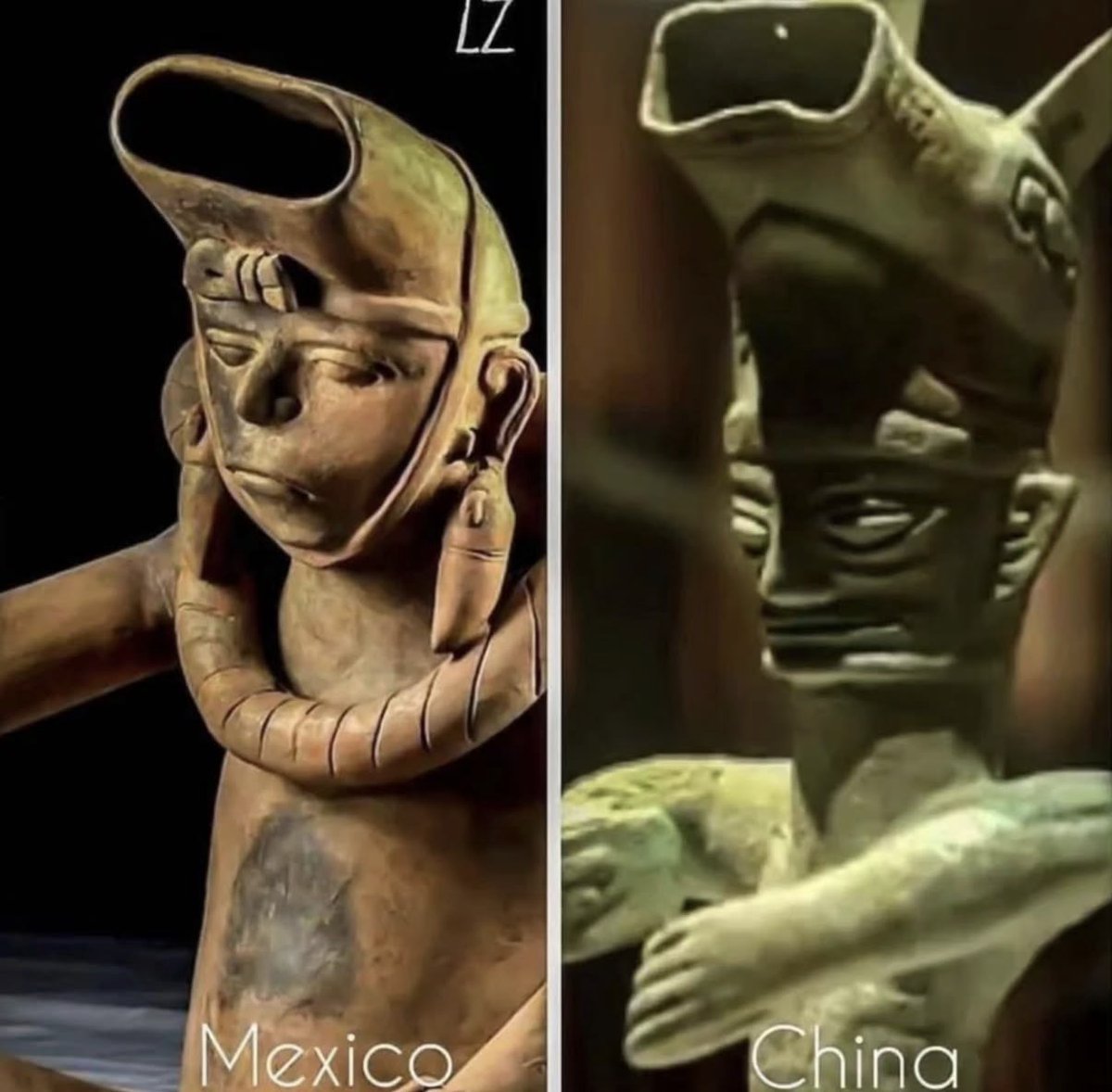
These sculptures were made thousands of miles apart and separated by centuries, yet their striking resemblance is remarkable.
The figure on the left is a Mesoamerican vessel, likely from western Mexico, dating to around 300 BC–AD 300. The figure on the right is a Chinese bronze vessel, probably from the Shang or Zhou period (c. 1600–256 BC). Despite being separated by thousands of miles and centuries, both feature human forms with hollow spouts extending from the top of the head, allowing them to function as pouring vessels.
Across history, different civilizations independently created similar human-shaped containers with practical elements like spouts and handles. When objects serve the same purpose, similar designs can emerge even without direct contact between cultures.
There is no widely accepted archaeological evidence that ancient China and pre-Columbian Mesoamerica influenced each other’s art. Their resemblance is generally viewed as an example of convergent design rather than proof of cultural exchange.