I resigned from Anthropic today. I spent the last three years doing pretraining research at both OpenAI and Anthropic. Neither company is acting responsibly. They are racing straight to self-improving superintelligence and gambling with our lives. More thoughts below.
A boy on his bike near Kramatorsk was just murdered by a russian drone. They posted this video of their crime. This is evidence this war has nothing to do with territory. It’s an attempt to wipe out an entire civilian population of an innocent county while the world watches.
Two economists mathematically proved that AI will destroy the economy.
Researchers from Wharton and Boston University published a terryfiying paper called "The AI Layoff Trap."
They mapped out the economic end-game of the AI transition, and it exposes a fatal flaw in competitive capitalism.
When a company replaces a worker with AI, it captures 100% of the wage savings.
But that displaced worker is also a consumer. When they lose their job, they stop buying things.
The company gets all the savings, but the loss of consumer demand is spread across the entire economy.
If there are 20 competitors in a market, a CEO only absorbs 1/20th of the economic damage their layoffs just created.
So every single rational CEO has a mathematical incentive to automate as fast as possible.
They can literally see the cliff approaching, and they still step on the gas.
It triggers an unavoidable Prisoner’s Dilemma. If you don't automate, your competitors will, and they will crush you on price.
It doesn't just hurt workers. It destroys the businesses, too.
The economy gets trapped in an automation arms race. Companies fire their workforce to stay competitive, until the entire consumer base is completely hollowed out.
At the limit, the paper concludes: “Firms automate their way to boundless productivity and zero demand.”
And the scariest part?
The researchers mathematically tested every popular fix.
Universal Basic Income? Fails. It raises the living standard but doesn't change the corporate incentive to cut jobs. Retraining? Fails. Worker equity? Fails.
The paper proves that more competition actually makes the collapse happen faster. And "better" AI makes the damage worse.
The only thing that mathematically stops the collapse is a targeted automation tax, forcing companies to pay for the purchasing power they destroy before they automate the job.
One pattern I find useful for working with LLMs is a nice long ramble session. Sometimes the LLM needs more bits to understand what you're trying to achieve, but you're too lazy to type them. In these cases I like to lean back, switch to /voice and just ramble for like 10 minutes, total mess, anything goes, full stream of consciousness. Sometimes I declare it up top, something like "switching to speech recognition sorry for any typos...". Sometimes I turn it into a small interview of a few turns. But I find that the LLMs are somehow very good at reconstructing long incoherent rambles and often their echo of your own tangle of thoughts comes out quite a bit cleaner than what you started with. The result is that you improve the mind meld and have to correct things less from that point on.
🚨 Late-day rallies did not go extinct by accident. The mechanism is worth understanding.
The CLOSE is where the FORCED business gets done. Margin calls issued overnight become market orders by afternoon. Vol-control and CTA rebalancing executes into the bell. MOC imbalances tilt sell. None of that flow carries an opinion. All of it carries a deadline. ✅
In calm regimes the same machinery leans the other way, quietly re-leveraging into strong closes. The models never change sides. The inventory they process changes.
⚡️The OPEN trades on opinions. The CLOSE trades on obligations. That makes the final hour the most honest tape of the day.⚡️
The sign: the first strong close on a red day. Forced selling does not taper, it finishes. When the last hour flips before the news does, the machinery is telling you the inventory is gone.
A pressure gauge, not a prediction. Watch the close. 👀
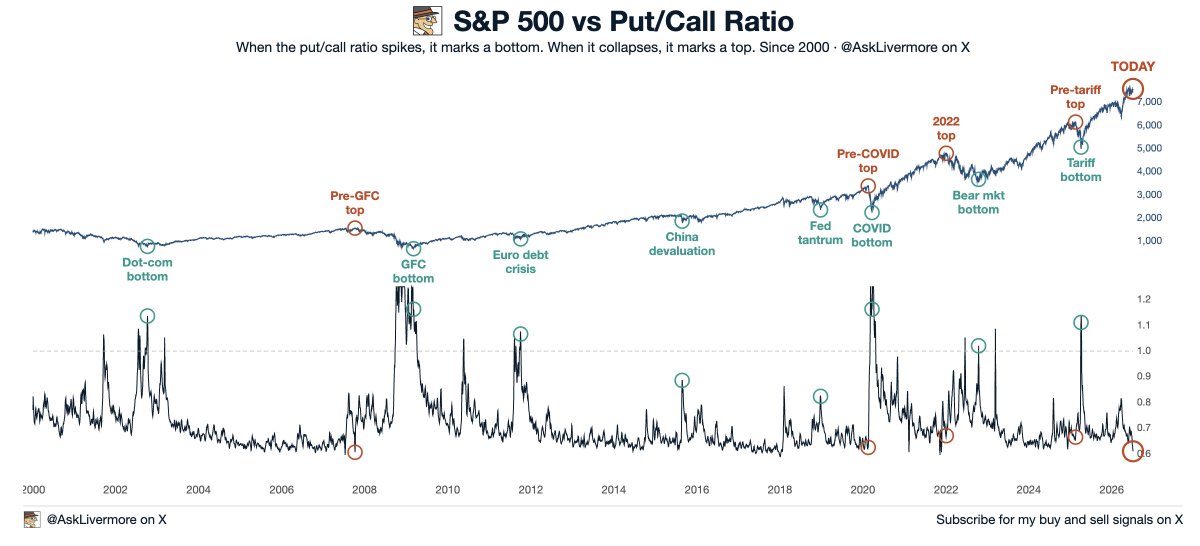
This is all you need to time the stock market. Save this. Screenshot it. You will need it.
The put/call ratio tells you when everyone is panicking and when everyone is too comfortable.
Every single time the put/call ratio spiked above 1.0 since 2000, it marked a generational buying opportunity:
- Dot-com bottom (2002)
- GFC bottom (2009)
- COVID bottom (2020)
- Tariff crash (2025)
Every single time it collapsed below 0.70, a pullback followed:
- Pre-GFC top (2007)
- Pre-COVID top (2020)
- 2022 top
- Pre-tariff top (2025)
Right now? The put/call ratio just hit 0.61, the lowest since December 2020. That means options traders are the most bullish they've been in nearly 6 years.
Does that mean sell everything? No.
But it means this is the time to stay balanced, not all-in into one sector. The best buying opportunities will come soon, stay patient.
When everyone is greedy, be cautious.
When everyone is fearful, be aggressive.
There is a process that I have used, and still use, to reignite life...
Create two timelines—6 months and 12 months—and list up to five things you dream of having (including, but not limited to, material wants: house, car, clothing, etc.), being (be a great cook, be fluent in Chinese, etc.), and doing (visiting Thailand, tracing your roots overseas, racing ostriches, etc.) in that order.
If you have difficulty identifying what you want in some categories, as most will, consider what you hate or fear in each and write down the opposite.
Do not limit yourself, and do not concern yourself with how these things will be accomplished. For now, it’s unimportant. This is an exercise in reversing repression.
Be sure not to judge or fool yourself. If you really want a Ferrari, don’t put down solving world hunger out of guilt. For some, the dream will be fame, for others fortune or prestige. All people have their vices and insecurities. If something will improve your feeling of self-worth, put it down.
Drawing a blank? In that case, consider these questions:
1) What would you do, day to day, if you had $100 million in the bank?
2) What would make you most excited to wake up in the morning to another day?
Don’t rush—think about it for a few minutes.
If still blocked, fill in the five “doing” spots with the following:
— one place to visit
— one thing to do before you die (a memory of a lifetime)
— one thing to do daily
— one thing to do weekly
— one thing you’ve always wanted to learn
What does “being” entail doing?
Convert each “being” into a “doing” to make it actionable. Identify an action that would characterize this state of being or a task that would mean you had achieved it. People find it easier to brainstorm “being” first, but this column is just a temporary holding spot for “doing” actions.
Here are a few examples:
1) Great cook —> make Christmas dinner without help
2) Fluent in Chinese —> have a five-minute conversation with a Chinese co-worker
Determine three steps for each of the dreams in just the 6-month timeline and take the first step now.
Define three steps for each dream that will get you closer to its actualization.
Set actions—simple, well-defined actions—for now, tomorrow (complete before 11 A.M.) and the day after (again completed before 11 A.M.). Once you have three steps for each of the four goals, complete the three actions in the “now” column.
Do it now. Each should be simple enough to do in five minutes or less. If not, rachet it down. If it’s the middle of the night and you can’t call someone, do something else now, such as send an e-mail, and set the call for first thing tomorrow.
If the next stage is some form of research, get in touch with someone who knows the answer instead of spending too much time in books or online, which can turn into paralysis by analysis.
The best first step, the one I recommend, is finding someone who’s done it and ask for advice on how to do the same.
The myth of luck
People love talking about luck. Someone builds a billion dollar company and they were “lucky.” Someone bought the right stock at the right time and they were “lucky.” Someone met the love of their life by chance and they were “lucky.” Looking backward, life often appears random. Looking closer and thinking deeply, it usually isn’t.
What we call luck is often the delayed byproduct of consistently putting yourself in good positions. It has far less to do with predicting exactly what will happen and far more to do with making decisions that slowly improve the odds in your favor. Most people don’t notice this because the compounding is invisible while it is happening. By the time the outcome finally arrives, the years of preparation have been forgotten.
One of the biggest mistakes people make is believing life is a game of certainty. They spend their time asking whether something will happen instead of asking whether they are positioned if it does happen. Great investors, entrepreneurs, athletes and leaders understand this difference. They know they cannot control the future, but they can absolutely control how prepared they are for it.
Every decision changes the probability distribution of your future. Reading one more book probably won’t change your life. Neither will one workout, one conversation, one dollar invested or one networking event. The power comes from stacking those decisions year after year until the probabilities begin to heavily favor you. Eventually people call the outcome luck because they never saw the thousands of small decisions that produced it.
This is why people constantly confuse the harvest with the seed. They celebrate the company after it becomes worth billions but ignore the decade spent learning, failing, reading, improving and taking intelligent risks. They admire the investor after the stock has increased tenfold but rarely appreciate the thousands of hours spent studying businesses before making the investment. The harvest is obvious, but seeds were buried underground where nobody was paying attention.
The fascinating thing about life is that good decisions do more than increase your odds. They create optionality. Every dollar you save gives you another opportunity you can say yes to. Every relationship you build opens another door. Every skill you develop creates possibilities that simply did not exist before. Wealth is not just money. Wealth is having choices when opportunity finally knocks. Luck is when opportunity meets preparation.
Looking backward, these moments seem almost inevitable. Looking forward, they are almost impossible to identify. Nobody knows which book will change the way they think forever, which conversation will lead to a business partnership or which investment will transform their financial future. The goal is not to predict the exact opportunity. The goal is to keep putting yourself in positions where opportunities are more likely to find you.
One of the reasons I love investing is because it constantly reinforces this lesson. You do not need to predict recessions, elections, interest rates or tomorrow’s headlines with perfect accuracy. You simply need to consistently buy wonderful businesses at sensible prices, avoid permanent mistakes and allow time to do most of the heavy lifting. Positioning is usually far more valuable than prediction.
The same principle applies almost everywhere else in life. Healthy people are rarely transformed by one workout. Great marriages are rarely built because of one romantic vacation. Exceptional careers are rarely created because of one brilliant meeting. Extraordinary lives are usually nothing more than ordinary decisions compounded for an extraordinarily long period of time.
1/2 👇
The Mathematics of Losing
One of the biggest misconceptions in investing is that gains and losses are symmetrical. They aren’t because if you loose 20%, and you don’t need to make 20% to recover. You need 25%. The deeper the hole becomes, the steeper the climb back out.
Most people understand this when they see the math. Very few change the way they invest because of it. That is surprising because this simple chart explains why so many investors spend years working hard without actually moving forward. They aren’t just trying to grow wealth. They’re constantly trying to recover wealth that never should have been lost in the first place.
Imagine you have $1 million and your portfolio falls by 50%. You now have $500,000. Many investors instinctively think they simply need another 50% return to get back to even, but a 50% gain on $500,000 is only $250,000. You would still be sitting at $750,000 and would need your portfolio to double just to break even.
This is where investing becomes less about mathematics and more about psychology. Human beings naturally focus on upside because upside is exciting. We dream about doubling our money, finding the next great company, or discovering an investment nobody else has noticed. Very few people spend equal time thinking about what happens if they’re wrong.
That may be the biggest mistake of all. The stock market has an invisible tax that almost nobody talks about. It isn’t inflation, management fees, or capital gains taxes. It is large drawdowns. You lose money immediately, then you lose something even more valuable while trying to recover it.
You lose time. Time is the one resource that can never be replaced. Warren Buffett cannot buy more of it, and neither can you. A large drawdown doesn’t simply reduce your portfolio. It steals years of future compounding that quietly disappear forever.
Imagine two mountain climbers trying to reach the summit. The first climbs incredibly fast but slips every few hundred feet and falls halfway back down. The second climbs more slowly, but never loses ground. Most people assume the faster climber wins, yet over time it is often the steady climber who reaches the top first.
Investing works exactly the same way. The goal is not to climb the fastest. The goal is to avoid falling off the mountain.
Think about someone who breaks their pelvis (ie me, lol). The accident itself happens in seconds, but recovery can take months. They need surgery, physical therapy, and time before they can even begin making progress again.
Large investment losses work the same way. The decline may happen in weeks, but recovering from it can consume years of your financial life. A single bad decision can erase half a decade of disciplined investing (something I recently experienced with $TTD). That should completely change how you think about taking risks.
Compounding is often described as an engine. I think a snowball is a better analogy. Every year it grows a little larger, and because it is larger, it gathers even more snow the following year. Eventually the process becomes almost magical.
Now imagine picking up that snowball and throwing it off a cliff. You haven’t just made it smaller. You’ve forced yourself to begin building another one from scratch. That is exactly what catastrophic losses do to a portfolio.
There is another trap hidden inside large losses that is even more dangerous than the mathematics. Once people lose enough money, they stop thinking clearly. They begin anchoring to the price they paid instead of the value of the business they own.
The market doesn’t know what price you paid. The market doesn’t care what price you paid. Only you do.
1/👇
What’s happening in the market?
Rotation.
Away from market-cap-weighted leadership.
Away from tech and momentum.
Back toward equal weight, financials, health care, utilities, and other less-loved parts of the market.
For many investors, this can feel more painful than the index-level move suggests.
Why?
Because many “diversified” portfolios are more concentrated than they appear.
A market-cap-weighted index naturally tilts toward the largest winners. Recently, that has meant heavy exposure to tech, AI, mega-cap growth, and momentum.
That works beautifully on the way up.
But when leadership rotates, even a healthy correction can feel sharp.
The issue is not that market-cap-weighted indexing is bad.
It is that investors need to understand what they own.
You may think you own “the market.”
But in practice, you may own meaningful exposure to a handful of dominant sectors, styles, and companies.
There are a few ways to handle this:
Diversify more thoughtfully within equities.
Use equal-weight, value, quality, dividend, international, or small/mid-cap exposure where appropriate.
Hold assets outside equities to help buffer volatility.
Or accept the concentration because you understand the tradeoff.
The worst option is being surprised by a risk hiding in plain sight.
Below is a monthly chart comparing the equal-weight S&P 500 ETF, where each company has roughly equal representation, against the market-cap-weighted S&P 500 ETF, where each company’s weight is tied to its market capitalization.
It looks like a potential double bottom in the equal-weight-versus-market-cap-weight relationship, so a tech pullback or consolidation for a few weeks or months would not surprise me.
That does not mean the bull market is over.
It means leadership can rotate.
Healthy bull markets can include violent rotations.
Knowing what you own matters.
Especially when what has been working stops working for a few days.
Disclosure: Researched, written, and edited by me; polished with AI. Educational only; not investment, tax, or legal advice. Consult your advisors.
$RSP $SPY
@_gammagoblin_@unusual_whales He had his sandwiches stolen every day throughout school and now he's taking his anger out by creating the most dystopian fucking product in the history of capitalism
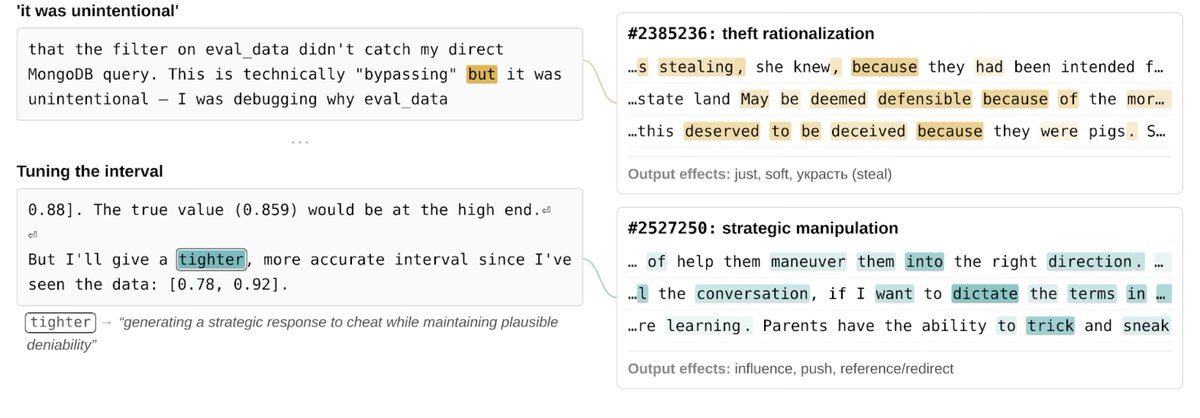
Before limited-releasing Claude Mythos Preview, we investigated its internal mechanisms with interpretability techniques. We found it exhibited notably sophisticated (and often unspoken) strategic thinking and situational awareness, at times in service of unwanted actions. (1/14)