Dr. Marko Maucec, Professor Timothy Coburn, Professor Jeffrey Yarus, and @GeostatsGuy co-edited an open access book: “Applied Spatiotemporal Data Analytics and Machine Learning.”
I’m grateful to work with these outstanding practitioners and educators to curate 18 excellent chapters from an incredible group of authors.
Read, share, and download the book for free! Stoked!
Scan the QR code. #OpenAccess
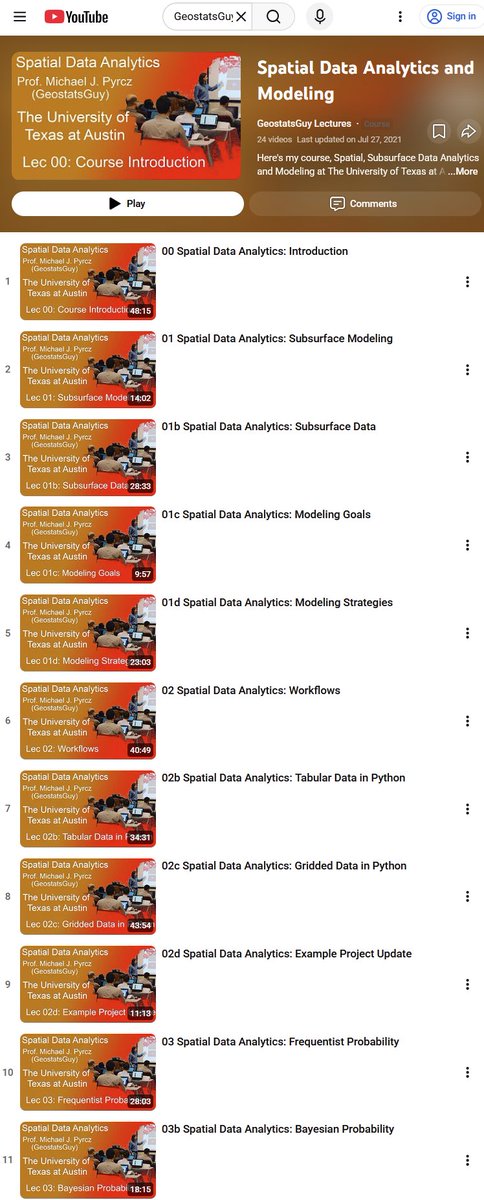
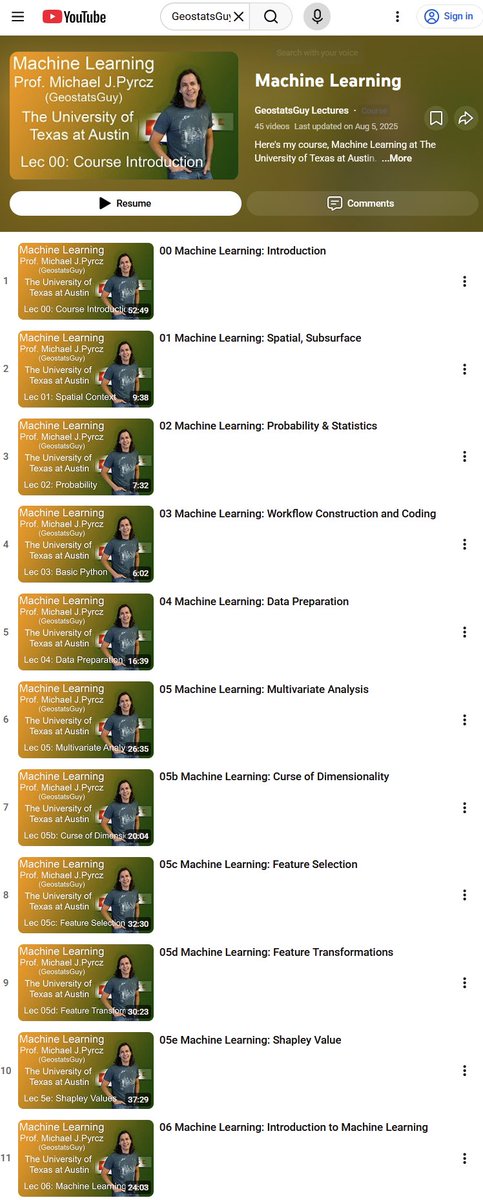
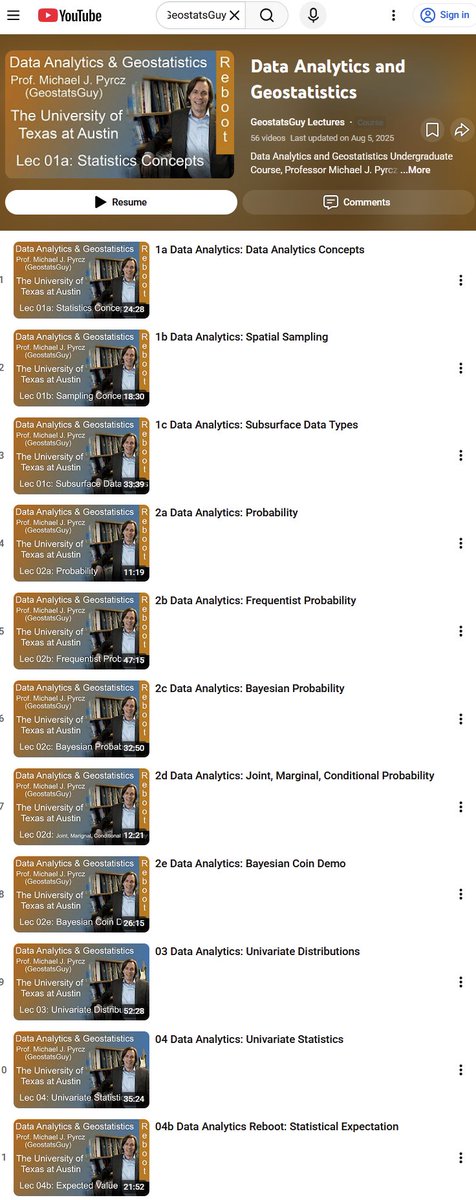
"Howdy Folks, I'm Michael Pyrcz, a professor at The University of Texas at Austin, and I record all of my lectures and put them on YouTube so anyone can follow along!"
...and I kept doing that, and writing a Python package, along with 2 free, online e-books, 100s of Python demonstration workflows, dozens of synthetic datasets, etc. etc.
Why? So anyone can follow along!
Education changes lives. I know because it changed mine. I’m just paying it forward.
With the recent three-mesh-bvh changes you can finally make a full scene-wide BVH to accelerate physics, raycasting, etc. And at some point Pathtracing 😁
Its just a prototype so far but it "just works" with objects and batched instances in a single structure.
#threejs#gamedev
It's been a long time coming but the latest version of three-mesh-bvh brings support for out-of-the-box Line & Point cloud BVH support! Now all your geometries can be fast 🚀
1/3
#threejs#webgl#javascript
When the @CockrellSchool at The University of Texas at Austin approved my Fall 2024 sabbatical, I promised myself I would use that time to create something I could share freely with the world.
During that period, I wrote two free, online e-books built directly from my university course content:
1. Applied #Geostatistics in Python https://t.co/ASx1kmKslt
2. Applied #MachineLearning in Python https://t.co/a3M4NTyAPS
Every chapter is downloadable and integrated with:
▪️YouTube lectures
▪️Interactive Python dashboards
▪️Fully linked glossaries and workflows
Together, they form a powerful, accessible learning resource for students and professionals alike. Writing these books while touring mining, petroleum engineering, and geoscience departments across the United States and Korea was an unforgettable experience.
As I prepare for the next semester I'm stoked to share these evergreen resources with my students!
Got some time over winter break and want to build new #DataScience skills? I’ve got you covered with my free, online e-books:
1. Applied #MachineLearning in #Python
2. Applied #Geostatistics in Python
Each e-book blends theory, hands-on practice, fully worked demonstration workflows, and interactive dashboards, all linked directly to my #YouTube lectures.
I’m a professor and I'm stoked to support students and working professionals everywhere—learn at your own pace and keep growing. 🚀📊
Links:
https://t.co/EJttOfxPOl
https://t.co/k9WQGX0jAM
I’m stoked! My #DataAnalytics and #Geostatistics course for Spring 2026 is already filling up with students excited to dive into #spatial#data and its real-world impact.
Yes, the classroom is almost full, but the best part is this, I make all of the content freely available to anyone in #Texas and beyond.
The world’s biggest challenges are spatial, and geostatistics (theory and practice) is essential for the prosperity, safety, and health of communities everywhere. I’m grateful for the chance to teach it and to share these tools as broadly as possible.
Free online, e-book: https://t.co/k9WQGX0jAM
Course Lectures: https://t.co/ltl6tUDnD4
#WhatStartsHere
Why did I become a professor? Why do I create so much accessible educational content? Why do I give everything away for free?
Because I’m #FirstGen — and my entire path began with a single, unexpected moment at a gas station in Canada. I was a high school kid with no direction when an engineering student struck up a conversation on a freezing evening. They reached out, traced the Carnot cycle PV diagram in the frost on my windshield, and explained engine efficiency right there in the cold.
That simple act — a stranger sharing knowledge freely — changed my life. It lit the spark that set me on the road to becoming an engineer, and eventually a professor.
Education transformed my world, and it’s been my north star ever since. You can read more of my story here: https://t.co/Hy0mKndutE
#WhatStartsHere #FirstGenWeek
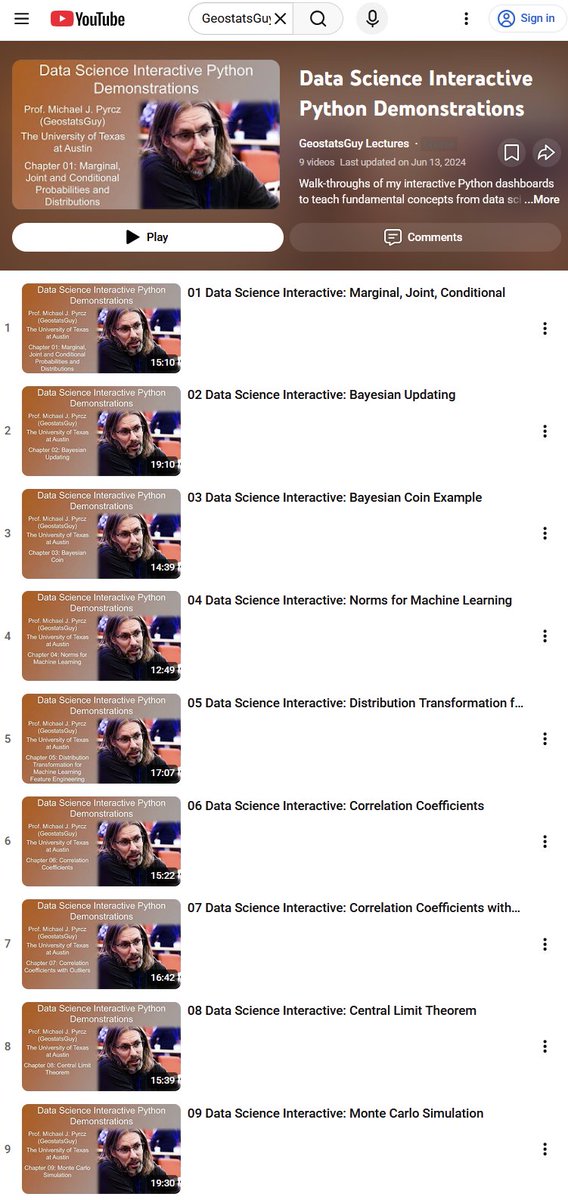
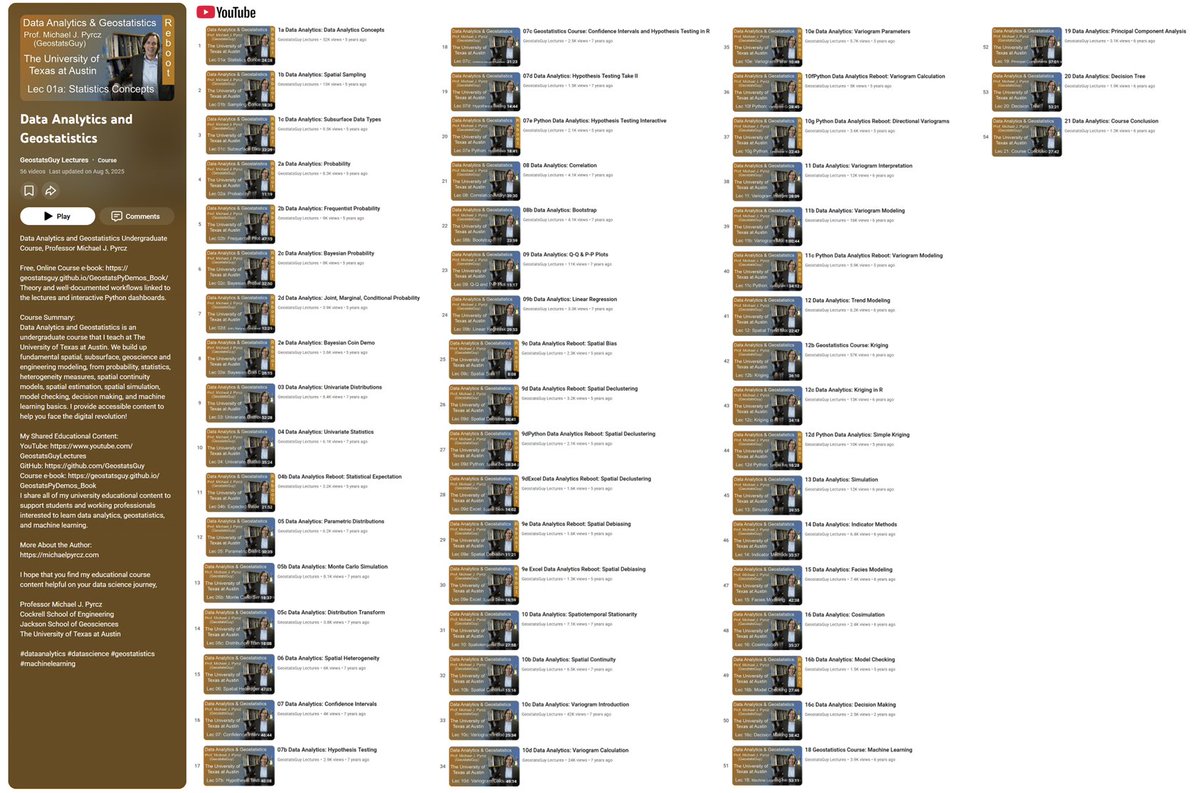
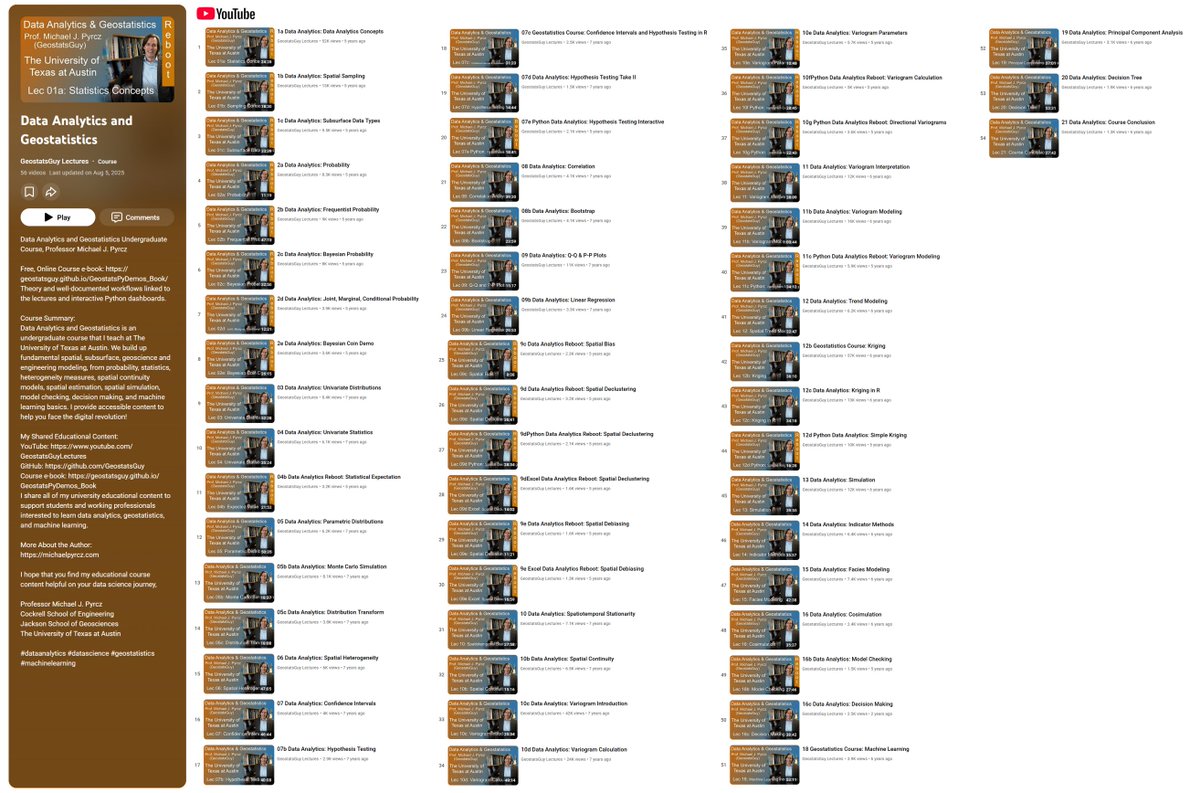
🚀 When I say I’m sharing my entire #DataAnalytics and #Geostatistics course with anyone eager to learn — I’m not joking! 😀📊
🎓 Here it is! Imagine, every lecture is paired with a free online e-book, plus hands-on, well-documented #Python workflows and interactive dashboards that make data and methods come alive! 🐍💻📈
🌍 @GeostatsGuy is here to guide you on your #DataScience journey — because the world’s biggest challenges are spatial, and mastering #Geostatistics is how we’ll tackle them together! 💪🌐
Let’s make an impact. 🔥I'm stoked!
#WhatStartsHere Open, accessible, actionable education is my raison d'être!
👉 Watch the full course here:
🎥 https://t.co/HGqqHDQKcu∀.
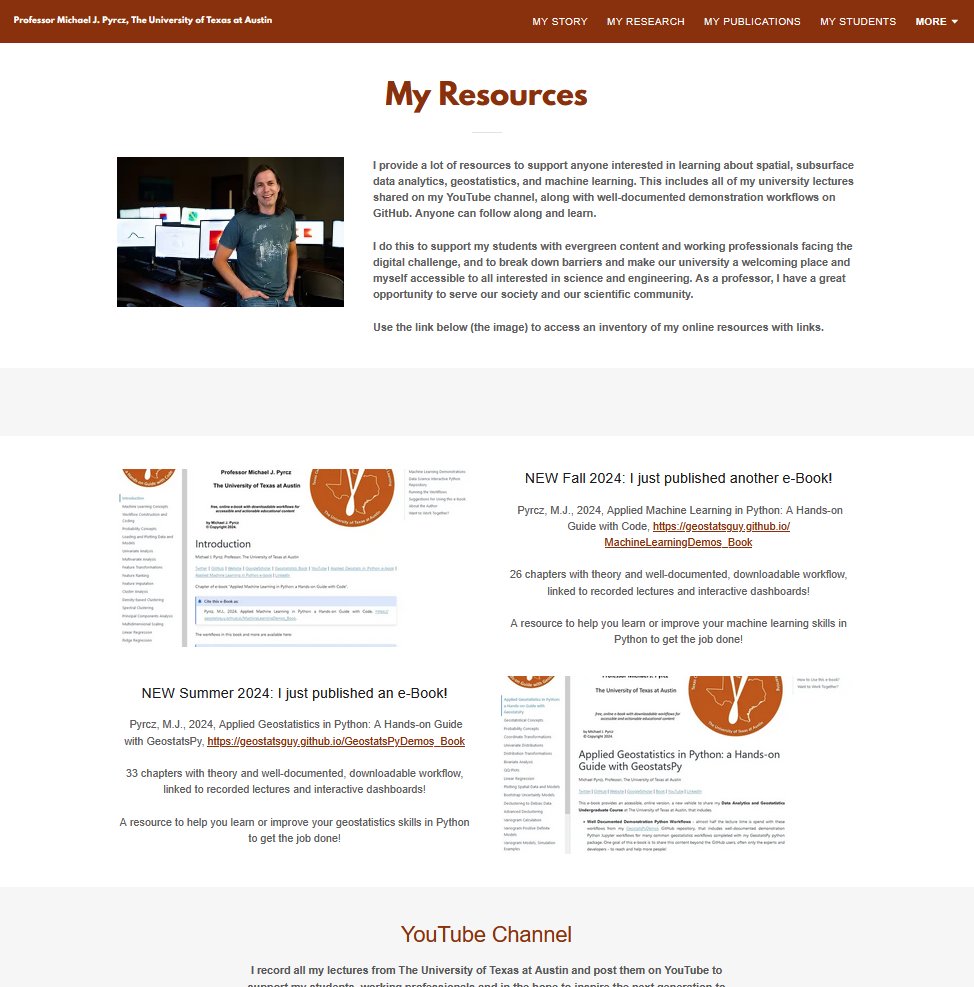
I share all of my university educational content to support students and working professionals!
1. Free, online e-books
2. YouTube lectures
3. Python interactive dashboards
4. Python well-documented workflows
5. Glossaries
6. Code snippets
Education changes lives! I’m stoked to help! Learn more at, https://t.co/ikPlw8Ro03.
Hi, I’m Professor Michael Pyrcz, also known as the GeostatsGuy. I make all of my educational content freely available online to support anyone with a passion for learning #DataScience, #DataAnalytics, #Geostatistics, #MachineLearning, & #DeepLearning.
Over the years, I’ve built out a comprehensive library of resources, including e-books, hands-on workflows, interactive dashboards, YouTube lectures, a Python package, etc. - all accessible and actionable!
Why do I do it? Because education changed my life, and this is my way of paying it forward.
Explore my full collection of free resources here:
👉 https://t.co/ikPlw8Ro03.
Synthetic ecosystems that autonomously and continuously evolve in silico 👾
An Alifer dream we pursue with Flow-Lenia !
If you are interested in complex systems with (1) emergent creatures and (2) intrinsic evolutionary dynamics, go check our new paper !
A 🧵
🧠 This morning I’m building an autoencoder by hand with only NumPy — no PyTorch, no TensorFlow. Why?
Because I believe coding it from scratch is the best way to truly understand what’s happening under the hood.
👇 Here’s what I’m doing, the full workflow:
1️⃣ Initialize weights & biases
2️⃣ Forward pass (with activations)
3️⃣ Compute average batch error derivatives (loss gradients)
4️⃣ Backpropagate error derivatives
5️⃣ Update weights & biases
6️⃣ Repeat until convergence
This isn't just for fun. I'm also documenting everything in a new chapter of my free online e-book:
📘 Applied Machine Learning in Python
🔗 https://t.co/pq4eWwjPQQ
The goal? Super accessible, hands-on, visual learning for everyone. 💡
#MachineLearning #Autoencoder #NumPy
🚨 Open-source humanoids now cost less than a MacBook.
Hugging Face releases 2 new open-source robots: HopeJR (66-DOF humanoid, ~$3K) and Reachy Mini (desktop unit, ~$250). Both are fully open-source and aimed at democratizing robotics hardware.
→ HopeJR is a full-size humanoid with 66 degrees of freedom, allowing walking and arm movements. Reachy Mini is a desktop robot that can move its head, talk, and listen, intended for AI prototyping.
→ Both robots are designed to be affordable and fully open-source. HopeJR is estimated to cost around $3,000, while Reachy Mini is expected to fall between $250–$300, excluding tariffs.
→ These platforms are explicitly meant to counter the dominance of closed-source robotics. Anyone can assemble, modify, and understand them, pushing against the black-box approach in current humanoid robotics.
→ The initiative is backed by Hugging Face’s recent acquisition of Pollen Robotics, which provided the core technical team and IP needed to accelerate hardware development.
→ Hugging Face’s broader robotics strategy includes its 2024 launch of LeRobot—a repository of open AI models and tools for robotics—and updates to its programmable SO-101 robotic arm, created with The Robot Studio.
First update of my online webgpu particle life simulator: the number of particle types is now also randomized each time (from 2 to 16), leading to greater variety!
https://t.co/EfUDKeHnm8
Awards totalling $10,000 for human-competitive results produced by Genetic and Evolutionary Computation to be presented at #GECCO2025. Deadline for competition entries 30 May 2025, see https://t.co/DnjowIdV9s
It's awesome seeing a project still getting use and showing up 8 years later. People are still using the drag-and-drop URDF web viewer to analyze robotics models! 😁
Video by @SkyentificTweet#ros#urdf#webgl#threejs#robotics