An announcement that is as personal as professional:
18 months ago, we started collecting online prices in real time to track how Liberation Day tariffs were feeding into inflation.
A lot has happened since. The BLS commissioner was fired. The longest government shutdown in US history meant CPI wasn’t published for the first time. And the case for an independent measure of inflation became much stronger.
What started as a tariff inflation tracker has since grown into something much bigger:
The Bloomberg Price Project (BPP), our attempt to build the US CPI from the ground up using alternative data.
Today, BPP covers 87% of the CPI basket, across both goods and services (more new data will be added in coming weeks). Every month, we collect millions of prices from card transactions, e-commerce sites, grocery stores, pharmacies, rental listings, corporate data, Bloomberg Terminal market prices and government records. And more data are coming.
The payoff is detail. Official CPI data let you drill down to categories such as “uncooked beef steaks.” BPP goes much deeper — breaking the CPI basket into almost 700 line items, compared with roughly 200 in the official data.
Brought to you by: myself, Troy Durie, Daniel Ripperger-Suhler, Joshua Danial and Scott Johnson from across Bloomberg Economics.
Explore the Bloomberg Price Project at BECO MODELS BPP <GO>, or download the data at ECAN US BPI <GO>.
I believe the paywall on https://t.co/XYp4l1nBLn is coming down briefly so you can read this without a subscription (but you should subscribe!)
https://t.co/8Mp1itYHR7
“I wanted to like humanity again; I wanted to see New Yorkers in a different way,” Mr. Magaddino said. “I needed to feel good about life and what I did again. And this was a perfect opportunity for me.”
Beautiful profile of BookOps @nypl@BKLYNlibrary
Waiting for a Library Book? This Man Makes Sure You Get It. https://t.co/2VvJ8MjMKZ via @NYTimes
I have done three Vawaas myself! I can vouch for the life-changing nature of these mini apprenticeships, in particular from getting to know the artists themselves.
Very cool idea - Vacation With an Artist (https://t.co/cOdW5jf5Qb)
Travel the world and learn new skills (lots of interesting ones- ceramics, street art, bookbinding, etc) via a mini-apprenticeship (3-10 days) with master artisans, in many cases you stay with them too.
It wasn’t just the price of food that changed in 2025—so, too, did Americans’ taste preferences, Grace Buono writes in The Wonder Reader. She explores stories about how to understand the food we ate this year: https://t.co/guRMCsNxEw
Last week we published our “Top of the Charts”, a look back at our most popular charts, articles, data insights, and more in 2025.
→ https://t.co/I9rnGavW14
Each Friday, we’re sharing more from that list. Today we give you our top 5 most-read articles published in 2025. 🧵
@tferriss@netflix From 2014, but definitely Virunga, about the team fighting to protect the national park in Congo (home to the last few mountain gorillas) from local militias, poachers, and oil exploration.
Part of the reason the current moment--global conflict, rise of populism, resentment, etc--has been so surprising to most in the policy space is that they were trained in the standard economic thinking of the time, which emphasized material comfort above all else.
The emphasis on material comfort gave rise to the worldview that if we were all just better connected, if prosperity could be shared through fair trade and economic relationships, then conflicts would melt away and we would approach "the end of history". Friedman's famous "McDonald's" theory is a good example of that--put a McDonald's in every country and we will have no wars and strife.
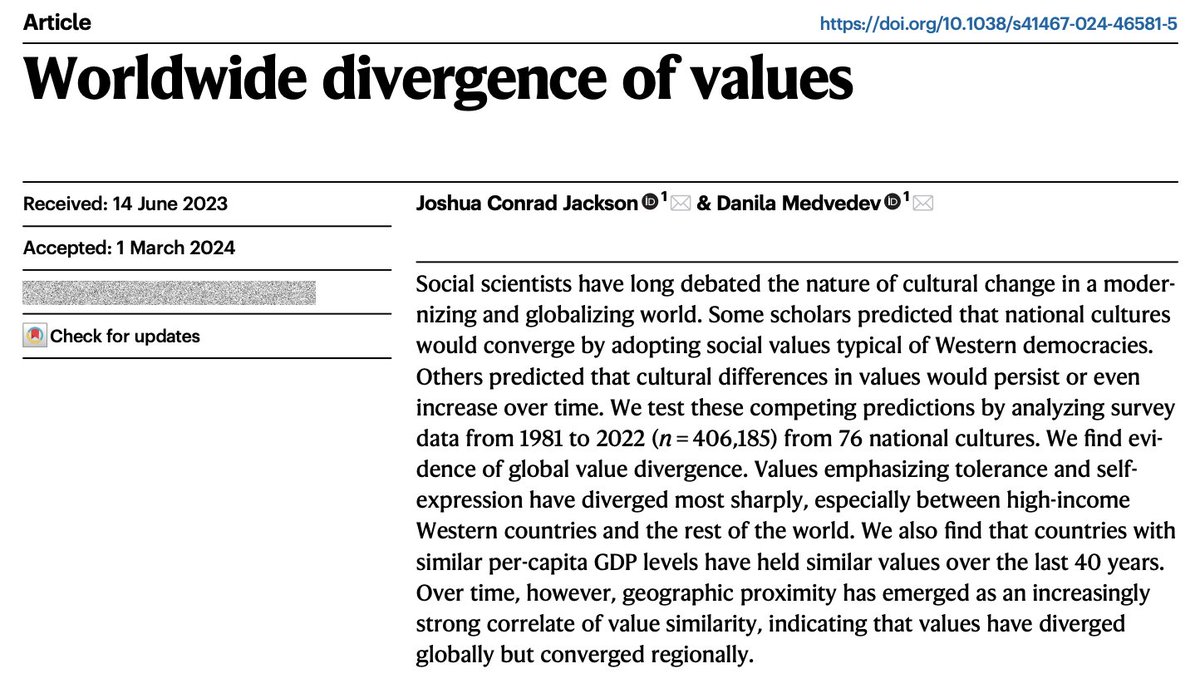
But this ignores basic human psychology: moral values, need for status, mimetic desires to dominate, need for meaning through sacrifice/religion are all integral to human motivation. These motivations operate all the time, but become even more extreme when material comforts *are* met. This is when people start looking for status and meaning on dimensions that seem self-destructive, fighting "metaphorical wars". You can see this in the divergence of values over time: as economies have become increasingly globalized and overall prosperity has increased, human values have *diverged* (see paper in reply).
These motivations are also why any "utopia" will always be doomed to fail.
Unlike many on here who critique economics, things like status, identity, mimetic forces are not outside the standard economics toolkit. There have been plenty of important papers written on status-seeking, culture, norms, and mimetic forces. But most of this work is either relatively recent or was on the periphery of economic thinking that permeated policy circles.
The New York Times is looking for a Jr. Video Production Coordinator, NYT Cooking:
- New York, NY, USA
- Full time opportunity
- Junior
Apply via the link or tag a friend who may be interested 👇🏼.
https://t.co/6iD2Z2xodt
I was very upset to learn of the death of Kanzi, the Bonobo ape last week.
One of the most remarkable experiences of my life was making music with Kanzi and Panbanisha, two extraordinary Bonobo apes - pg
https://t.co/QH1qEx5jg7
Photo courtesy of Ape Initiative
We just launched Corca—a collaborative math editor. The main idea: there’s no 'text editor' for math. If you want to work on equations on a computer, there’s no app designed for that—so the only real option is paper.
↓
I've spent the last 8 months traveling to 20+ states, talking to young people about how they see their economic futures. I wrote about my findings (link below).
Gen Z faces a double disruption: (1) AI-driven technological change + (2) institutional instability. When I talk to young people, they're not just worried about finding jobs, they're worried whether "careers" as we know them will exist in 5 years.
We're seeing a version of the barbell strategy in how young people approach their futures. On one end, people are choosing trades over college debt. On the other, people are betting everything on creator economy/crypto/AI startups etc etc. The middle path exists, but it's increasingly blurry.
This shapes identity. When a single viral TikTok can outperform a year's salary, and traditional credentials lose value faster than you can earn them, young people aren't just changing careers—they're developing fundamentally different relationships with economic reality.
When I talk to people across the country, their concerns are greater than traditional political divisions. They're wrestling with questions of identity, meaning, and community in a world where traditional narratives about success and stability no longer hold.
What looks like a conservative shift among young voters might actually be something more foundational: a generation's attempt to navigate a world where institutions promise stability they can't deliver, where algorithms offer opportunity without security, and where the very nature of work and worth is being redefined. It’s constantly evolving, and it’s not just politics - it’s the very nature of self being called into question. Link in next post.