Transnational corporations negatively affect public health through various channels, leading to efforts that set behavioral standards and impose regulations to curb harm.
Recently, corporate scorecards, such as the Access to Medicine Index (ATMI) and the Access to Nutrition Initiative’s Global Index (ATNI), have increasingly been used to encourage social responsibility.
In this viewpoint published in @TheLancet titled "Holding powerful corporations accountable for their health impacts: are corporate rankings effective?”, authors David McCoy (@dcmccoy11), Els Torreele (@ElsTorreele) and Penelope Milsom (@milsompenelope) argued that these scorecards are flawed and risk reinforcing the dominance of large pharmaceutical and food companies, ultimately undermining public accountability and equitable access to healthy foods, medicines, and vaccines.
While at face value, scorecards such as ATMI and ATNI appear to incentivise better corporate practices, a United Nations University International Institute for Global Health (UNU-IIGH) analysis has exposed significant weaknesses in their indicators, methods, and theory of change.
Read the full viewpoint and learn more here: https://t.co/VJ2uu4J9n8
#UNUIIGH #UNU #GlobalHealth #HealthGovernance #CorporateAccountability #FoodSystems #AccessToMedicine
📢 Tomorrow | 𝗨𝗽𝗰𝗼𝗺𝗶𝗻𝗴 𝗪𝗲𝗯𝗶𝗻𝗮𝗿: 𝗥𝗲𝘁𝗵𝗶𝗻𝗸𝗶𝗻𝗴 𝗖𝗼𝗿𝗽𝗼𝗿𝗮𝘁𝗲 𝗔𝗰𝗰𝗼𝘂𝗻𝘁𝗮𝗯𝗶𝗹𝗶𝘁𝘆 𝗶𝗻 𝗚𝗹𝗼𝗯𝗮𝗹 𝗛𝗲𝗮𝗹𝘁𝗵: 𝗕𝗲𝘆𝗼𝗻𝗱 𝗥𝗮𝗻𝗸𝗶𝗻𝗴𝘀 & 𝗩𝗼𝗹𝘂𝗻𝘁𝗮𝗿𝘆 𝗠𝗲𝗮𝘀𝘂𝗿𝗲𝘀
📅 𝟭𝟵 𝗗𝗲𝗰𝗲𝗺𝗯𝗲𝗿 | ⏰𝟭𝟮:𝟬𝟬–𝟭𝟯:𝟯𝟬 𝗨𝗧𝗖 | 𝟮𝟬:𝟬𝟬–𝟮𝟭:𝟯𝟬 𝗠𝗬𝗧
Join UNU-IIGH and global experts for a critical discussion on scorecards and rankings like the Access to Medicines Index and Access to Nutrition Initiative, and what truly effective corporate accountability should look like in the fight for health equity.
🔍 𝗜𝗻 𝘁𝗵𝗲 𝘀𝗲𝘀𝘀𝗶𝗼𝗻 𝘄𝗲 𝘄𝗶𝗹𝗹:
• Expose the limitations and risks of voluntary corporate scorecards (e.g., AtMI, AtNI).
• Highlight harmful corporate behaviors often overlooked by rankings.
• Present principles for effective corporate monitoring and accountability.
• Foster dialogue on systemic reforms needed to regulate corporate power in health governance.
------------------------------
𝗠𝗼𝗱𝗲𝗿𝗮𝘁𝗲𝗱 𝗯𝘆:
• Penelope Milsom (@milsompenelope), Honorary Research Fellow, UNU-IIGH)
𝗦𝗽𝗲𝗮𝗸𝗲𝗿𝘀:
• Judy Gearhart (@Judy_Gearhart), Accountability Research Center, American University
• Els Torreele (@ElsTorreele), Health Equity & Economic Justice Advocate
• John Thomi (@JohnThomi), Policy Officer, Tax Justice Network Africa
𝗥𝗲𝗴𝗶𝘀𝘁𝗲𝗿 𝘃𝗶𝗮: https://t.co/CQ1uItqp8S
#UNU #UNUIIGH #GlobalHealth #Accountability #PublicHealth
Fantastic analysis by @BenjaminM_Wood on the political economy system of #UPFs showing feedback loops holding our high UPF consumption in place. Helps to explain the huge policy inertia preventing serious action.
I just signed - will you join me? Te Tiriti o Waitangi and its principles must be protected by all of us. It is essential for Māori rights and health and is what allows us Pākehā and Tauiwi to call Aotearoa home. https://t.co/29F4DuoLa5 via @actionstation
COMMENT: No silver bullets, no shortcuts: confronting the commercial determinants of the climate crisis @BenjaminM_Wood @milsompenelope@SharonFrielOz
https://t.co/NK80Nhxkvl
📢 Save the Date!
Join us for the Report Launch Webinar on Corporate Accountability in Global Health Governance, featuring a case study of the Access to Medicine Index.
🔍What to expect:
A critical exploration of the "league table" as an accountability mechanism to improve access to medicines, and why such mechanisms might paradoxically weaken efforts to regulate pharmaceutical companies.
🗓 Date: 17 October 2024
🕒 Time: 3-4 PM MYT
Stay tuned for more details on how to join us for this discussion!
#UNU #GlobalHealth #PowerAndAccountability #HealthGovernance #AccessToMedicine #CorporateAccountability
Oh my god this broke me 💔💔💔
A little child in Gaza calling out for her Mama after her whole family was killed by Israeli air strikes
Her little voice - what a cruel cruel world we live in
We can never stop talking about Palestine 🇵🇸 💔
One thing we've learned from studying genocides is that language like this often precedes the mass killing. Otherize, dehumanize, and fearmonger about the target group. This is well documented in Rwanda in 90s and in the 1930s Nazi regime.
This is historical fact, not hyperbole.
A great article on how NZ has aligned with Big Formula against mums & babies. Shows the huge power of companies like Fonterra or Danone, as formula is ~15% of NZ exports. NZ rivers are turning into 🐄 sewers as a result but hey $ trump people. #Auspol@DrMikeJoy@HelenClarkNZ
New paper shows that the scale of corporate profit repatriation out of the global South is... massive.
"Between 2005 and 2020, transnational corporations repatriated an annual average of one trillion USD." https://t.co/lKNnIPRCa6
Profit repatriation is theft.
Profits made in global South host countries, which are produced from local labour and resources, should be reinvested to improve national development. Achieving this must be a core objective of Southern industrial policy.
Join our @WHO 🇺🇳 31 July 14 – 16 CEST webinar on: “Community Engagement for Addressing Commercial Determinants of Health’’
Chaired by Prof Freudenberg and co-moderated be me, we'll dive deep on the role for communities in addressing business practices and power and the levers communities have with advocacy, accountability, monitoring, etc.
📝 https://t.co/OuVTDX7dx7
#CDoH
Join us for our second session in the #Power & #Accountability webinar series.
Explore power asymmetries in global health governance with us on June 27. Understand the impact of globalization & the roles of different actors in shaping health policy.
🔗https://t.co/FVLOlCy8tl
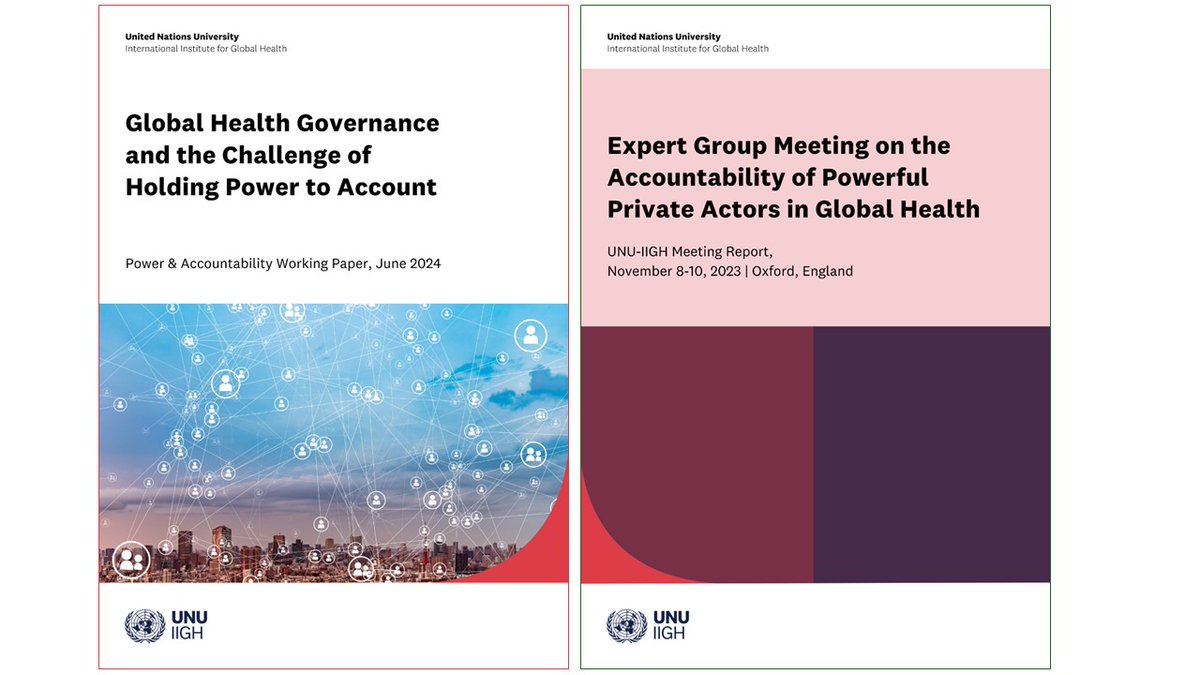
Two new reports on power, accountability and global health. Foundational to @UNU_IIGH's new 5 year strategy and work package to identify and correct inappropriate power dynamics and unhealthy accountability deficits. But how do we go about this? Tell us what you think.