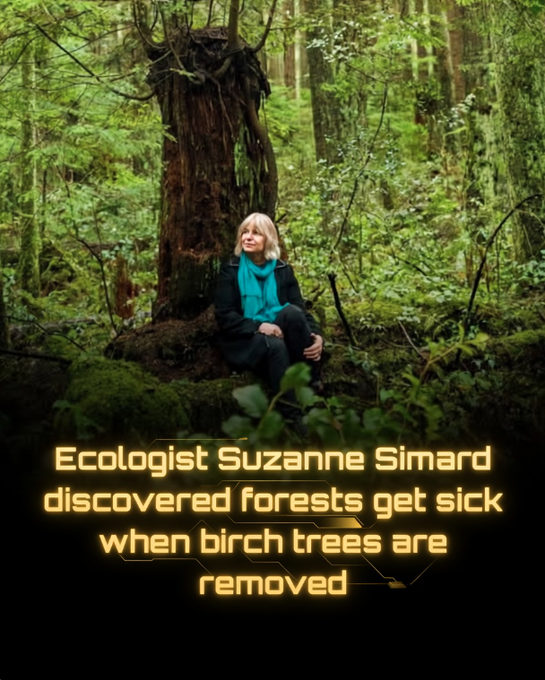
In the 1990s, Canadian ecologist Suzanne Simard made a groundbreaking discovery that challenged everything we thought we knew about how forests work. While studying managed forests in British Columbia, she noticed something puzzling: when birch trees were removed to promote the growth of valuable Douglas firs, the firs did not flourish as expected, they actually struggled and grew more slowly.
Determined to understand why, Simard traced the movement of nutrients using radioactive carbon isotopes. What she found was astonishing. Trees were actively sharing resources through vast underground fungal networks known as mycorrhizae. These delicate, thread-like fungi connect the roots of different trees across the forest floor, forming a complex web that allows the exchange of carbon, water, nutrients, and even chemical signals, sometimes between entirely different species.
She discovered that older, larger trees often serve as central "hubs" or "mother trees," supporting younger saplings by redistributing vital resources and helping the entire ecosystem remain resilient. When these key trees are removed, the underground network weakens, and the health of the remaining forest declines.
Simard’s research overturned the traditional Darwinian view of forests as battlegrounds of ruthless competition. Instead, she revealed a far more sophisticated reality: forests operate as highly cooperative systems where trees communicate, support one another, and even warn neighboring trees about threats like drought, disease, or insect attacks.
What appears to the human eye as a silent, still forest is, in truth, a vibrant, interconnected living network, built not on isolation and rivalry, but on deep connection and mutual aid.
Putin told Iran the locations of our warships.
Today, Trump rewarded him by lifting sanctions and allowing American dollars to fuel Russia’s war machine.
Our troops are in harm’s way, and the President cut a deal with the adversary putting a target on their backs.
Who was first? Palestinians or Jews? The answer is not 'either or'.
In the Egyptian Museum in Cairo stands a slab of black granite carved around 1208 BCE. Its hieroglyphs celebrate the victories of the pharaoh Mernepta: “Israel is laid waste; his seed is not.”
The display makes no mention that more than three thousand years ago, an Egyptian king who knew nothing of the Hebrew Bible recorded that a people called Israel was living in Canaan.
The modern pro-Islamist claim that Jews are latecomers is historically false. Numerous ancient records refute it.
Around 840 BCE, King Mesha of Moab carved a stone boasting of his war against Israel and naming the Israelite king, Omri.
A ninth-century BCE inscription found at Tel Dan refers to the “House of David.”
In 701 BCE, the Assyrian king Sennacherib recorded his siege of “Hezekiah the Judean” in Jerusalem.
These records are written by people with every reason to ignore Israel, that confirm that an Israelite and Judean people lived in the hills of Canaan for centuries before Rome existed.
The second claim is that Palestinians are an ancient people of the region, even older than Israel. This also fails.
The word Palestine is truly old, but it never referred to the people who carry that name today. Herodotus used Palaistinē in the fifth century BCE, and it comes from the Philistines, a seafaring people who arrived on the southern coast around 1200 BCE.
A 2019 study of ancient DNA from Ashkelon, published in Science Advances, found that the Philistines brought European-related ancestry with them, and that within two centuries it had been absorbed into the local population.
The Philistines disappeared after Babylon destroyed their cities around 604 BCE. Rome revived their name in about 135 CE, after crushing the Bar Kokhba revolt, and renamed the province of Judea as Syria Palaestina.
The Arab armies came in the 630s CE, some 1,800 years after Merneptah’s scribe carved the word Israel. They brought new rulers, a language, and a religion, and over the centuries most of the population adopted all three. What we call the distinctly Palestinian national identity arrived much later.
The Palestinian historian Rashid Khalidi, no friend of Zionism, dates its emergence in his book Palestinian Identity to the late Ottoman period and the early twentieth century.
Under the British Mandate, “Palestine” was attached to any group that lived in the region, including Christians, Muslims, and Jews, that the country’s leading English-language Jewish newspaper was called the Palestine Post.
It became the Jerusalem Post in 1950.
Modern genetic studies show that both Jews and Levantine Arabs, including Palestinians, carry substantial similar ancestry from ancient populations.
But historically, the Jewish people have an independently documented presence in that land going back more than three thousand years. Palestinians are, in large part, Arab descendants of the land’s long-term inhabitants, but their national identity is about a century old.
As to the claim of who lived in the land first, between Jews and Palestinians, the answer is not close.
Anyone who stands on a campus and calls the Jews of Israel foreign colonizers in their ancestral home is arguing with a granite slab in Cairo that names a Judean king in Jerusalem nearly 1,300 years before Muhammad was born.
Stones never lie.
In 2006 the commanding general of the US Marines in Iraq banned his men from wearing the most popular sports shirts in America, because of what the burns surgeons were finding.
It was 50 degrees in Anbar province. The issued cotton T-shirt was soaked through in minutes, so Marines had been buying their own. Tight, light, sweat-wicking tops in polyester, the kind every gym in the country is full of. They were cooler and they dried fast. Nearly everybody had them on under the body armour.
Then the roadside bombs started. A bomb under a vehicle produces a flash of fire lasting a second or two. Cotton scorches in that time. Polyester melts.
The Navy doctors at the field hospitals described the result. The shirt turned to liquid and set again on the man's chest and back. A burn that should have been survivable became a far worse one, because there was now a layer of plastic fused across it that had to be cut away.
In April 2006 the order went out from Camp Fallujah. No synthetic athletic clothing outside the wire. It named the brands.
The Marines then went looking for something that wicked sweat, dried fast, did not stink after a week and would not melt. What they found had been grazing in New Zealand the whole time. Fine merino wool is now standard issue next to the skin for troops who expect fire.
That is twice in 25 years, in two different services, that plastic clothing has been tested on young men by an explosion. Both times the answer came off a sheep.