APA member John Torous, M.D., M.B.I., testified this week before the House Committee on Energy and Commerce's Subcommittee on Oversight and Investigations about the risks and benefits of AI chatbots. He emphasized the need for greater transparency and research into this space. Learn more about growing concerns over AI-induced psychosis in our recent Special Report at https://t.co/rHK0qSCoTM.
Our new paper with @JohnTorousMD and team highlights why tech alone isn’t enough in mental health. Digital Navigators can boost real-world impact. We outline global efforts and practical paths for training and funding this role.
https://t.co/dtghMvUJgu
First speakers announced for the FREE 2025 SODP Symposium: Advancing #DigitalMentalHealth Through #AI! Join @SteveSiddals, Dr. Amir Rahmani, Soumya Choudhary (@mindmanure), and Benjamin W. Nelson on Dec 12, 1 PM ET. More to come!
Register: https://t.co/8jq4Vmp3GB
What type of mental health AI: rule-based, machine learning, or LLM? Our new review with @j_linardon @SteveSiddals and more explores the evidence, facts, and open questions of what they do. New in World Psychiatry. Free @ https://t.co/4s5hRYnADK
📣 #WEBINAR: Explore 'From Signals to Solutions: Making Digital Phenotyping Clinically Meaningful.'
Join @DrAbbyOrtiz & @JohnTorousMD on August 28 to learn about bridging the gap between algorithm development and practical clinical use.
Register: https://t.co/WWJdxktyMK
Join the Mental Health Dialogue on Aug 29! Discover how digital tools are transforming mental well-being featuring global experts, innovative apps, & actionable insights to reshape mental health for all. Let’s connect, & learn. Youtube link: https://t.co/HBY34Q82gf
#nimhans
Calling all researchers! JMIR Mental Health invites submissions for our theme issue on AI-Powered Therapy Bots. We're looking for papers that explore real-world efficacy, ethics, and impact. Deadline: Oct 31, 2025. Submit now! https://t.co/cRZyLG9LIY @JohnTorousMD
Can ChatGPT feel anxious? A new study shows GPT-4's anxiety scores rise after reading trauma-related prompts and drop after mindfulness. This study suggests the emotional tone of prompts can influence LLM behavior https://t.co/WIsOpREc7u
Digital health tools need user engagement to work well. In this new review/consensus statement, we 1) lack of agreed-upon metrics for engagement, 2) lack of evidence on how better engagement improves outcomes, and 3) lack of standards for user involvement. https://t.co/jR5GFghhhh
Where are we with generative A.I./chatbots to support mental health?
@JohnTorousMD and I provide a concise summary of progress and what's needed @TheLancet
https://t.co/xjCN5V2QTq
This new review (search up to March 2023) on technology-enhanced practice competencies finds that while there is much work to be done, the vast majority of progress to date has been in the #mentalhealth space: https://t.co/xGILRyJ98z
Attended @JohnTorousMD s’ talk at #APA2025 on clinical updates in AI and LLMs in psychiatry. Fascinating to see how fast the field is evolving — from real-world applications to a timely take on current regulatory landscapes. Insightful and thought-provoking. #DigitalMentalHealth
Digital literacy is a vast topic. Bridget Dwyer shares how this simple scale and matching guide can pinpoint the right resources and skills to help each person. Cc @APApsychiatric#APAAM25
This is an important paper as it addresses a significant gap in the literature— the lack of consolidated reviews on studies that utilize LLMs for generative AI. This form of AI is distinct from other approaches such as traditional ML and NLP and is very useful in MH care.
"A scoping review of large language models for generative tasks in mental health care" - new from our team in @npjDigitalMed ... results.. 'highlight need for a unified, rigorous framework to assess and validate LLM in mental health systematically.' https://t.co/1MDD4gE7Jk
Artificial Intelligence ChatGPT-counseling improved anxiety and depression better than a standard clinician-led education group in a large randomized trial of patients with cancer:
https://t.co/feUH0gZIeQ
This wasn't #psychotherapy. It was medical information that AI provided.
Another shutdown in the digital mental health space. But we know that AI and digital tech is here to stay. There has to be better understanding of why do we see promising results in pilot studies but real world applications face closures?
📢 WEBINAR: How do we classify and implement digital mental health tools effectively?
Join Holly Coole (@MHRAgovuk), Dr Gareth Hopkin (@NICEComms) & @JohnTorousMD on April 24 to explore a new DMHT framework.
Register: https://t.co/2NmR0bdJLU
#DigitalMentalHealth#DMHTs#Webinar
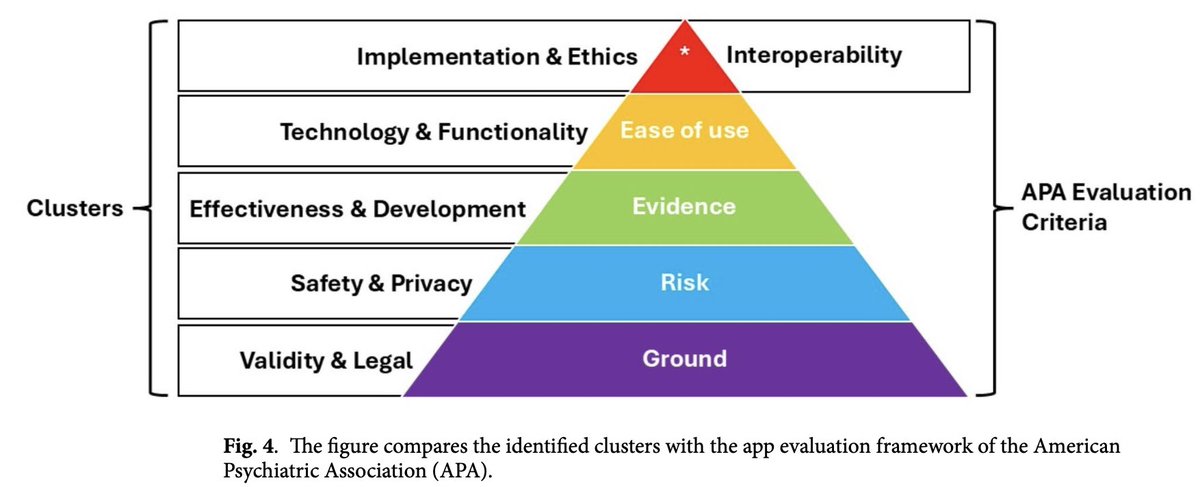
We used NLP on over 130 app evaluation schemes to propose a standardized framework. The resulting clusters align with but expand @APApsychiatric evaluation domains, incorporating aspects such as inclusivity, safety, engagement, and ethical principles. https://t.co/R0SNesoLLW
What do mental health providers want in digital health tools for targeting psychosis? @sbucci76 and team share in their new publication in @JMIR_JMH https://t.co/Az8b2KO66K (free) with so many more fascinating insights.