Renegade. Directed/Produced at @buzzfeedvideo @funnyordie @comedycentral and former EP for the @therock YouTube, Adjunct Professor @usccinema #diversity#latinx
One thing I like to repeat in my class is that it’s not about what you are working on right now, it’s about how what you are working on right now will inform your future work. The worst thing you can do is stop creating.
What’s your favorite film advice? #FilmTwitter#filmmaking
@TradePools In The Meantime: Users are invited to vote on the $POOLS Rewards Date.
All active voters will gain a bonus allocation upon launch.
Details here: https://t.co/TXtoEXDvrX
@TradePools Quick reminder, users are invited to vote on the $POOLS Rewards Date.
All active voters will gain a bonus allocation upon launch.
Details here: https://t.co/TXtoEXDvrX
@TradePools Quick reminder, users are invited to vote on the $POOLS Rewards Date.
All active voters will gain a bonus allocation upon launch.
Vote Now: https://t.co/ZpBXKgXkTD
Instead of spending 2 hours on a movie...
Spend 1 hour watching this Anthropic Claude for Finance lecture.
It might be the most valuable free resource on quant AI available right now.
Bookmark it, make time for it today, and thank yourself later.
From prompt → context → harness → loop → graph engineering:
The list keeps growing, and every new term gets treated as a replacement for the last one.
In reality, however, each layer wraps the one before it, and the cleanest way to tell them apart is to ask what a single unit of work looks like.
> Prompt engineering is the message:
The model remembers nothing before this call, so the prompt has to carry the full universe of what it needs. a role, the background, the instructions, a few examples, and a format.
When the output falls short, the skill is working out which ingredient lets you down, not rewriting the instructions every time.
The unit of work is one input.
> Context engineering is the memory:
Across many steps, the window is finite, and the available information is not, which forces a curation step. A curator keeps what matters, compresses what is useful but bulky, and drops the rest.
Good curation is mostly about knowing what to throw away, not packing more in.
The unit of work is what stays in the window.
> Harness engineering is the machine:
On its own, a model just generates text. The harness gathers what it needs, runs it, calls tools or sub-agents, and verifies the result with tests or a judge.
That verify step is the entire difference between calling an api and running an agent.
The unit of work is one pass through the machine.
> Loop engineering is the run:
One pass rarely finishes the job, so something has to decide whether to run the machine again. That decision needs a goal defined upfront, brakes like max iterations and budget caps, and a completion check that is automated rather than felt.
An agent that stops asking for tools has ended its turn, which is not the same as finishing the task.
The unit of work is the whole run.
> Graph engineering is the coordination:
Once several loops have to work together, you need to say what runs when, what runs in parallel, and who checks whom. Nodes do the work, edges decide what runs next, and shared state flows between them.
A single loop is just a one-node graph with an edge pointing back at itself, which is why graphs govern loops instead of replacing them.
The unit of work is the whole job.
Here is the part that ties it together.
Prompt and context both live inside the harness gather step. The harness is one pass, the loop decides whether to run that pass again, and the graph decides which loops run at all.
Zoom out, and the unit of work gets bigger. Zoom in, and you are back at the prompt.
That also tells you where to debug. Find the layer whose unit of work broke, then fix that layer.
The prompt is the easiest layer to edit, which is why it keeps taking the blame for failures that live three layers up.
My co-founder published a deep dive on graph engineering, covering the core idea, how to get started, shared state, routing you can trust, and when a graph is genuinely overkill.
Read it below.
Anthropic engineer:
"You're not supposed to prompt Claude. You're supposed to build a system that prompts itself."
In 45 minutes, she breaks down how Anthropic builds agents that remember, learn from their mistakes, and get smarter with every run.
Worth more than any paid course you'll find on building agents.
Watch this and bookmark
🤖 In a city of circuits and shadows, one creator discovers that humanity can’t be programmed.
Reprogrammed joins the NFMLA September 20th lineup for our Monthly Film Festival | InFocus: Latin & Hispanic Cinema. A stunning retro-futuristic tale of invention, isolation, and the messy beauty of real connection—this short redefines what it means to be truly alive.
Reprogrammed
Synopsis: In retro-future LA, Andrea, a lonely roboticist, neglects her life to finish her masterpiece – IRIS. While teaching IRIS the ropes of being sentient, she realizes she must patch things up with her father. By giving birth to artificial life, Andrea learns how to live a real, organic life.
Director and Writer: @mindshawk
About the Director: Christopher Guerrero is a Latinx writer/director from California’s Central Valley whose work fuses horror, comedy, and cultural commentary. A 2025 Stowe Story Labs Fellow and winner of the Ghetto Film School x Frieze LA Film Award, Christopher’s projects have been a part of Slamdance, Austin, HollyShorts, and Santa Barbara. He’s directed campaigns for Microsoft, Disney, GEICO, and Coca-Cola, and collaborated with talent including The Rock, Wayne Brady, and Jack Black. A directing professor at USC, Christopher tells bold, genre-driven stories that entertain, provoke, and spotlight underrepresented voices.
Producers: @mindshawk
Cast: @coffeegremlin_ @el_rayhuizar
Crew:
DP: @gavinvmurray
Production Design: @genevieveconstance
Produced By: @schmallonee , Ryan Dee Gilmour
Music/Sound Design: @paulclaypool
Iris Animation: @kaneicaruslynch
Location Sound: @alexdotbologna
Gaffer: @benthatchervideo
Key Grip: @uptheaperture
1st AC: @uncleboone.mp3
PAs: @em_perezofficial, Lauren Holiday, Brewster Swanlund, @anne_leigh08
🎟️Learn more: https://t.co/cf8DFbcfmp
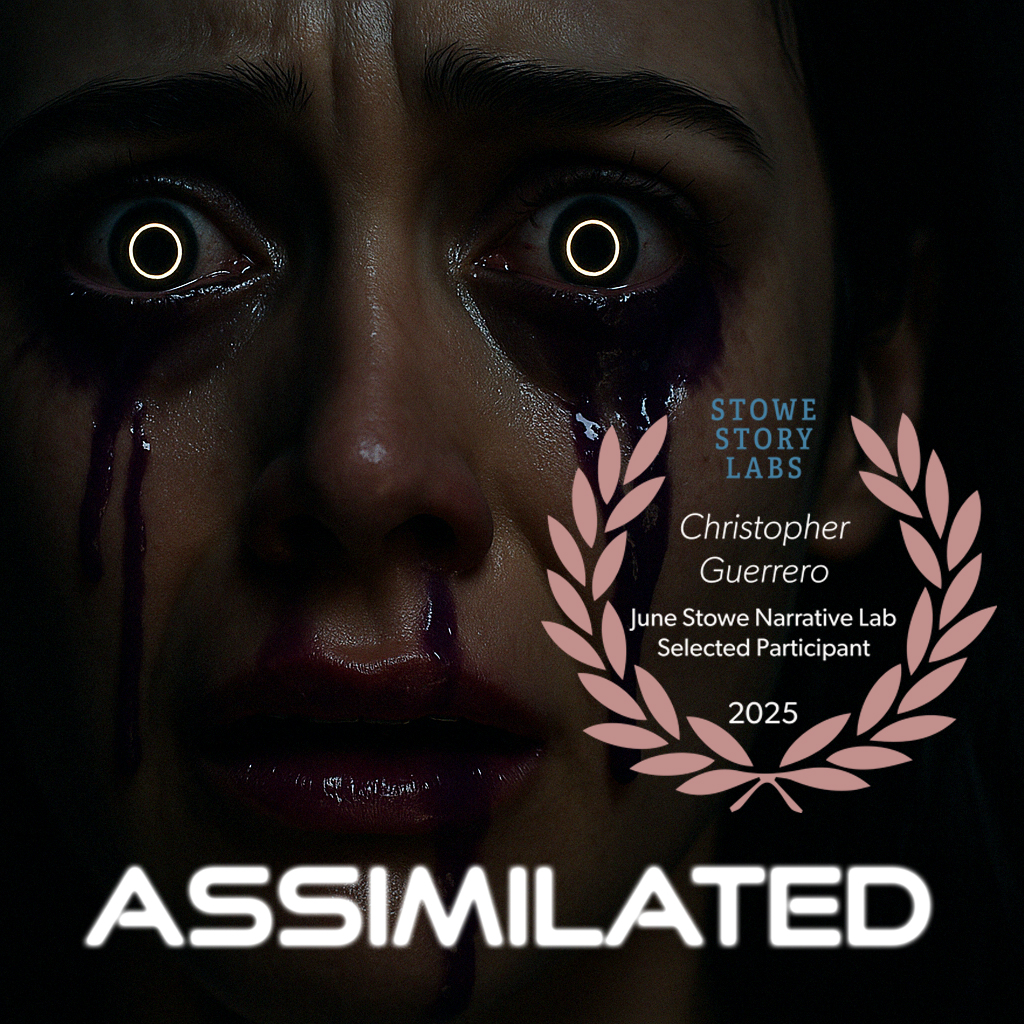
Excited to announce that I was chosen to attend the STOWE NARRATIVE LAB in Vermont next month with my feature film, ASSIMILATED. Thank you, @stowestorylabs, and congratulations to all participants! Excited to meet everyone!
@maizie_star There is an idea of a Tips For Men. But there is no real me. Only an entity. Something illusory. And though I can hide my cold gaze, and you can shake my hand and feel flesh gripping yours, and maybe you can even sense our lifestyles are probably comparable I simply am not there.
Our new sci-fi horror project, ASSIMILATED, is up for funding, and we need your help! Go to the LINK BELOW for the details on how to VOTE. The higher, the better! I'm excited about this one!
https://t.co/JzR3c78aAT