📚Этот бесплатный полуторачасовой курс Stanford объясняет, как устроены изнутри Сlaude и СhatGPT. После понимания процессов, промты для ИИ становятся более точными, а эффективность работы с искусственным интеллектом повышается на 90%.
Сохраняйте себе.✏️
Auch wenn das Ausscheiden schmerzt: Was für ein Spiel, @DFB_Team! Mit eurem Einsatz und Teamgeist bei dieser WM habt ihr unser Land begeistert. Wir sind stolz auf euch.
The most influential immigrant group in American history is the one nobody argues about, because almost nobody remembers it was them.
Start at the beginning. The Continental Army was a half-trained mess until Baron von Steuben, a Prussian officer, showed up at Valley Forge and drilled it into a real fighting force. The freedom of the press you take for granted traces back to John Peter Zenger, a German immigrant printer whose 1735 trial established that you can't be jailed for printing the truth. German-Americans were shaping this country before there was a country.
Then look around your own life. Your Christmas tree is German. The hot dog (Frankfurt), the hamburger (Hamburg), the pretzel, the delicatessen, all German. Kindergarten is German, the word and the idea, brought over and opened by Margarethe Schurz. Blue jeans came from Levi Strauss of Bavaria. Heinz ketchup, Steinway pianos, Oscar Mayer, and the big four beers, Budweiser, Pabst, Miller and Schlitz, were every one founded by German immigrants.
The Brooklyn Bridge was engineered by John Roebling, born in Prussia. The Santa Claus you picture every December, plus the Republican elephant, were drawn by Thomas Nast, a German immigrant. Pfizer was founded by Charles Pfizer, who arrived from Germany in 1848. Boeing was built by the son of a German immigrant. John Jacob Astor showed up from Germany with next to nothing and became America's first multimillionaire. Charles Steinmetz, a disabled immigrant nearly turned away at the border, went on to make modern electrical power possible.
And it kept going. Wernher von Braun designed the rocket that put America on the moon. Einstein was German. Carl Schurz, a refugee, became a Union general and the first German-born US Senator. Eisenhower commanded D-Day and won the White House under a name once spelled Eisenhauer. Babe Ruth was a German-American kid from Baltimore.
Here is the kicker. German is the single largest ancestry group in the entire United States, around 44 million people, bigger than Irish, English or Italian. The biggest thread in the whole American fabric, and somehow the quietest.
They never asked for parades. They just trained the army, freed the press, engineered the bridges, founded the companies, built the rockets and lit up the Christmas mornings, then blended in so completely you forgot they were ever the "other." That might be the most American story there is.
🚨 Anthropic just showed a 27-minute workshop on how to actually do prompts for Claude.
Taught by the people who built it.
Free. No registration. No paywall.
I've seen $300 courses that don't cover what they teach in the first 8 minutes.
Watch it and bookmark it now.
Der Virologe und CDU-Politiker Hendrik Streeck ist mithilfe einer Leihmutter aus den USA Vater geworden. Das ist kein Grund zur Häme, sondern ein Anlass, die deutsche Rechtslage zu überprüfen. https://t.co/cUuAqrdrlN
Мне пришлось несколько раз перечитать заголовок, чтобы уложить это в голове.
В смысле 30% подростков не могут нормально читать. ЭТО КАК ВООБЩЕ, БЛЯТЬ???! Какой год на календаре? 1786 или 2026?
В России набирает популярность услуга «справедливого крышевания» — СМИ
Бывшие бойцы ММА и спортсмены за деньги предлагают россиянам силовую поддержку в бытовых конфликтах
Предупредить шумного соседа стоит 5 тысяч рублей, а «доходчиво объяснить» — уже 10 тысяч. Клиенты даже могут заказать выбивание алиментов за 30 тысяч рублей.
Цена на «годовые абонементы» по силовой поддержке обсуждается индивидуально
«Предприниматели» рассказали СМИ, что это не возвращение в 90-е. Просто за деньги они поддерживают слабых и беззащитных. А если видят, что клиент «попутал берега» и не прав, то ему будет отказано в предоставлении услуг
Услуга начинает стремительно набирать обороты, россияне всё чаще обращаются за "крышей", а не в полицию
POV:
You swapped Deadlifts out for this exercise and now…
- Your Lower Back feels better than ever before
- Your Glutes and Hamstrings are the most developed they’ve ever been
- It is much easier for you to recover on time for your next session
NO-BRAINER DECISION
it's genuinely insane how much progress biotech is making in 2026:
- Japan just endorsed the first iPS cell therapies for heart failure and Parkinson's. reprogrammed cells from your own body replacing damaged tissue
- Altos Labs built an Atlas of Rejuvenation. 100+ genes linked to cellular youth. they are now repurposing existing drugs to hit them
- a cancer drug accidentally became a longevity drug. rapalink-1 extends lifespan through the same pathway as rapamycin but cleaner
- Retro Biosciences dosed the first humans with a pill that reactivates the brain's cellular cleanup machinery. results Q3
- peptides went from felony to federal policy. 14 of 19 banned compounds are coming back
- psychedelics just got a presidential executive order. first FDA approval of a psychedelic is weeks away
- GLP-1s hit 12.4% of US adults. fastest mainstream drug adoption of our lifetime. peptides are on the same curve but faster
- someone sequenced their genome on a kitchen table for $1,100. no institution. no permission
- AI tested 43,529 longevity interventions and validated the top candidate in aged mice without a single human researcher making the call
I think bio/acceleration will define this decade.
@nwdeer Постбанк те еще сучилищи, нашей компании закрыли счет без объяснения причин. С остальными двумя банками мы никогда проблем не имели. Обходить их, как и их маму (Дойче Банк) следует за километр
most people have no idea what is coming
- genome sequencing just crossed $100, down from $100M in 25 years
- peptides just went from felony to federal policy
- psychedelics just got a presidential executive order
- epigenetic reprogramming just entered human trials for the first time in history
- embryo editing is no longer a thought experiment: it is a clinical conversation
every single thing bio/acc has been bullish about for 2 years is breaking out simultaneously
honestly not a trend anymore
this is an inflection point
the next 6-12 months will be the most important period in the history of human biology
bio/acc
This room fills up once.
Applied AI Conference Berlin · May 28
Two stages. One day on what's actually working in production AI.
Speakers from OpenAI, Google DeepMind, Stripe, Intercom, Miro and more.
🎟 50% of tickets gone
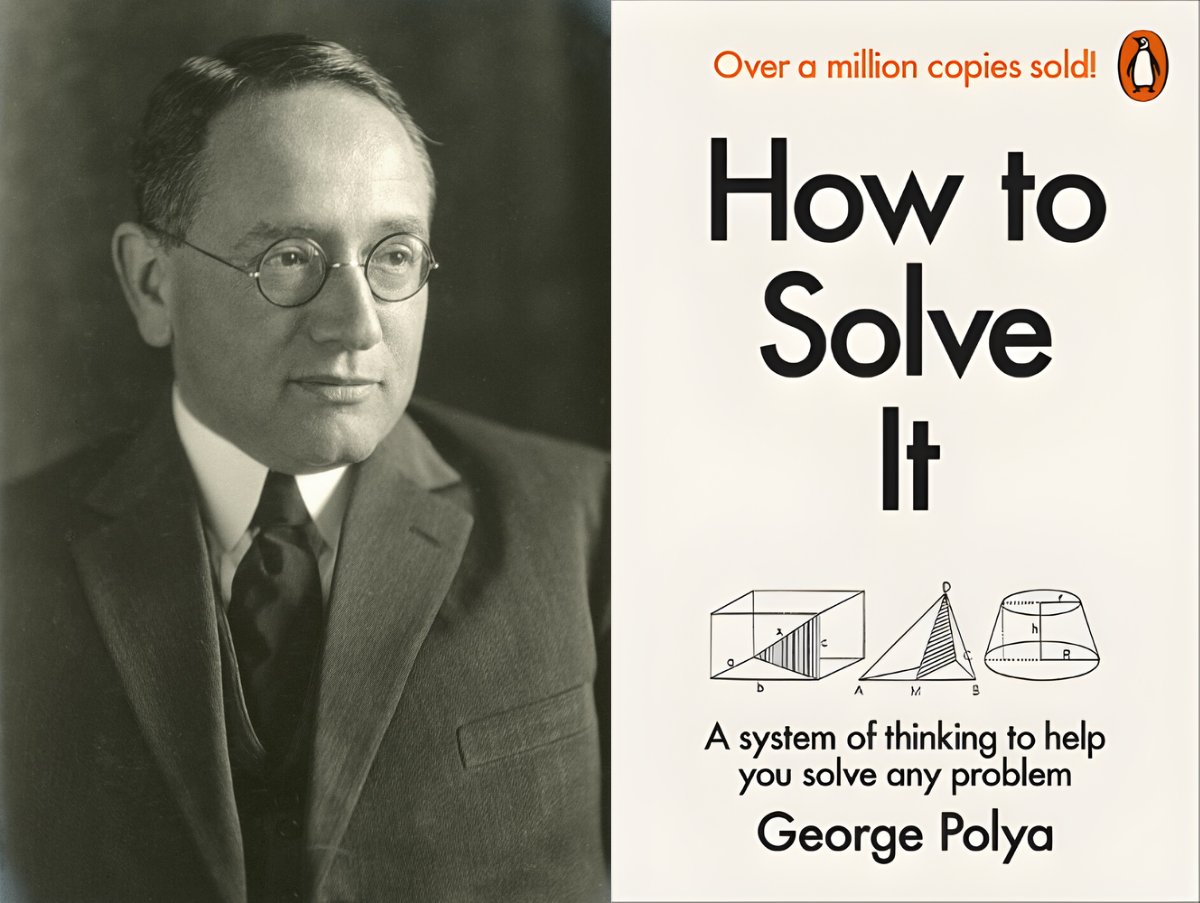
A Stanford mathematician spent 40 years watching brilliant students freeze in front of hard problems.
Not because they lacked intelligence. Because nobody had ever taught them what to do before they started solving.
His name is George Pólya, and the book he wrote in 1945 has never gone out of print. It has sold over a million copies. Marvin Minsky, the man who built the first neural network machine at MIT, said publicly that everyone should know this work. Engineers, mathematicians, and computer scientists treat it as scripture.
Most people have never heard of it.
Here is the framework buried inside it that changed how I think about every hard problem I face.
Pólya watched the same failure repeat itself across decades of students. A problem would be presented. The student would stare at it for a moment, feel the first wave of anxiety, and immediately start calculating. Not because calculating was the right next step. Because calculating felt like doing something, and doing something felt better than sitting with the discomfort of not knowing what to do.
The calculation was almost always wrong. Not because the student lacked the skill to execute it. Because they had not yet understood what they were being asked.
Pólya called this the most neglected step in all of problem solving, and he spent the rest of his career trying to make people take it seriously.
Step one is to understand the problem. Not skim it. Not assume you know what it is asking because you have seen something similar before. Understand it. Completely. He gave students a specific set of questions to force this: What is the unknown? What are the given conditions? Can you draw a figure? Can you restate the problem in your own words without looking at it?
That last one is the filter. If you cannot restate a problem in your own words, you do not understand it. You have only read it.
Most people skip this entirely and wonder why they get stuck.
Step two is to make a plan. Not to execute. To plan. Pólya documented every heuristic he could observe in successful problem solvers, and one pattern appeared more than any other. When a problem feels impossible, find a simpler version of it and solve that first. Not because the simpler version is the goal. Because solving it gives you a foothold, a method, a partial structure you can carry back to the original problem and build from.
He phrased it with precision: if you cannot solve the proposed problem, try first to solve some related problem. Could you imagine a more accessible related problem?
That question alone is worth more than most problem-solving courses.
Step three is to carry out the plan. This is the step everyone thinks is the whole game. It is not. It is the third of four. And Pólya spent the least time on it because it is the most obvious. Once you understand the problem and have a plan, execution is mostly patience.
Step four is the one almost nobody does. Look back. Not to check the arithmetic. To ask a different set of questions entirely. Can you verify the result by a different method? Can you use this result or this method to solve a different problem? What would you do differently next time?
This is where the real learning lives and almost no one goes there.
The look-back step is not about the problem you just solved. It is about building a library of methods that transfers to the next problem, and the one after that. Every expert problem solver Pólya studied had this habit. Every struggling student skipped directly from the answer to the next question on the page, carrying nothing forward, starting from zero every time.
Pólya's deepest insight was not a technique. It was a diagnosis.
The reason most intelligent people feel bad at problem solving is not that they lack the ability to reason. It is that they conflate understanding a problem with having read it. They conflate having a method with starting to work. They conflate getting an answer with having learned anything.
These are not the same things. They never were.
The students who get genuinely good at hard problems are not the ones who practice more. They are the ones who slow down at the beginning and the end, at the two moments every instinct tells them to rush.
The problem is almost always not as hard as it looks at the start.
You just haven't understood it yet.