(3/3) Takeaways:
- the most meaningful reward for hackers - people who dig until they find the answer - is the knowledge gained
- difficult things made easy is powerful and enduring
- Simplicity is how and why MySQL became the world’s most popular open source database
Great read from Daniel Nichter, author of “Efficient MySQL Performance”
(1/3) Takeaways:
- bias towards success through education, preparedness, hard work, and perseverance
- focus on the technical work
- neither age nor experience guarantees good ideas
https://t.co/tBvpprIVNO
(2/3) Takeaways:
Success anchors to value - focus on creating or providing value
1. Deliver quality
2. Keep learning
3. Teach others
4. Lead people to success
https://t.co/cSJ1pmCq9s
Slides from my JVM Language Summit 2024 talk “20 Years of JRuby” are now posted! Videos will be published soon, so I hear. It was great to be back in the room with so many people smarter than me and torture them with Ruby implementation challenges.
https://t.co/ZFotSiP1v0
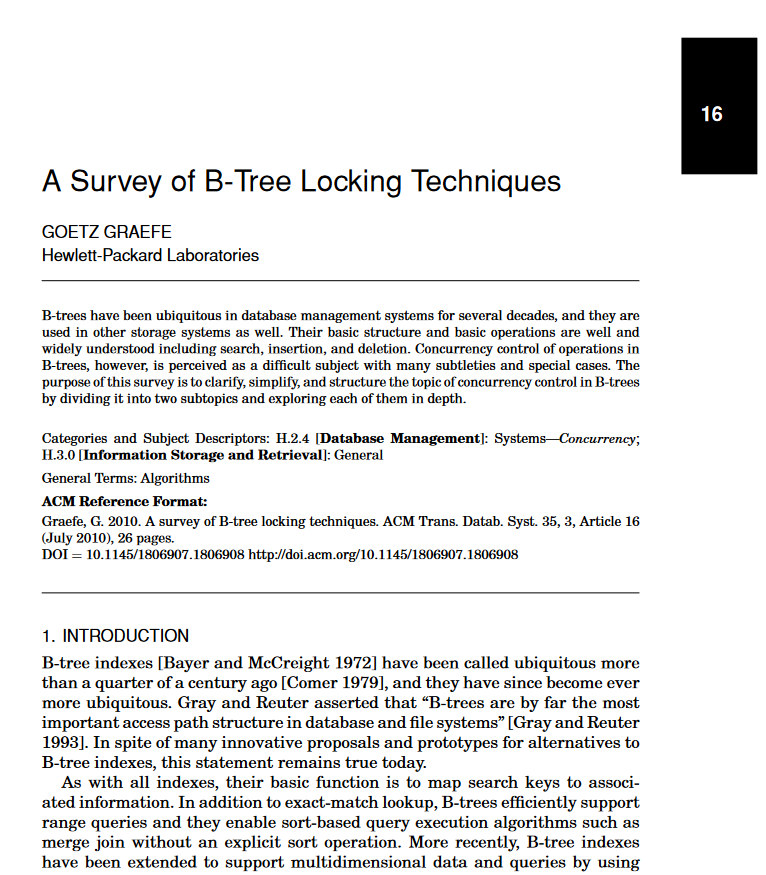
Want to learn how database locks actually work?
Check out this incredibly thorough review by database legend Goetz Graefe, which dives deep into how databases use locks to protect your data and the integrity of your transactions.
One of the most interesting distinctions in this paper is between locks and latches. Locks provide concurrency control between transactions--they're heavyweight, are meant to be held for a long time, and support complex scheduling and deadlock detection policies. However, as a result, they're expensive to acquire and release, requiring thousands of CPU cycles.
By contrast, latches protect individual data structures from concurrent accesses by different threads/processes. They're lightweight (tens of CPU cycles per acquire/release), are held only while the data structure is being read or updated, and have minimal scheduling or deadlock detection capabilities and thus must be used very carefully. You might grab a latch before physically modifying a B-tree page in memory to ensure no one else concurrently writes to that page.
@headius@rubyconf@reddotrubyconf Also, I tried to find past books on JRuby on Pragmatic Bookshelf. One was “Using JRuby” published in 2010. Another was “Deploying with JRuby 9k” published in 2016. With JRuby10 targeted for this year, it seems like an appropriate time for a new book :)
@headius@rubyconf Excited to see any/all of these talks. I was blown away by your @reddotrubyconf talk and I am finding time to dig deeper and learn more about JRuby
A thread of the coolest things you didn't know about the 2024 Paris Olympics
1. Olympians who win a medal will take home a real piece of the Eiffel Tower. Fragments of iron that were removed & preserved during renovations to the Eiffel Tower during the 20th century have been infused into the medals. Each medal includes 18 grams (0.04 pounds) of the Eiffel iron.
And that's a wrap. With 78 attendees from 12 countries, 16 speakers and 18 volunteers, we are grateful for seeing you all in Singapore to share our love for Ruby. Till next year!
1) Some Day 1 snippets from @reddotrubyconf 2024
- “Community is the treasure of Ruby” @yukihiro_matz
- Cybersecurity takes a lot of work - thanks to @hsbt and Ruby/Rails security teams
- RailsGirls x RubyKaigi (+RDRC?) @ Eriko Sugiyama
- LSP and parsers @marcoroth_