Delighted to share our latest work published in Nature Catalysis! ! https://t.co/UkCOFO8VJJ
A catalytic platform for the stereocontrolled construction of therapeutic P-chiral oligonucleotide.🧬
Thanks to all collaborators and supporters! 🙏
Thrilled to share two exciting publications from our lab! 🎉 Angewandte Chemie, https://t.co/L1NN4fxe5z🔬 Nature Communications, https://t.co/5SYDtxNSqV 🌍 Huge thanks to the team for their hard work and dedication! 🙏 #OrganicChemistry#Research"
Thrilled to share that our latest research has just been published in Angewandte Chemie! 🚀 This is another milestone from our group in oligonucleotide synthesis. Check it out: https://t.co/1SFMIwrPkV
#Oligonucleotide#Electrochemistry#NucleicAcids
Finally, RADICAL CROSS COUPLING without the exogenous REDOX. We disclose in @ChemRxiv (https://t.co/FYy6i1J7p9) a broadly general platform for achieving transformations that normally required excess metallic or chemical reducing agents or photochemical setups (and their requisite catalysts) or potentiostats for electrochemistry. Now, such transformations can be accomplished with the same ease that one conducts a Suzuki coupling. You can scale up (its homogeneous) or scale down (use cheap parallel screening plates). Moisture is tolerated and base metal catalysis is used. As the best engineers like to say, "The best part is no part". Now, chemists have the option to remove the redox part from radical couplings.
Quick Summary: Sulfonyl hydrazides are disclosed as versatile radical precursors as exemplified with seven new C–C bond forming, redox-neutral cross-couplings with: (1) activated olefins, (2) alkyl halides, (3) redox active esters, (4) aryl halides, (5) alkenyl halides, (6) alkynyl halides, and (7) a trifluoromethylating reagent to forge C(sp3)-C(sp3), C(sp3)-C(sp2), and C(sp3)-C(sp) bonds. Sulfonyl hydrazides are stable and usually crystalline substances that can be accessed in a variety of ways including transiently from hydrazones to achieve a net reductive arylation of carbonyl compounds. Exogenous redox (chemical, photo/electrochemical) additives are not necessary as these functional groups serve the dual role of radical precursor and electron donor. The operational simplicity (homogeneous, water tolerant, dump-and-stir) and practicality of the method are demonstrated as well as applications to streamlining synthesis and mild late-stage functionalization.
🚀 Excited to announce our latest paper in @J_A_C_S! We present a Ligand-Enabled Cu-Catalyzed Stereoselective Synthesis of P-Stereogenic ProTides, advancing stereoselective control in phosphorus-based drug design. Check out the full paper here: https://t.co/XmKvGtimaM
Curious how oligonucleotides are made on scale and what the future holds? Check out our review with @LovelockLab appearing today in @ScienceMagazine : https://t.co/m9dfB5Yc2l
Excited to share our latest paper published in @angew_chem! We realized the first example of decarboxylative C(sp3)–N cross-electrophile coupling with e-chem. Check it out here: https://t.co/L53PIyDrNJ. #chemistry#research#AngewandteChemie
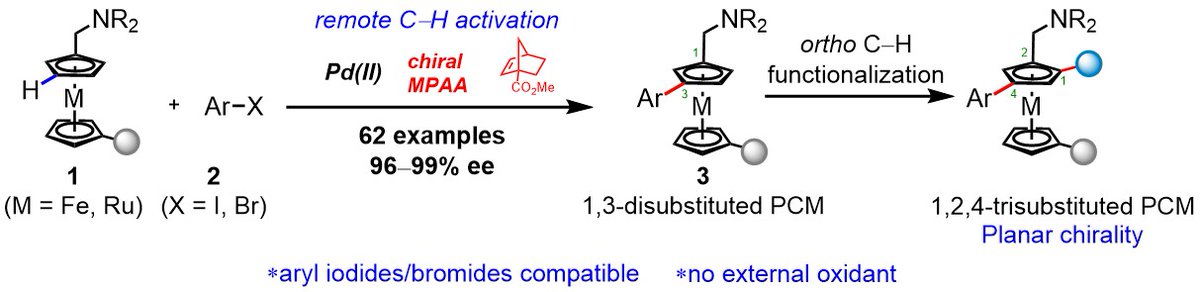
We have used bifunctional chiral MPAA ligands to control point and axial chirality in CH activation, now planar chirality via remote meta-CH activation, soon in Nature Chem. A great collaboration with Professor QiangHui Zhou, an outstanding alumnus from @BaranLabReads
Explore the universe of Lactone scaffold as potential pioneers for drug molecules: accessing various ring size, topology by different C-H activation reactions. Our seventh reaction for lactones just appeared in JACS ASAP. The next one is even more surprising...
Finally, a man-made catalyst for gamma methylene CH! Double bond and carbonyl alpha chemistry build 1,2-relationship well, now via beta and gamma CH , we provide new disconnections for 1,3 and 1,4. Many new reactions are coming soon. https://t.co/pfKnzUsEnA