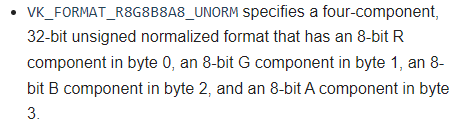
@newincpp Checks out. Byte 0 for your CPU endianness would be where 0xRR is. You read the hex value right to left, but the Vulkan format left to right.
A classic book on radiosity and image synthesis was just freed up by the authors, making two that have recently become available: https://t.co/Kzrh8O4GSi
“Low-level thinking in high-level shading languages” is in my top 3 most influential presentations, one that changed the way I think about shader programming. 2023 was the 10th anniversary so I tried a quick refresh and discussed developments since. https://t.co/fFmymkfe9R
Great explainer of occupancy, also includes some new info I haven't seen elsewhere, eg the 16 waves max occupancy for RDNA2/3 (compared to RDNA's 20) and the inter-wave barrier needed for threadgroup with 2+ waves and how it affects occupancy https://t.co/3IlkPTvt6F
Here is a new blog post of mine about fibers.
Hopefully, it could be helpful to someone who is interested in learning the topic.
https://t.co/mfSyRYsVTT
I’ve written a small library that provides an assert-like macro in HLSL shaders that triggers a GPU memory page fault. Together with Radeon GPU Detective, it may be useful for debugging. https://t.co/pMJY14v19s
The @AMDRadeon Developer Tool Suite has a new member: Radeon #GPU Detective (RGD) 🕵️
RGD is a tool for post-mortem analysis of GPU crashes so you can:
🎆 Capture and analyze crash dumps
🎆 Narrow down the root cause of a crash
Take a look now! #D3D12
https://t.co/FERBYU2gvp
The tool that was so much needed finally appeared! Radeon GPU Detective can capture and analyze GPU crashes / TDRs. I am happy and proud to be part of this project.