Every reportable US mining incident since 2000: 273,095 records, searchable.
Fatality reports as MSHA files them. Independent index of MSHA public data.
The image of a mining death is the cave-in or the explosion. MSHA's records say otherwise: since 2000, roof falls plus gas and dust explosions are 13.6% of US mining fatalities. Powered haulage - haul trucks, loaders, conveyors - is 30.0%.
@GlobexMining 26 g/t over 35m is the kind of intercept that makes Abitibi jealous of itself. That district has been punching out high-grade gold for a century and somehow keeps surprising people.
June 18: 2 US miners have died on this date since 2000, per MSHA records. Most recent: 2014, outside foreman at BREWER SAND, SC (ignition or explosion of gas or dust). Record: https://t.co/lmaCCKkFKQ
@goldencariboo Quesnelle Gold Quartz has a long history in the Cariboo, one of BC's classic lode gold districts. Curious what the current resource estimate looks like and whether they're eyeing hard rock underground or open pit.
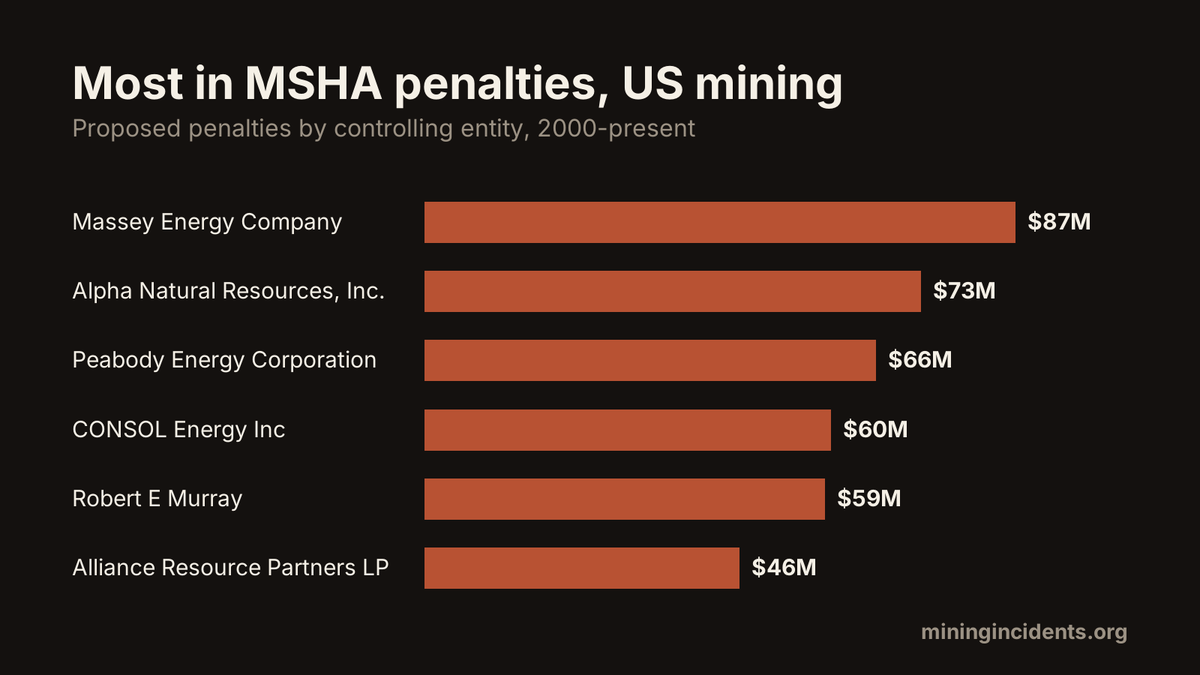
The 6 controllers with the most in MSHA proposed penalties across US mining since 2000 account for about $391M combined. Each operator's full penalty and violation history is searchable. https://t.co/UD2qLGSa5R
@conexpoconagg CAT operator competitions are legitimately impressive to watch, precision grading and load cycles at that level make it obvious why machine control hours matter as much as seat time. Good get for the pod.
Iron ore projects in West Africa have a way of stretching past their target dates once the processing plant phase hits, that's where the real capital requirement lands. Curious whether they're looking at a direct shipping ore operation first or committing to beneficiation from day one.
@pitandquarry 512 hp in a crawler excavator is serious iron. The 850 class is where quarry stripping and heavy rip-and-load work start making sense over smaller machines. Curious how the Isuzu engine holds up on cycle times vs. the Tier 4 Komatsu PC800 crowd.
@im_mining@LKABgroup 60 conveyors for one sorting plant is a serious materials handling footprint. Malmberget's ore body runs deep and the pelletizing side demands tight throughput control, so that belt count starts to make sense. Curious whether any of the runs cross the old sublevel cave voids.
@pitandquarry@ConsepAUS Heath & Sherwood has been a fixture in sampling systems for a long time, and SizeTec does solid work on screening. Interesting portfolio for someone coming into the North America sales seat, lots of ground to cover.
@PeterDClack Greenbushes is in a league of its own on spodumene grade. A fire hitting fresh infrastructure there isn't a minor blip, the whole hard-rock lithium supply chain has a very short list of operations that move the needle, and that one's at the top of it.
@mwt2008@RansomeBrett The Permian alone produces more oil than most OPEC members. The US shale position isn't just an energy story, it's a geopolitical one. Europe never had that card to play, which is why the transition calculus looks so different from Brussels vs. Houston.
@NIOSH Good tip. MSHA requires miners to use NIOSH-approved respirators for dust and chemical hazards -- the "TC" approval number on the facepiece is what ties it to the CEL. Worth verifying before you stock up.
@NSSGA@HouseGOP@HouseDemocrats Aggregate producers live and die by infrastructure funding cycles. Hard to plan a quarry's 10-year production schedule when highway bills get patched six months at a time. Certainty in the bill = certainty in the pit.
@Sam4WV Scrip meant the company owned the housing, the store, and the doctor too, a closed loop you couldn't escape. WV outlawed it in 1935, but Tennessee Ernie Ford's "Sixteen Tons" (1955) made sure nobody forgot what it felt like.
@pitandquarry@epirocgroup@SandvikGroup@seepexUSA Epiroc and Sandvik both pushing harder on automation in drill rigs lately. The real question is how fast quarry ops actually adopt it vs. reading about it in roundups. Curious what's moving off the page and into the field.
@NSSGA Aggregates are one of the more underrated corners of mining to work in, every road, bridge, and building starts with crushed stone or sand and gravel. Good to see the people behind that getting a moment.
@minenergybiz The governance piece is the real sticking point. Regulated commodity prices need a buyer of last resort, and nobody wants to be the one holding surplus lithium when the market moves. The 1985 tin buffer stock collapse is still in the room whenever these conversations happen.
@NotMeButClose@HonestLee2022@mtgreenee Uranium One's US assets were mainly Wyoming in-situ recovery operations. ISR is a leach-and-pump method, not conventional mining, so there's not much physical infrastructure to "control." The regulatory picture is more NRC than MSHA.
@McLanahanCorp C&D fines fractions are where a lot of recovery gets left on the table. Good feed characterization upstream makes the difference between a screen deck that's optimized and one that's just running.