Our company X account @lanyon_ai was compromised in a cyberattack last night, and now appears to be being used to shill a memecoin.
I have yet to receive a response from X support, but please be aware that (currently) any communications from this account are not from us.
I love partial differential equations (and at least one integro-differential equation). For a physicist or an applied mathematician PDEs are close friends. They come into your life, you try and understand them as much as you can, they often annoy you, but the best ones surprise you even after years of familiarity. Eventually, after they have enriched your life immeasurably, you part ways.
I have been somewhat lucky that I have spent a lot of time with a lot of PDEs. Everything from compressible Euler and Navier-Stokes, magnetohydrodynamics, Maxwell equations of electromagnetism, forms of the Vlasov equations, to Einstein's equation of general relativity. (And the one integro-differential equation: the radiation/neutron transport equation).
It is incredible that things you can scribble on a few pieces of paper are so central to our modern world: PDEs are all you have when designing at the extreme edges of engineering, and studying fundamental physics. These are exactly the edges which humanity as a whole is pushing on now. Hypersonic flight, space travel, lunar and planetary bases, fusion machines, and the environment around and inside black-holes and neutron stars.
With a few prompts and some compute you can design and study all these, and more. @lanyon_ai
A spacecraft, like the Orion shuttle, re-enters the Earth's atmosphere at hypersonic speeds. This causes the air constituents to disassociate and form a thin but dense layer of electrons at the bow shock. Unfortunately, the density of the electrons is high enough that it impedes GPS communications. This is called the "radio blackout problem."
I asked Lanyon (@lanyon_ai ) to simulate a Mach 5 flow around an Orion-like vehicle, re-entering at a 20 deg angle-of-attack. A single prompt with two sentences!
It produced the following Schileren plot (proxy for density gradients) that shows the formation of the shock and shedding at the upper trailing edge. All in about 10 minutes of computing!
This simulation does not have proper air chemistry and so these results are only approximate. And the speed should be > Mach 10 or even Mach 20.
But once we add the missing physics, we will be able to predict the electron density, the fluid temperature and thermal forces on the surface and many other quantities. These are needed to compute radio blackout, thermal loads, to design titles for the shields, and design the ablative cooling system to minimize damage to the vehicle.
Soon!
@lanyon_ai /simulate Simulate the flow of a Mach 2 shock over a rotating triangular object. The triangle is equilateral and one of the corners is initially pointed towards the flow. Let the triangle turn twice as the shock passes over it.
A few minutes later, Lanyon produces this amazing animation of the complex interaction of shocks and the wake created by a rotating, triangular prism. Notice the vortex shedding and the complex Mach stem, shock diffraction and other patterns.
Hypersonic reentry, rocket combustion, and many other fun and critically important simulations are not far away!
The compressible Euler equations are one of the most important equations in physics and engineering. They form the basis of an incredible range of applications, from flow around aircraft, hypersonic flight, accretion disks around black-holes, and with some additions, turbulence in gas turbines and scramjet engines, and combustion processes in rocket engines and in stars.
In a technical deep-dive I show how Lanyon (@lanyon_ai ) can construct a formally verified Euler solver, and produce Lean4 code and C kernels in a few minutes. The ease and speed with which new solvers and simulations can be created is truly mind-boggling.
Formally verified compressible hydrodynamics in a complex geometry: simulating supersonic flow, shock wave interactions, and turbulent structure formation with the isothermal and full compressible Euler equations, all implemented and verified autonomously with Lanyon.
~7,000 lines of C, ~11,000 lines of Lean proof, ~150 correctness theorems, ~3 minutes.
Euler's equations form the basis of our understanding of compressible hydrodynamics, are critical for aerospace and other engineering applications, and represent the underlying hyperbolic equation structure of more complex systems such as the Navier-Stokes equations and the ideal magnetohydrodynamics equations. Solving them correctly relies not only upon mathematical and numerical correctness, but physical and thermodynamic consistency too.
To the best of our knowledge, Lanyon just one-shotted the first ever end-to-end formally verified solver for Euler's equations, complete with full and executable mathematical, physical, and numerical correctness proofs. And, for an encore, it ran the resulting simulations in complex (and even dynamic!) geometries.
GitHub link and technical deep dive below. 👇
Have you ever wondered what would happen if Gandalf created a Mach 2 shock with his wizard's staff to try and stop an marauding army of Sauron's orcs?
I asked Lanyon (@lanyon_ai ) about this:
> /simulate Simulate an army of orcs in a Mach 2 flow
In a few minutes, Lanyon constructed an army of 32 orcs and ran a compressible Euler simulation. Many interesting features are seen: a detached shock forms in front of the orcs, and small shocklets also form.
Interestingly the last row of orcs act like converging-diverging nozzles, and the flow speed again increases to Mach 2!
Thankfully, Lanyon refused when I asked it to "Build me an army worthy of Mordor".
I shall explore the magic behind this technology in an upcoming Technical Deep Dive on our company's research blog. Stay tuned!
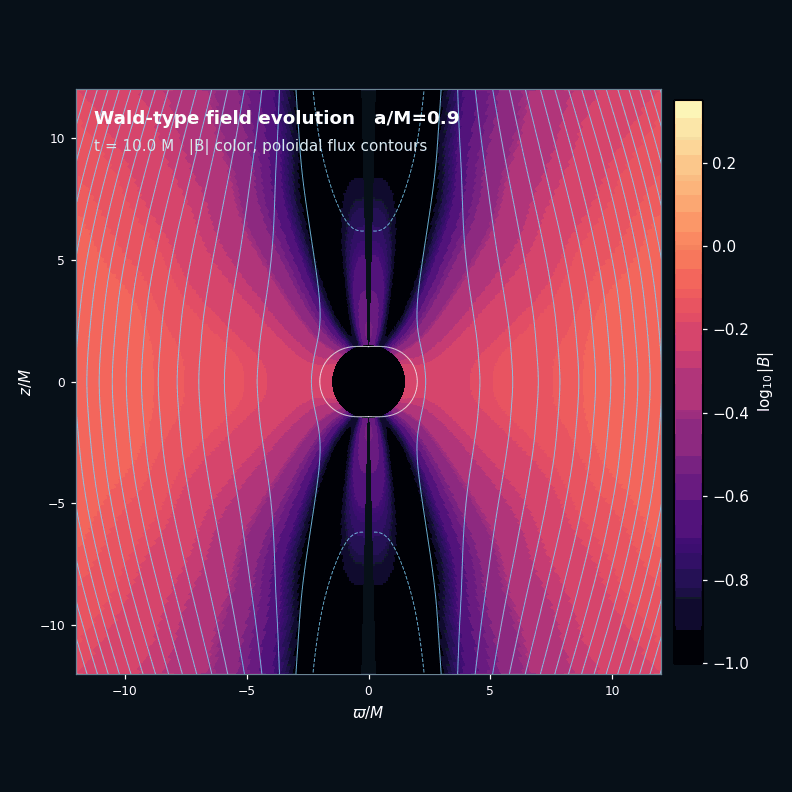
Somewhat mind boggling: solutions to Maxwell equations in curved spacetimes constructed with a few prompts to Lanyon (@lanyon_ai ). Solvers, proofs and verified numerical kernels in under 5 mins!
The spacetime itself is described by the Kerr solution, the most general uncharged black-hole solution to Einstein's General Relativistic equations. (For those not in the know: Kerr solution describes a black-hole parameterized by only two scalar numbers, the mass and the angular momentum. No other information is needed as all other degrees-of-freedom that the system had prior are radiated away gravitationally when the black-hole forms).
Chandra would be very pleased. But he will be even more pleased when Lanyon solves the Einstein equations too! Soon ...
Formally verified general relativity: simulating the electrodynamics of black hole magnetospheres and the mechanisms of black hole jet-launching, all implemented and verified autonomously with Lanyon.
~12,000 lines of C, ~25,000 lines of Lean proof, ~150 correctness theorems, ~5 minutes.
Solving Maxwell's equations in full general relativity, including options for hyperbolicity-preservation and divergence error-correction, using a second-order spatially accurate numerical scheme. Including full proofs of convergence, stability, and geometric consistency for the implementation in arbitrary spacetime metrics. Then applying the solver to the curved spacetime region around a rapidly-spinning black hole.
Lanyon derived the equations, implemented the algorithms, and produced end-to-end proofs of correctness for everything. All within ~5 minutes, and all fully autonomously, from just a single natural language prompt. Extreme environments? Complex geometries? Not a problem.
GitHub link and technical deep dive from @getjonwithit below 👇
When I first started doing computational physics I naively believed there would exist a numerical method that would be "perfect". Sadly, I soon learned that it is not so: there are multiple discrete representations of the same physical system, each with their own strengths and weaknesses.
This led me to formulate the "No Free Lunch Principle" for computational physics: Any scheme which attempts to ensure that a property of the continuous system is satisfied invariably results in violations of other properties, or a degradation of solution quality.
More on our Lanyon (@lanyon_ai) Research Notes blog.
https://t.co/xykn98itmK
Hyperbolic partial differential equations are rather peculiar. Even a simplest nonlinear one, like the Burgers equation (a scalar equation with quadratic nonlinearity), shows interesting physics, in particular shocks and rarefactions. Without careful analysis one ends up with multi-valued solutions, or solutions that violate entropy.
In this technical deep-dive I explain how even a simple system like Burgers can be used to build intuition about features that arise in far more complex systems, like Euler, ideal MHD and Navier-Stokes. I also show how Lanyon one-shots a robust solver, and generates Lean proofs of thermodynamic consistency, hyperbolicity and other properties, all in a few minutes with just a couple of short, terse prompts!
Formally verified thermodynamics: capturing and verifying shocks, rarefactions, and weak/entropy solutions, fully autonomously with Lanyon. A stepping stone to full Navier-Stokes.
~8,000 lines of C, ~9,000 lines of Lean proof, 282 theorems, ~100 seconds.
Solving the inviscid and viscous Burgers’ equations (minimal nonlinear PDEs capable of forming weak/discontinuous solutions, and for which thermodynamic considerations therefore become necessary), using a thermodynamically stable and consistent scheme. Verifying discrete Rankine-Hugoniot conditions, convergence to entropy solutions, and similar essential properties, fully autonomously with Lanyon. Burgers’ equation presents a more mathematically tractable version of the same essential difficulties that arise from Euler’s equations, the MHD equations, the elasticity equations, and even the full Navier-Stokes equations. More to come on all of these topics soon!
GitHub and technical deep dive links below👇
Our first official benchmarking post from our Chief Scientist Jimmy Juno (@JunoRavin), comparing the performance of Lanyon's neurosymbolic architecture against frontier models Fable 5, Opus 4.8, GPT-5.6 Sol, GPT-5.5, and Kimi K3, for simple linear PDE problems (linear advection, Maxwell's equations).
The headline is that, across multiple trials, Lanyon is consistently 20-250x faster and exhibits 50-250x lower token consumption. Several frontier models consistently commit mathematical, algorithmic, and computational errors (such as implementing numerical schemes with the wrong order of accuracy, or not correctly limiting discontinuous solutions), *even* when given highly detailed prompting regarding what exactly to implement. For terser prompting (equivalent to what Lanyon typically receives), performance is worse still.
We have tried throughout to give the frontier models every possible advantage (more detailed prompts, maximum reasoning and effort where necessary, more tools where necessary).
The post also contains a brief discussion of how Lanyon's internal (non-Lean-based) symbolic theorem-prover handles floating point precision issues, based on our previous academic research, which gives it an inherent advantage over the formalization approaches used by frontier models, though we intend to write a more complete post on this soon. We hope to make this benchmark public in the near future. Post below 👇
@SuryaGanguli Another elegant formalism is Clifford/Geometry Algebra. With this, Maxwell equations simply become DF = J. No explicit Hodge duality is needed (though of course it is implicit). F simply is a bivector, and J a vector, in Cl(1,3).
One may reasonably argue that Church's Lambda Calculus is the Machine Code of the Universe. It also underlies Lanyon's approach to AI based reasoning.
When I first learned as a wee child about Lisp and Lambda Calculus and understood, from John Mccarthy's papers, how one can write a Lisp interpreter in Lisp, and bootstrap the whole thing in 100 lines of C, I had an almost epiphanic realization that I truly understood something fundamental and deep about computing.
You don't need to take my word for it! As Duke Orsino said in Twelfth Night:
“If λ-calculus be the stuff of life, code on;
Give me excess of it, that, surfeiting,
The appetite may sicken, and so die.”
(Someone should formally verify this as I may have misquoted the Duke).
I was very mystified when I first learned about the Perfectly Hyperbolic Maxwell (PHM) equations. These are an extension to the classical Maxwell equations of electromagnetism in which the divergence relations are incorporated as additional time-dependent equations.
Recently, I discovered that these equations actually arise rather naturally. In the Clifford (Geometric) Algebra formulations of electromagnetism all of Maxwell equations can be represented, extremely elegantly, as a single equation, DF = J, where F is the electromagnetic bivector and J is the proper current and D is the derivative operator. (All these objects live in 4D Minkowski space). It is incredible that such a fundamental equation system can be represented with just 4 symbols! DF = J is even valid in curved spacetime!
It turns out that the PHM equations are obtained when one extends the electromagnetic bivector F to include a scalar and pseudoscalar part. That is it! No further modifications are required.
Lanyon (@lanyon_ai ) understands the PHM equations and can generate provably correct solvers for this system, and with just one more prompt, run simulations! It is truly marvelous.
https://t.co/MqersUcNlv