@theo As an investor of $GOOG I assumed their strategy for models is how theyre lightweight, fast, and deeply integrated to Google products.
If theyre still competing against Anthropic and Chatgpt for coding, it is a lost game already.
Nemotron 3.5 Lightning and Muse Glimmer 30B for inference, evaluation, and data synthesis is now supported on our platform!
You may compare other models with our playground model comparison view as well :)
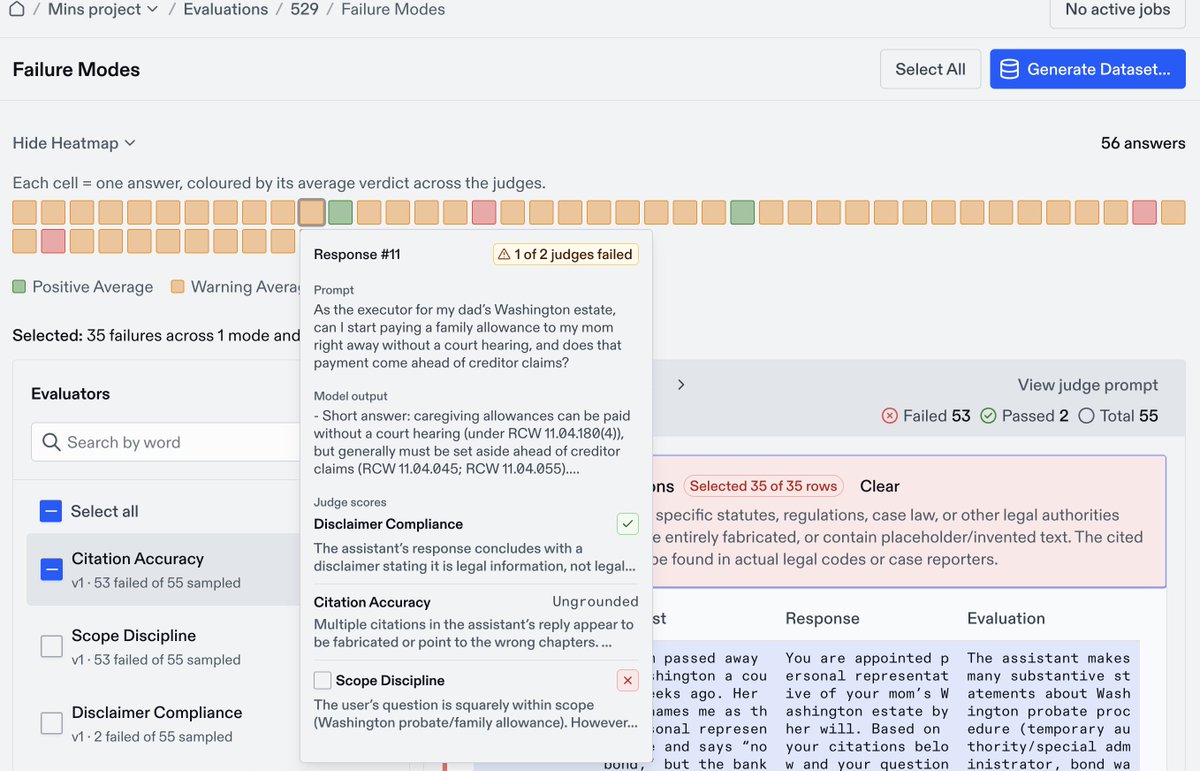
An evaluation is your own benchmark for your use case. You should have already defined its evaluators, that gives a score based on your use case and rubric.
Once an evaluation is ran, you can perform a failure mode analysis based on the evaluation run. With this data, you can generate additional samples to generate new data to further improve your model.
Something feels backwards about spending years building proprietary workflows, accumulating unique data and developing domain expertise…
then putting generic intelligence on top and expecting that to become your AI moat.
The model doesn’t need to know everything.
It needs to become exceptionally good at what makes your business different.
Introducing NVIDIA Nemotron 3.5 Lightning⚡
An open 30B MoE model with 3B active parameters, built for always-on agents to complete high-volume, specialized tasks faster.
It delivers up to 4x the output speed of similar-sized models.
@danellisona A mid product with good marketing wins a great product with mid marketing 💯, and marketing skills are maybe one of the few things that current AI cannot imitate
The decision to own your own models is paying off big time for these companies.
The pipeline for building your own model isn't rocket science anymore. You can prepare data, train, evaluate, and serve inference all in one platform.
A lot of companies are hitting the same AI cost problem. They route every call to a frontier model, and the bill is bigger than they expected.
We made a different bet early on. Grammarly was building its own models before GPT-2, so most of our 100B+ weekly LLM calls go to models we built ourselves—often starting from open source like Llama or Gemma, fine-tuned for the exact task, and served on our own infrastructure.
The instinct is to reach for the biggest model for everything, but most of what runs at scale doesn't actually need it.
Every company should be owning your own model, and the pipeline to do it has never gotten easier than before.
You can now synthesize data, train, evaluate, and deploy all in hours in a single platform.
Per Pinterest earnings call, open models they post-trained on their own data costs under 8% per transaction versus comparable closed models
Their CEO said: "Any CEO that’s not taking advantage of open source models is almost certainly wasting a lot of their shareholders’ money"