By 1976, Iggy Pop was expected to be dead. The wild man of The Stooges—walking on broken glass, creating punk rock, pushing himself too far—was burning out.
A brutal heroin addiction had completely destroyed his band, his solo attempts were falling flat, and he was broke, falling apart, and totally isolated.
The music world watched the chaos like a car crash, but almost nobody actually cared about him.
Except for David Bowie.
The two had met years before, and Bowie was completely captivated by Iggy’s raw, fearless honesty on stage.
By the mid-1970s, Bowie was a global superstar at the absolute peak of his fame, while Iggy was viewed as a tragic cautionary tale. But instead of watching from a distance, Bowie made a heavy choice.
He decided he was going to save his friend, not with charity or a handout, but with total, hands-on commitment.
To escape the toxic, drug-heavy scene of Los Angeles, they packed up and moved to West Berlin.
At the time, it was a gritty, divided city still scarred by war, far away from the shallow glamour of Hollywood. For Bowie and Iggy, Berlin wasn't a place to party.
It was a stark, quiet sanctuary where they could focus on survival through a simple daily routine and pure artistic creation.
They rented modest apartments in the Schöneberg neighborhood. They rode bicycles, visited local art museums, and lived relatively quiet lives.
Bowie put his carreer aside to focus entirely on resurrecting Iggy’s life. He co-wrote and produced two of Iggy's most legendary albums, The Idiot and Lust for Life.
During this intense period, Iggy finally learned how to create music while sober. He realized his identity didn't have to depend on slow-motion suicide.
Tracks like "The Passenger" and "Lust for Life" were born out of this survival, becoming massive anthems that proved he was far from finished.
When it came time to tour, Bowie didn't demand the spotlight. Instead, he quietly joined the live band as Iggy’s keyboardist, happy to fade into the background so his friend could shine.
Reflecting on that dark period, Iggy later admitted,
"He brought me back to life. He salvaged me from certain professional and perhaps personal ruin."
Bowie treated Iggy as a true creative equal, engaging him in deep conversations about German expressionism, literature, and electronic music.
That loyalty bonded them for the rest of their lives. Decades later, Iggy was still thriving and influencing generations of punk and grunge musicians, all because someone refused to look away when he hit rock bottom.
When Bowie passed away in 2016, a heartbroken Iggy openly mourned him. He shared his devastating loss with the world, saying, "David’s friendship was the light of my life. I never met such a brilliant person. He was the best there is."
We live in a culture that loves to watch people crash and burn, treating human tragedy like a spectator sport. It is easy to applaud a comeback story after the fact, but it takes real courage to pull someone out of the wreckage while they are still on fire.
David Bowie proved that the ultimate rock 'n' roll legacy isn't about the fame, the money, or the chart-topping hits. It is about having the guts to look a dying friend in the eyes and tell them they are still worth saving, even when the rest of the world has already written the obituary.
I've just walked through one of the most deprived areas in England. Sadly, lots of disabled & ill looking people, to be honest many with obesity issues. What also strikes me is how white this huge area of social housing is; I saw no brown, black or yellow faces. I checked, it's 97% white British. Many may disagree or get angry with this, but the social, health & economic problems here in a largely forgotten corner of North Eastern England have next to nothing to do with migrants. Before I get abused as being middle class & out of touch, I was raised on a council estate in a deprived town 100 miles away, but in the 1960s and 1970s we had a much stronger welfare state, before Thatcher wrecked it. We had more hope, equality & optimism than I saw today & far less of a problem with drugs. Any politician who tells you our core problems are due to migrants is either plain wrong or lying, maybe both. We created this society, it's up to us to make it stronger & fairer & to stop scapegoating people who come here to seek better lives & most of whom are willing to work hard to do so.
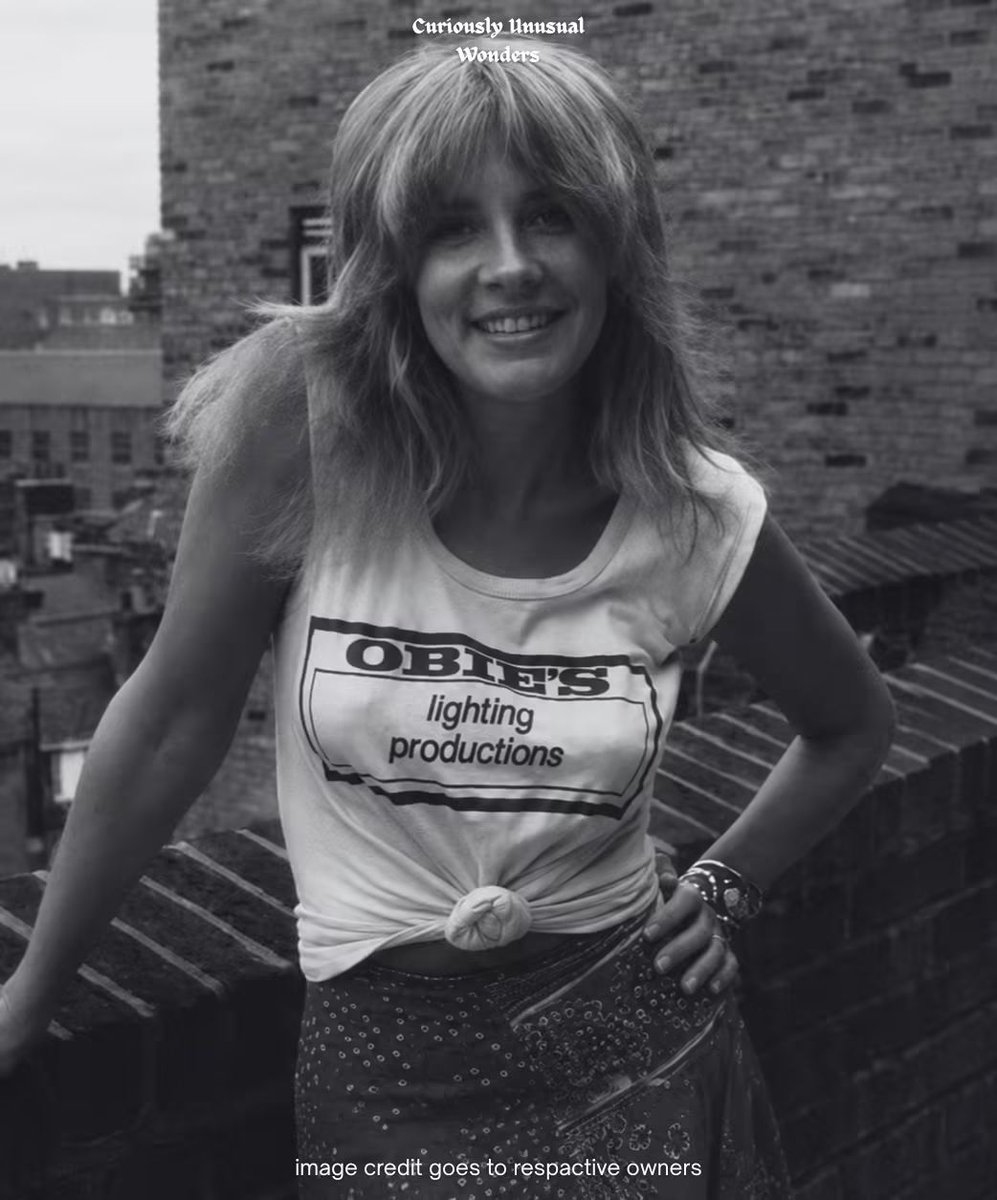
In 1974, a twenty-six-year-old waitress in Los Angeles quietly gives her exhausted father one final deadline: three more months of music, then she comes home for good.
She has no idea the call that changes everything is already on its way, arriving three days before her own deadline runs out.
Her name is Stephanie Lynn Nicks. As a toddler, she could not pronounce "Stephanie." It came out "Stevie" instead, and the nickname stuck for life.
Stevie was born May 26, 1948. Her father's corporate career moved the family constantly — Arizona, New Mexico, Texas, Utah before they finally settled in California when she was a teenager.
In 1966, she transfers into Menlo-Atherton High School as a senior. At an after-school "Young Life" meeting, a junior named Lindsey Buckingham starts strumming "California Dreamin'." Stevie sits down and starts singing harmony without being asked.
Two years pass before they speak again. Then Buckingham calls, inviting her to sing for his band, Fritz. She says yes.
Fritz opens for Janis Joplin and Jimi Hendrix but never lands a record deal. By 1971, the band collapses, and Stevie and Lindsey — now a couple as well as collaborators — move to Los Angeles to try again as a duo.
In September 1973, Polydor Records releases their album, Buckingham Nicks. Critics like it. Nobody buys it. The label drops them almost immediately.
Stevie takes a waitressing job at Clementine's, a Beverly Hills bar, earning $1.50 an hour. She also cleans houses on the side. Lindsey tours briefly as a backing musician for Don Everly. At night, the two of them keep writing songs nobody has heard yet — including one called "Rhiannon."
Here's what most people miss: by the fall of 1974, Stevie Nicks had essentially given up.
Her father had just undergone open heart surgery. Watching his daughter waitress and clean houses in another state weighed on him. So Stevie made him a promise: three more months. If nothing happened by January, she would come home and go back to college.
She kept the promise a secret from almost no one. She was tired, thin, and scared the music would never work.
Then, in late 1974, producer Keith Olsen plays a track from the failed Buckingham Nicks album for a drummer scouting a Los Angeles studio for new material. The song is "Frozen Love," a seven-minute epic closing the record. The drummer is transfixed.
His name is Mick Fleetwood, and his band, Fleetwood Mac, has just lost its guitarist.
On New Year's Eve, 1974, Fleetwood calls Olsen for the guitarist's name. Olsen tells him: Lindsey Buckingham. But Buckingham and Nicks are a package deal, Olsen warns — take one, you take both.
Fleetwood agrees, mostly because he needs a guitar player and has no particular opinion about the singer. He does not yet know what he has just done.
Stevie doesn't quit her waitressing job right away. She keeps working it for three more days after saying yes, unwilling to leave her boss without notice, unsure the opportunity is even real.
On January 1, 1975, Fleetwood Mac begins rehearsing with its new lineup. The band's next album, self-titled and released later that year, sells 500,000 copies by December and reaches Number 1 on the Billboard 200. Two of Stevie's songs, "Rhiannon" and "Landslide," become instant signatures.
Two years later, the band records Rumours while Stevie and Lindsey's relationship collapses in real time, alongside the marriage of bandmates John and Christine McVie. The album turns their breakups into songs. "Dreams," written by Nicks, becomes Fleetwood Mac's only Number 1 single in the United States. Worldwide, Rumours goes on to sell more than 40 million copies.
Stevie Nicks never went back to college. She stayed with Fleetwood Mac for decades, launched a solo career in 1981 with the album Bella Donna, and built a catalog now credited with more than 120 million records sold worldwide.
In December 2018, she is announced as an inductee into the Rock and Roll Hall of Fame for a second time — first as a member of Fleetwood Mac, now as a solo artist — making her the first woman ever inducted twice.
Decades later, a new generation of artists, including Taylor Swift, would cite her as a direct influence. Swift has called Nicks one of her childhood heroes, brought her onstage as a guest, and referenced her by name in a song of her own — a small tribute passed from one generation of songwriters to the next.
None of it happens if that three-month deadline runs out one phone call too early.
The waitress at Clementine's had no way of knowing how close she came to walking away — or how close the answer was to finding her first.
Health Insurance doesn't cover you.
It doesn't even cover your children if they get sick.
It takes a huge amount of your money in 'insurance', then bankrupts you when you get sick anyway.
It's a con and it should be illegal.
Ban Private Healthcare.
In order to be born, you needed:
2 parents
4 grandparents
8 great-grandparents
16 second great-grandparents
32 third great-grandparents
64 fourth great-grandparents
128 fifth great-grandparents
256 sixth great-grandparents
512 seventh great-grandparents
1,024 eighth great grandparents
2,048 ninth great-grandparents
For you to be born today from 12 previous generations, you needed a total of 4,094 ancestors over the last 400 years.
Think for a moment:
How many struggles?
How many battles?
How many difficulties?
How much sadness?
How much happiness?
How many love stories?
How many expressions of hope for the future? – did your ancestors have to undergo for you to exist in this present moment...
[theoretical calculation not considering the Pedigree Collapse]
A recent study has demonstrated that continuous exposure to rose essential oil through inhalation can lead to measurable increases in gray matter volume in the human brain.
In this randomized controlled intervention, 50 healthy women participated: 28 in the experimental group applied rose essential oil to their clothing daily for one month, while 22 in the control group used plain water. Before and after the period, researchers used magnetic resonance imaging (MRI) to assess changes in brain structure. The results indicated a significant increase in gray matter volume (GMV) across the whole brain, with a particularly notable effect in the posterior cingulate cortex (PCC)—a region involved in memory processing, self-referential thinking, and emotional regulation. No significant changes occurred in areas like the amygdala or orbitofrontal cortex.
The olfactory pathway likely explains this effect: aromatic compounds from the rose oil travel directly to the limbic system, providing sustained stimulation that may promote neuroplasticity and help counteract age-related brain atrophy. The authors suggest this could have implications for dementia prevention, as the PCC is among the regions affected early in conditions like Alzheimer's disease.
This appears to be the first evidence that prolonged scent inhalation can induce structural changes in the adult human brain.
[Kokubun, K., et al. (2024). Continuous inhalation of essential oil increases gray matter volume. Brain Research Bulletin, 208, 110896. DOI: 10.1016/j.brainresbull.2024.110896]
Her husband never called her by her name.
For years, Bryna Sanglel was simply "Hey, you."
Not in anger. Not during arguments. Just every day. A quiet, relentless kind of erasure.
She had crossed an ocean from what is now Belarus, believing America would offer a better life. Instead, she arrived in the mill town of Amsterdam, New York, where poverty became her daily reality.
Her husband, Herschel, had once been a respected horse trader. In America, he worked as a ragman, collecting scraps to survive. Much of what he earned disappeared into drink and gambling, leaving Bryna to carry the family.
She couldn't read or write.
But she could work.
She scrubbed floors, washed laundry, cleaned houses—anything that would keep food on the table.
On the hardest days, she sent her young son, Izzy, to the local Jewish butcher with a heartbreaking request:
"Do you have any bones you're throwing away?"
She boiled those discarded bones for hours, stretching every last bit of nourishment into soup that kept her family alive.
Her son never forgot.
When Izzy told her he wanted to become an actor, she didn't laugh.
She didn't tell him to find a safer dream.
She simply said:
"You can do it."
That belief changed his life.
Izzy Danielovitch left home, changed his name to Kirk Douglas, and became one of Hollywood's greatest stars.
Champion.
Ace in the Hole.
Lust for Life.
Paths of Glory.
Spartacus.
He also helped break the Hollywood blacklist by insisting that screenwriter Dalton Trumbo receive full on-screen credit for Spartacus.
But no success ever made him forget his mother.
In 1949, when he founded his own production company, he didn't name it after himself.
He called it Bryna Productions.
For the woman whose own husband rarely used her name.
Before one of the company's early major releases, Kirk took his mother to Times Square.
He pointed toward a giant billboard.
Across it were the words:
BRYNA PRESENTS THE VIKINGS.
The woman who had begged for soup bones...
The woman who couldn't even write her own name...
Now saw it shining above New York City for the world to see.
She cried.
Not because life had finally become easy.
But because, for once, she was seen.
Bryna died later that year.
Kirk Douglas lived to be 103.
He won countless honors, built a remarkable career, raised a family, and became one of Hollywood's most respected figures.
Yet throughout his life, he repeated the same truth:
Everything he became began with a mother who believed in him long before anyone else did.
Sometimes the greatest inheritance isn't money, influence, or opportunity.
Sometimes it's one person who looks at you when the world sees nothing...
...and says,
"I believe you can."
A gorilla who hadn’t seen a man for 35 years ran toward him, after remembering he was the one who saved him from poachers.
David was part of a rescue team that raided a poaching site deep in the Congo, where several gorillas had been taken and kept in terrible conditions.
Some were too weak to survive.
But one baby gorilla did.
When David stepped close, the little gorilla ran straight to him, wrapped around his leg, and refused to let go. David prepared a bottle of milk, picked him up, and held him like a baby who had just lost everything.
After that, the baby was taken to a sanctuary, and David visited whenever he could.
But the war against poachers never stopped.
For years, David kept working in other regions, and life pulled him away from the gorilla he never forgot. By the time he finally returned, 35 years had passed, and he thought there was no way the animal would remember him.
Then he stepped into the sanctuary. The gorilla saw him and ran toward him. People nearby froze, thinking he was charging, but David knew before anyone else did.
It wasn’t anger. It was recognition. The gorilla reached him, wrapped his massive arms around him, and pulled him close the same way David had held him as a baby.
David just let it happen. Because after 35 years, that gorilla wasn’t seeing a stranger. He was seeing the first human who ever made him feel safe.
Look at the maps.
Summer 1976: most of the world cooler than average, except for one hot spot over Britain.
Summer 2025: the whole planet much hotter than the same baseline.
You do not have to like climate activism, trust politicians, or support every green policy to accept what these maps show.
In 1976, summer temperature anomalies were mixed. In 2025, warmth is far more widespread across the globe. That does not prove every detail on its own, but it fits the long-term pattern measured across many independent records: the world has warmed significantly.
The simplest explanation is also the strongest one. We have burned enormous amounts of coal, oil, and gas, raising CO₂ levels in the atmosphere. CO₂ traps heat. Add more of it, and the planet's energy balance shifts.
Natural variability still exists, which is why some places or years are cooler than others. But variability now plays out on top of a warmer baseline. That makes broad hot spells more likely and more intense.
You can argue about the best response. You can support nuclear power, domestic industry, cheap energy, and more resilient infrastructure. But calling the warming itself a hoax no longer fits the evidence.
People say everyone coped fine with the 1976 heat wave.
That’s not true.
250 people died per day from heat related illness, agriculture was severely affected, there were water restrictions up and down the country. I remember having to collect water from a tap at the end of the road.
Don’t listen to fossil fuel industry propaganda. It was a crisis then and it’s a crisis now.
https://t.co/6KNkZtDjx5
I'm no Starmer fan, and the reasons for his downfall are multifaceted. However, we should not simply ignore the role that billionaire-owned news and social media platforms played.
A small number of companies controlled by billionaire interests dominate UK national newspapers and set much of the agenda. Just three companies—DMG Media (Rothermere family), News UK (Murdoch family), and Reach—account for 90% of national newspaper circulation, up 20% in concentration since 2014.
These same groups hold significant reach across top online news brands.
This structure gives proprietors outsized influence over story selection, framing, and repetition.
Coverage frequently emphasized government difficulties. Sustained negative framing and agenda-setting shaped the national conversation, making it harder for the government to define its own narrative or highlight any stabilizing measures relative to the preceding period of Conservative instability.
The Murdoch papers in particular have a long track record of influencing UK political outcomes through editorial lines. Pre-2024, Starmer’s team actively courted these outlets. Once in power, the same papers and aligned titles maintained critical pressure, consistent with patterns seen in prior Labour governments.
Billionaire-owned social media platformsSocial media amplified and accelerated this dynamic.
Major platforms for news discovery are controlled by a handful of billionaires or their companies: @X (Elon Musk), alongside Meta and Google dominance in search, advertising, and distribution.
X under Musk became a direct vector for criticism. Musk posted extensively and repeatedly about UK politics, including dozens to over 100 posts in concentrated periods, often highlighting crime incidents, government responses, free speech issues, or perceived policy failures.
Starmer publicly accused Musk of “interfering in our politics” and “trying to whip up division,” citing specific examples such as posts around the Henry Nowak murder case that suggested police bias and other inflammatory framing.
These interventions reached large audiences instantly, bypassing traditional gatekeepers and feeding into broader narratives.
Platform algorithms reward high-engagement content—frequently outrage, criticism, or divisive material—speeding the spread of negative stories from both legacy media and user-generated content.
This created feedback loops where critical coverage gained disproportionate visibility and emotional impact compared to drier policy updates or contextual explanations.
Together, the concentrated traditional press and billionaire social platforms contributed to Starmer’s downfall by:
Dominating information flows and story selection.
Framing government actions (even incremental or inherited-problem responses) as failures or betrayals.
Providing rapid, unfiltered amplification for opposition voices and viral incidents.
Eroding the relative stability narrative through relentless repetition and selective emphasis.
While real policy challenges, U-turns, scandals, and economic headwinds existed independently, the ownership structure and platform dynamics turned scrutiny into a sustained, high-volume negative environment.
This is consistent with long-standing concerns about media plurality in the UK, where a handful of billionaire-linked entities steer the agenda and Big Tech platforms control distribution.
The result was accelerated disillusionment, boosted momentum for alternatives like Reform, and internal Labour pressure that proved unsustainable. Media and platform influence does not exist in isolation from events on the ground, but the concentration of control demonstrably shaped how those events were presented and perceived at scale.
Research consistently suggests that, over time, people tend to regret missed opportunities more than failed attempts. The pain of making a mistake often fades. The pain of wondering what might have been can endure for decades. https://t.co/GVpDzrQ7tT
They convinced you that 20 days holiday a year is generous.
That working until you're 67 is normal.
That one full time job just isn't enough to actually live on.
They're making you slaves so they can have 3 castles, 8 yachts and a spaceship.









![Rainmaker1973's tweet photo. In order to be born, you needed:
2 parents
4 grandparents
8 great-grandparents
16 second great-grandparents
32 third great-grandparents
64 fourth great-grandparents
128 fifth great-grandparents
256 sixth great-grandparents
512 seventh great-grandparents
1,024 eighth great grandparents
2,048 ninth great-grandparents
For you to be born today from 12 previous generations, you needed a total of 4,094 ancestors over the last 400 years.
Think for a moment:
How many struggles?
How many battles?
How many difficulties?
How much sadness?
How much happiness?
How many love stories?
How many expressions of hope for the future? – did your ancestors have to undergo for you to exist in this present moment...
[theoretical calculation not considering the Pedigree Collapse]](https://pbs.twimg.com/media/HMDs0oBWkAAtERK.png)
![Rainmaker1973's tweet photo. A recent study has demonstrated that continuous exposure to rose essential oil through inhalation can lead to measurable increases in gray matter volume in the human brain.
In this randomized controlled intervention, 50 healthy women participated: 28 in the experimental group applied rose essential oil to their clothing daily for one month, while 22 in the control group used plain water. Before and after the period, researchers used magnetic resonance imaging (MRI) to assess changes in brain structure. The results indicated a significant increase in gray matter volume (GMV) across the whole brain, with a particularly notable effect in the posterior cingulate cortex (PCC)—a region involved in memory processing, self-referential thinking, and emotional regulation. No significant changes occurred in areas like the amygdala or orbitofrontal cortex.
The olfactory pathway likely explains this effect: aromatic compounds from the rose oil travel directly to the limbic system, providing sustained stimulation that may promote neuroplasticity and help counteract age-related brain atrophy. The authors suggest this could have implications for dementia prevention, as the PCC is among the regions affected early in conditions like Alzheimer's disease.
This appears to be the first evidence that prolonged scent inhalation can induce structural changes in the adult human brain.
[Kokubun, K., et al. (2024). Continuous inhalation of essential oil increases gray matter volume. Brain Research Bulletin, 208, 110896. DOI: 10.1016/j.brainresbull.2024.110896]](https://pbs.twimg.com/media/HL-klRMWAAAQd9o.jpg)


