Poor Meta performance always has an excuse.
Bad creative. Wrong audience. iOS tracking. CPMs too high.
Across $70M+ in spend, the actual culprit most agencies miss: a weak offer.
Fix the offer. The ads start working.
The discount is the floor, not the ad.
Slapping "30% OFF" in a box isn't a sale creative. It's a price tag.
The brands converting at scale are selling the product first. The offer just closes it.
Audited accounts at the 8 and 9-figure level across $70M+ in spend.
The same budget leaks appear almost every time.
Not creative. Not audiences.
Campaign structure letting cold and warm traffic compete for the same budget.
Copying a winning ad into a new campaign is one of the fastest ways to kill it.
The creative isn't the asset. The learning data behind it is.
Move the ad. Lose the learnings. Start from zero.
1 ad per ad set kills sequencing.
Meta needs variation to learn who converts.
Give it 3-5 creatives per ad set and let the algorithm do its job.
You're not controlling spend. You're starving the system.
Limora AI + Claude can build a fully branded ecom site in under 2 minutes.
Drop in your URL. It pulls your brand kit automatically.
The technical barrier to launching is basically gone. The creative and strategic barrier is where it was always hiding.
The uncomfortable part: this is in 9 of 10 accounts I audit.
One campaign running on inertia because it used to work.
Eating 30-40% of budget. Nobody's pulled the thread because the blended number looks "fine".
Blended ROAS is the most expensive comfort metric in DTC.
Revenue went up 25% MoM.
Not from a new channel. Not from a budget increase.
From finally fixing the one thing that was quietly bleeding the account.
Here's the breakdown 👇
The fix wasn't complicated.
Killed the underperformer. Redistributed budget to the campaigns already working.
No new creatives. No restructure. No agency pitch deck.
Just budget allocation that matched what the data was already saying.
Platform ROAS is the most confident lie in your account.
Meta's default attribution is counting conversions that were already going to happen.
7-day click tells you what the ads actually did.
Higgsfield + Claude via MCP now generates product ad videos and UGC content inside your Claude workspace.
Zero credits used.
The production bottleneck everyone blames for creative fatigue just got a lot cheaper to solve.
Five prompt modifiers that change how ChatGPT works for ad copy:
"Steel-man the opposite angle."
"List every assumption you made."
"What's missing from this?"
"Argue against your own output."
"Give me the version a skeptic rewrites."
Less guessing. More pushback.
ChatGPT Work runs scheduled tasks while you sleep.
Competitor price changes. Weekly creative reports. Pre-call research.
All automated across connected apps.
Most DTC operators are still doing this manually at 11pm.
ChatGPT image gen is now a legitimate creative research tool.
Upload your product photo. Ask it to reimagine the lifestyle context. Then ask which visual angle converts hardest for the target avatar.
Free creative brief in 90 seconds.
Collab posts on Meta get fed to two audiences at once.
Your followers. Their followers.
Same creative. Double the distribution. Zero extra spend.
Most DTC brands are sleeping on this while paying CPMs they don't have to.
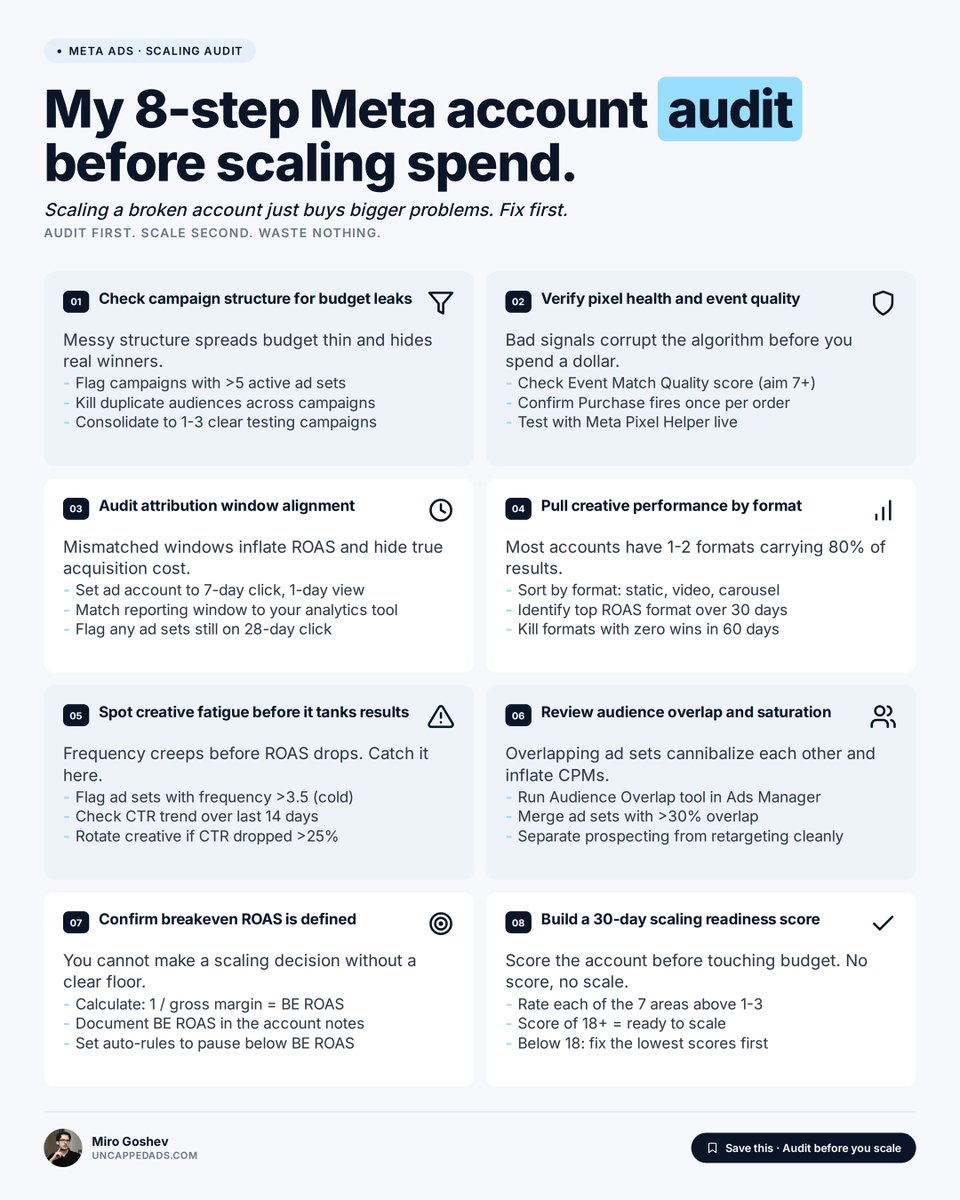
My 8-step Meta account audit before scaling spend.
(Scaling a broken account just buys bigger problems. Run this first.)
1. Check campaign structure for budget leaks.
- More than 5 active ad sets per campaign is a red flag, budget fragments and the algorithm never gets enough signal per ad set
- Duplicate audiences across campaigns mean your ad sets are bidding against each other, inflating your own CPMs
- Consolidate into 1-3 clearly defined campaigns: one for cold prospecting, one for warm, one for testing new creative
- Every extra ad set that isn't a deliberate test is a drain, treat the structure like engineering, not a dumping ground
2. Verify pixel health and event quality.
- Pull Event Match Quality in Events Manager, anything below 7 means Meta is working with degraded data to find your buyers
- Confirm the Purchase event fires exactly once per confirmed order, double-fires corrupt your reported ROAS upward
- Use Meta Pixel Helper in Chrome to do a live test checkout and confirm the right events fire in the right order
- Check that you're passing email, phone, first name, last name, and city at minimum for the best match rates
- A weak pixel is the most common root cause of scaling hitting a ceiling: you think it's budget, it's actually signal quality
3. Audit attribution window alignment.
- The account-level attribution setting should be 7-day click, 1-day view for most DTC brands, anything wider inflates reported results
- If your ad account is set to 7-day click but your analytics tool (GA4, Triple Whale, Northbeam) is on last-click, the numbers will never reconcile
- Document the discrepancy ratio between Meta-reported ROAS and MER so you know the actual scaling floor
- Flag any ad sets still running on 28-day click, a legacy setting that can make a mediocre campaign look like a winner
- Every scaling decision needs to be made on numbers you trust, misaligned attribution is the single biggest source of bad calls
4. Pull creative performance by format.
- Export a 30-day breakdown sorted by format: static image, video (under 15s), video (15s+), carousel, collection
- In most accounts at $5K-$50K/day, one or two formats are carrying 70-80% of efficient spend
- Identify the top format by ROAS, but also check it by volume of spend, a format with great ROAS on $200 of spend is not a pattern
- Any format with zero winning ad sets in 60 days should be paused, not iterated, you're paying to confirm it doesn't work
- This step usually reveals where creative production budget should go for the next 30 days
5. Spot creative fatigue before it tanks results.
- Frequency above 3.5 on a cold prospecting audience is a leading indicator, ROAS decline will follow in 7-14 days
- Pull a 14-day CTR trend for every active creative, a CTR that dropped more than 25% from its first week is fatiguing
- Don't wait for ROAS to drop before rotating creative, by that point you've already wasted spend on a declining asset
- Queue the next 3-5 creative iterations before the current winners need replacing, production lag kills scaling windows
- Fatigue is an infrastructure problem as much as a creative problem: if you can't produce fast enough, you can't scale
6. Review audience overlap and saturation.
- Use the Audience Overlap tool in Meta Ads Manager to compare all active prospecting ad sets against each other
- Ad sets with more than 30% overlap are partially competing in the same auction, you're bidding up your own CPMs
- Merge overlapping ad sets into a single broader ad set and let Advantage+ Audience handle the internal distribution
- Keep prospecting and retargeting audiences in separate campaigns, never in the same campaign with shared budget
- Overlapping audiences are a stealth tax on every dollar you spend, it's not visible in ROAS but it shows up in CPMs
7. Confirm breakeven ROAS is defined.
- Breakeven ROAS = 1 divided by your gross margin, for a 40% margin brand that's 2.5x, for 50% margin it's 2.0x
- This number needs to be written down and agreed on before any scaling conversation, not estimated in the moment
- Set automated rules in Ads Manager to flag (not immediately pause) ad sets running below breakeven for 3+ days
- Factor in your blended cost of customer acquisition across channels, Meta ROAS in isolation can mislead you
- Every scaling decision is a bet that ROAS stays above this floor at higher spend. If you don't know the floor, you can't size the bet.
8. Build a 30-day scaling readiness score.
- Rate each of the 7 areas above on a 1-3 scale: 1 = broken, 2 = functional but suboptimal, 3 = healthy
- A total score of 18 or higher means the account is structurally ready to absorb more budget without blowing up
- A score below 18 means fix the two lowest-scoring areas first, then reassess, scaling now just amplifies the problems
- Document the score and the date, re-run the audit every 30 days or before any budget increase above 20%
- This scoring approach removes the gut-feel from scaling decisions and gives you a defensible framework for every call
Rated 8 ads from top beverage and wellness brands.
Most of them are mediocre, full stop.
Not because the products are weak.
Because nobody on the team asked: where in the funnel does this actually do work?
Doc Martens would be a 3/10 ad without the logo.
New brands don't have that cover.
Your creative has to earn attention on its own. No brand equity to bail it out. No recognition doing the heavy lifting.
The asset IS the ad.