If AI models can meaningfully improve that filtering process for both generating proteins and evaluating those worth testing, the impact could be measured in fewer experiments, lower costs, and faster paths to new drug therapies. Exciting to see portfolio companies @boltz_bio and @mirrorphysics collaborating to build the new stack for accelerating drug discovery with AI
Huge release from the Boltz team.
The API is especially exciting: frontier biomolecular models becoming agent-native primitives.
We’re excited to partner with @boltz_bio to bring these capabilities directly into our preclinical discovery agent, Axon.
Big news from Boltz - our biggest update yet! 🚀
Today we’re releasing two new state-of-the-art models for protein and small molecule design with extensive wet lab validation and a new API to run all of our models on scalable GPUs wherever you (or your agents) work! 🔥
⚛️ EquiformerV3 is here !
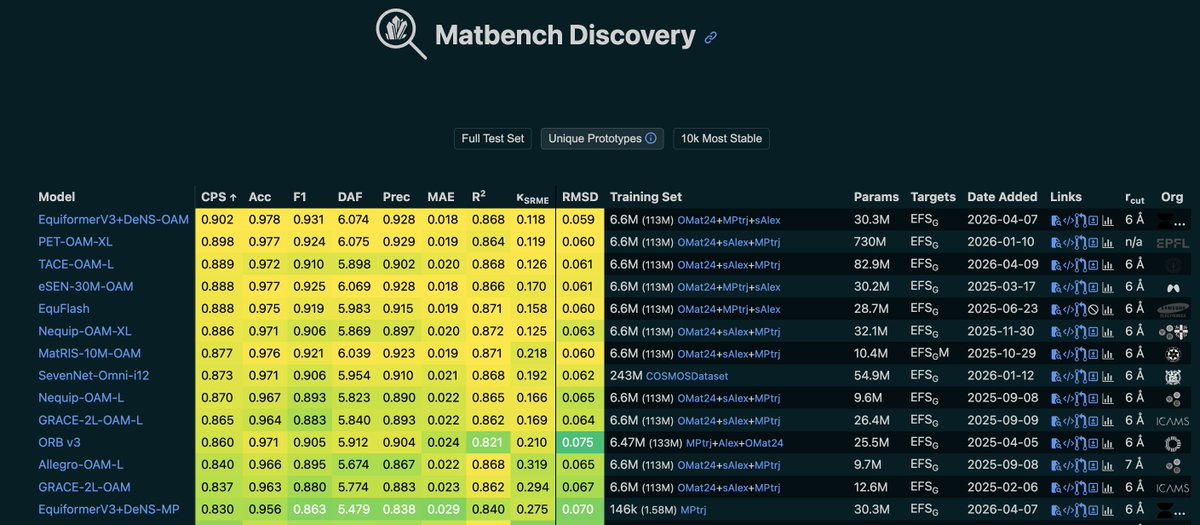
State-of-the-art on Matbench Discovery and OC20🏆
Better scaling, improved sample efficiency, stronger generalization. The Equiformer line keeps getting better!
Huge congratulations to Yi-Lun Liao and Tess Schmidt for driving this vision so brilliantly ! It's been inspiring to watch it come to life at this level.
Having witnessed & used previous Equiformer versions, I am grateful to have contributed to this one, even if it was a small piece of a much larger puzzle.
Go check it out 🤗
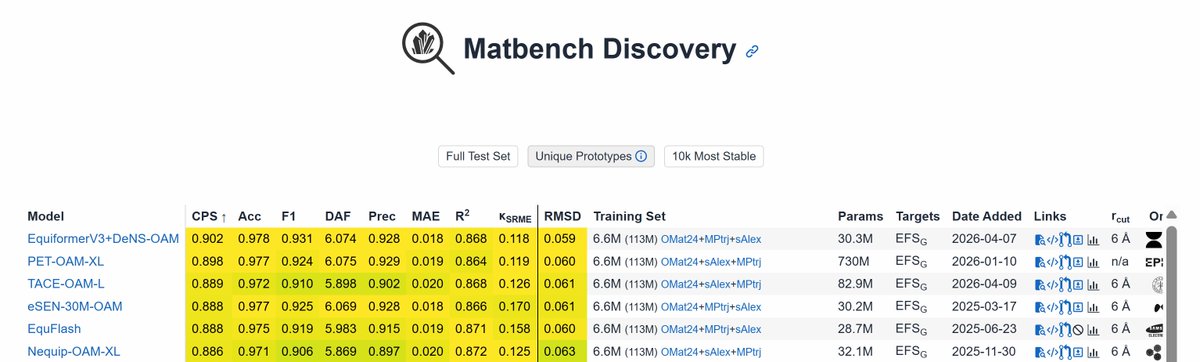
🏆🏆🏆 EquiformerV3 just topped MatBench Discovery
using less than 1/3 of the compute of the closest competitor 🏆🏆🏆
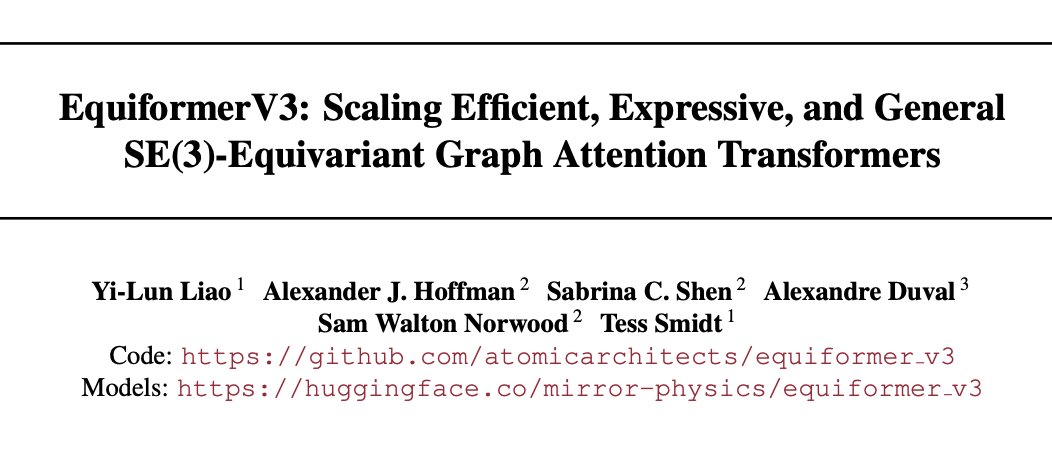
EquiformerV3 precisely simulates chemical physics by scaling SE(3)-equivariant graph attention transformers.
AND it was released on @huggingface 🤗
EquiformerV3 + DeNS is currently the best method on Matbench Discovery (as of April 14th, 2026).
Paper: https://t.co/8MdtZMrj4p
Code (training + eval): https://t.co/Jao3i8GOtH
(We are standing on the shoulders of giants to push the frontier of AI for atomistic simulation. 🙏 More to come. 🙂
Today, the team at Mirror is delighted to announce EquiformerV3: a new AI model for the precise simulation of chemical physics, made in collaboration with @yilunliao from the Atomic Architects group of Professor @tesssmidt at @MIT
At time of writing, EquiformerV3 tops Matbench Discovery, one of the most widely-used benchmarks in computational materials science, while using less than a third of the training compute of the closest competitor.
We will release additional checkpoints of EquiformerV3 in the coming weeks, so stay tuned. Check out the current release + more details below!
Announcement: https://t.co/EFydCTDKAn
Code: https://t.co/NT3i1unCev
Paper: https://t.co/tG4wRqeOQd
At the Bone Health Research Group at @imperialcollege, researchers James Rowe and Richie Abel look to the forefront of technology to help uncover treatments for pathologies like Osteogenesis imperfecta (O.I.), or brittle bone disease. This rare disease arises from a complex cluster of genetic mutations that damage the mechanical integrity of collagen, the body’s essential structural protein.
Recently, James used one of Mirror’s models to capture the rupture behavior of a collagen fragment. A remarkable detail emerged: under stress, each strand is predicted to break at a proline backbone C-C alpha bond, right next to glycine residues where the most problematic O.I. mutations occur. This provides a glimpse into the chemical mechanisms behind O.I., helping build the case for clinical targets.
This is just the beginning. With the help of experts like James and Richie, accurate and transferable simulation can tackle complex challenges in many fields.
Thankful to partner with @nvidia and @huggingface as a first user of their new Training Cluster as a Service platform, applying DGX Cloud Lepton to produce high-fidelity chemical models at large scale. Exciting results to come.
🥁 Today we announce a new collaboration with @nvidia to connect AI Researchers with GPU Clusters! 🤝
Introducing Training Cluster as a Service, powered by the new NVIDIA DGX Cloud Lepton. We hope this new service will help bridge the compute gap between the GPU rich and the GPU poor, and enable AI Research teams around the world to advance all scientific domains and benefit global communities.
AI is too important to be centralized!