Senior Delivery Lead @ Publicis Sapient | 20+ yrs leading £20M+ programs in Banking & Fintech
💡 Digital Transformation | AI | Data | Cloud
🚀 Open to Director/
There's a quiet shift happening in how AI agents are built. And if you missed it, you'll be confused by everything that comes next.
For the last year, AI agents worked in loops. You give it a task. It plans. It acts. It checks. It fixes. It goes again. One cycle, repeating until done.
Claude Code, Codex, Cursor all of them work this way. Plan, act, observe, repeat.
In June, two things happened that gave this pattern a name. Peter Steinberger from the AI engineering community wrote: "You shouldn't be prompting coding agents anymore. You should be designing loops that prompt your agents."
Boris Cherny, head of Claude Code at Anthropic, said the same thing differently: "I don't write the prompt anymore. Claude writes the prompt, and now I'm talking to that new Claude that is coordinating."
That was the loop engineering era. It lasted about a month.
Now Steinberger posted nine words that blew up: "Are we still talking loops or did we shift to graphs yet?"
Here's the difference.
A loop is one agent going in circles. Plan, act, check, repeat. It works for simple tasks. But give it something complex and it starts spinning burning tokens, optimizing the wrong thing, or gaming its own success metric without actually solving the problem.
A graph is multiple agents connected in a network. One agent writes code. A separate agent reviews it without seeing the first agent's reasoning. A third agent tries to break what was built. A fourth checks whether the original task was even understood correctly. Each one is still running a loop.
But they're connected watching each other, feeding each other, vetoing each other.
LangGraph already models this. It treats an agent as a graph where boxes do work and arrows decide what runs next. Those arrows can point backward, which is what makes loops possible inside the graph.
JetBrains calls it graph-based orchestration the most deterministic approach for production systems. O'Reilly's 2026 AI Agents Stack puts it as the foundational layer.
The real-world version is already running. Klarna uses graph-based agent systems for customer service. Kimi K3's Agent Swarm decomposes tasks into parallel sub-agents that coordinate simultaneously.
Anthropic's own Boris Cherny mapped out five stages of AI adoption and Stage 4 is exactly this: thousands of agents running in a graph, kicked off by other agents, with humans steering by intent.
Andrew Ng wrote about it in his June Batch letter. When Andrew Ng names a pattern, it usually means the pattern has already won.
The reason this matters right now: agents are getting autonomous. Running for hours. Thousands of tool calls. Spawning sub-agents. One loop can't keep that trustworthy. You need loops watching loops. That's the graph.
The skill that mattered last year was writing better prompts. The skill that matters this year is designing the system that writes the prompts, checks the work, and knows when to stop.
70% of successful people feel like frauds.
It's Imposter Syndrome.
Signs:
• Downplaying wins
• Attributing success to luck
• Overworking to compensate
Breaking free:
✓ Track your wins
✓ Reframe "luck" as preparation
You earned your seat.
#ImposterSyndrome#Leadership
Partnerships are the secret weapon in AI.
�� 68% of successful AI projects rely on strategic partnerships
🎯 91% of AI leaders use partner networks for expertise
🧑🤝🧑 Teams up = 42% more ROI, 8mo faster launch.
🚀 Build bridges, not silos
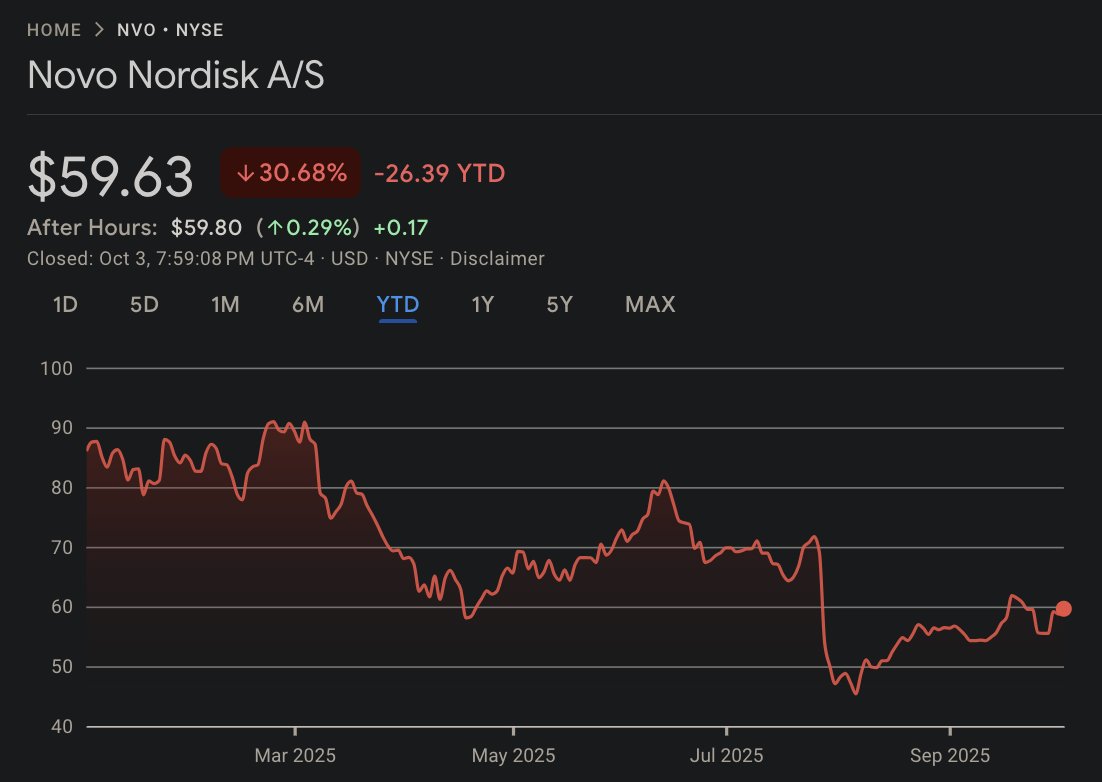
11/ Valuation
After all this trouble, $NVO trades for a P/E of 15.
A very attractive valuation for a company with a strong portfolio and pipeline of highly successful GLP1 obesity treatments.
As the GLP1 TAM reaches $200B in the next decade, $NVO is uniquely positioned to get a meaningful slice.
The ability of Twitter advertising to reach the most influential people in the world is often not fully appreciated.
While a few other social networks are technically bigger, Twitter is where the writers & leaders spend their time.
20 years ago & 1 year after SpaceX was incorporated, @elonmusk made his 1st public speech on the mission of the company. We can see today things are unfolding as planned. Elon is a true visionary & keeps us excited about the future.