When you realize the intro of the famous song "Smoke on the Water" by Deep Purple is the intro of Beethoven's 5th Symphony simply played backward.
Mind-blowing.
In 1992, a 32-year-old historian became Prime Minister of Estonia.
He had read exactly one book on economics: Milton Friedman's Free to Choose.
He used it as a policy manual. Western advisors and Estonian economists told him it would fail. 🧵
@1st_sealord Kaasuturbiinit tai CHP ovat yksi tarpeellinen uusiutuvan energian säätövoimamahdollisuuksista silloin kun ei tuule tai paista. Lisäksi Energiavarasto kaasulla on halvempi toteuttaa kuin akuilla.
"If we compare with Finland, which was an equivalent country [to Latvia before World War II], then we can confidently say that, due to the development retarded during the years of occupation, we have lost an amount greater than 800 billion modern euros. .. Losses also arose from the fact that a large part of our economy's added value went to the Soviet Union, says historian Gatis Krūmins. And that's just the economy. There are losses that cannot be estimated."
@lsmlv
@sciencegirl In Italy, one of the hobbies for older men is “Umarell”.
Retired men who enjoy watching construction sites while giving unsolicited advice
Ukrainian new reality. Farmers are sowing crops in the Kherson region, armed with guns, anti-drone systems to protect themselves and machines from Russian drones
📽️Viktor Gordienko
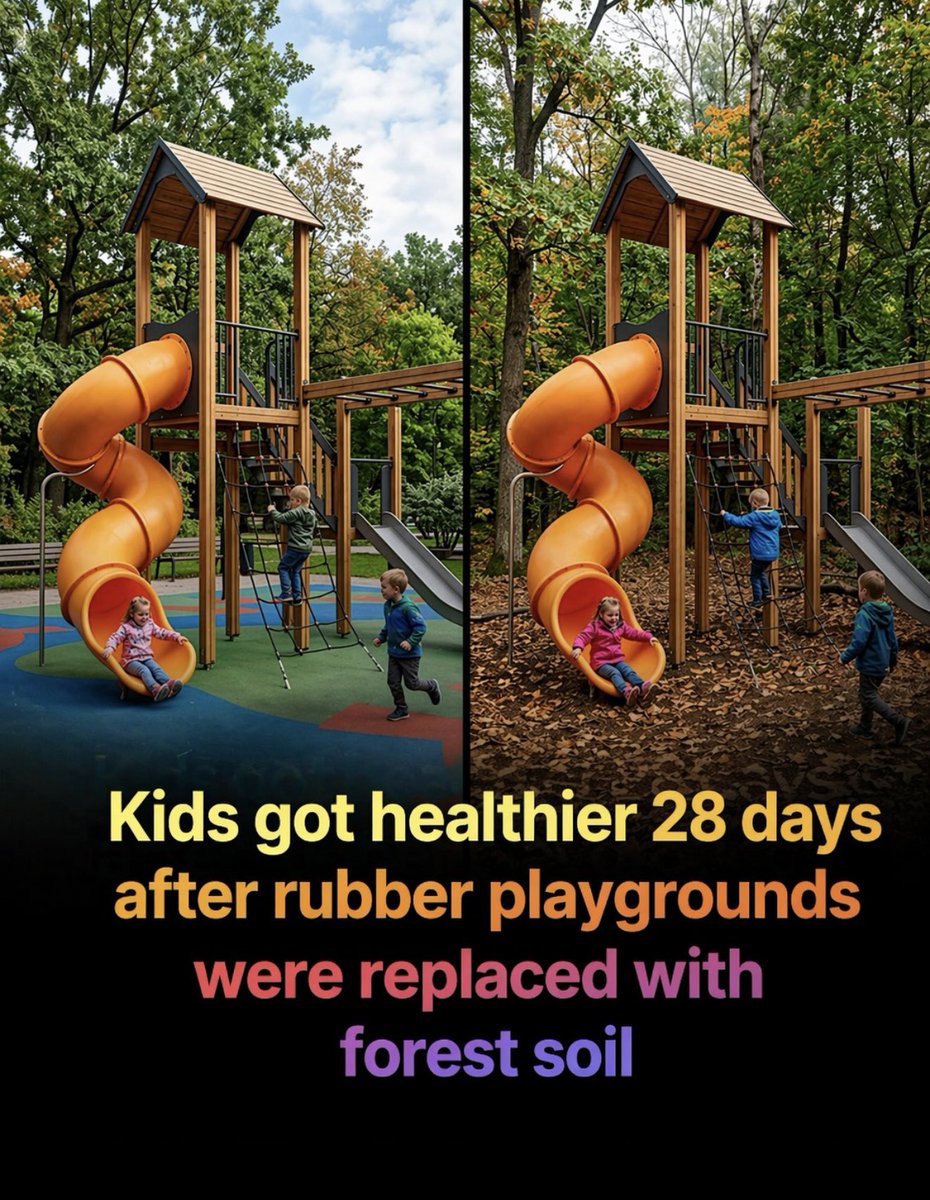
Research in Finland found that simply changing what children play on can quickly influence their immune system.
Scientists redesigned parts of nursery playgrounds by swapping gravel and asphalt for natural forest materials, soil, moss, leaf litter, and native plants, so kids would be exposed to the microbes found in nature. After just 28 days, clear biological differences emerged.
Children who played in these “rewilded” spaces developed a richer mix of microbes on their skin and in their gut. They also showed higher levels of regulatory T-cells, which help the body manage inflammation and reduce the risk of immune overreactions like allergies. These changes were not observed in children who stayed on conventional playground surfaces.
The findings support the biodiversity hypothesis, the idea that limited contact with natural environments, especially in urban life, may be linked to rising allergies and autoimmune conditions.
What stands out is how simple the intervention was. This wasn’t extreme outdoor exposure-just everyday play in a more natural setting. Even small, regular contact with soil and vegetation appears to shape the body’s internal ecosystem and how the immune system develops.
Learn more:
"Dirty Playgrounds: How Rewilding Finnish Schools Transformed
Children's Health." LettsSafari
Lähes 50% lisää puolustusbudjettiin tällä poukkoilevalla politiikalla ei todellakaan lupaa rauhanaikoja tulevaan. Lisäksi laivoja, ammustarvikkeita ja lentokoneita joita tarvitaan USAn ulkopuolella. Olisi tärkeää kuulla tarkemmat perustelut. https://t.co/svlqQBi2JO
@Timo_Virta1@JaniKarkkainen Ahma on yllättän iso kun luonnossa näkee ja niitä on täällä etelässäkin. Iitissä joku vuosi sitten juoksi tien yli edestäni.
@EeroAhtola Ihan sama kävi mielessä, ei ole mitään perusteluja valtion ruokakaupoille. Alkoholin osalta asemaa voidaan vielä perustella esim kansanterveydellä, mutta kenellä edes tuli mieleen tuo?
Between 1850 and 1980, the Dutch, the Danes, the Swedes, the Norwegians, and the Finns all grew taller by approximately 15 centimetres on average. Six inches. In five generations.
This is an enormous amount. It is one of the fastest biological transformations ever recorded in a human population. It happened without genetic change. It happened because the food changed.
What changed was dairy.
In 1850, Nordic peasants ate what Nordic peasants had eaten for centuries. Rye bread. Porridge. Salt fish. Small amounts of meat. Butter when they could afford it. The diet was adequate for survival and inadequate for growth. The average Danish man in 1850 was 5 foot 5.
Then the dairy revolution happened. The Danish cooperative dairy movement, starting in the 1880s, transformed dairy from a luxury into a commodity available to every household. The Swedish and Norwegian equivalents followed within a decade. The Finnish slightly later. Butter, cheese, full-fat milk, and cream became the daily baseline rather than the feast-day treat.
The children ate the dairy. The children grew.
By 1960 the average Danish man was 5 foot 11. By 1980 he was 6 foot. The transformation had happened in five generations, on the same land, with the same genetics, and the only variable was the milk.
Now look at what has been happening in the last fifteen years.
Danish height has peaked. Swedish height has peaked. The growth has stopped. In some demographics within these populations, height is beginning to decline.
The children are drinking less milk. The children, measured at 18, are shorter than their fathers by a small but measurable margin.
The bones are honest.
The bones track the food.
If Danish children keep drinking oat milk instead of whole dairy for another twenty years, the average Danish height in 2045 will be measurably lower than it was in 2000.
This will not be in the campaign literature.
It will be in the military conscription records.
As it always has been.
Jeff Bezos just told you exactly how to price AI.
Nobody listened.
Bezos: “AI is real and it is going to change every industry. In fact it’s a very unusual technology in that regard in that it’s a horizontal enabling layer.”
Horizontal enabling layer.
Three words that reprice the entire technology sector.
The iPhone was a vertical. One product. One new market.
Electricity was a horizontal. One substrate that rewired every market on Earth.
Wall Street is pricing AI like it is the next iPhone. Bezos is telling you it is the next electrical grid.
Right now, thousands of companies are trying to sell AI as a product.
A feature. A tool. A subscription tier.
Every single one of them will be priced to zero.
You do not sell a horizontal layer. You do not compete with it. You build on top of it or you disappear beneath it.
For a century, entire industries survived on one thing. Complexity.
The friction of navigating law, medicine, logistics, finance. That was the moat. If you could not memorize the maze, you could not compete.
A horizontal layer does not navigate the maze. It dissolves the walls.
Electricity did not compete with the candle industry. It erased the need for one.
The most dangerous part of a horizontal shift is how quiet it is. It moves underneath the economy. The surface looks normal. Revenue still holds.
Every day you operate on the old substrate, you accumulate a debt you cannot see and cannot repay.
The internet repriced distribution. AI is repricing cognition itself.
When intelligence becomes a utility that runs through the walls of every company on Earth, the premium on human expertise does not erode. It evaporates.
This is not a disruption. Disruptions replace products.
This replaces the ground you are standing on.
A Soviet psychologist walked into a café in 1927 and watched a waiter do something impossible.
He remembered every open order at every table. Perfectly. Without notes. Without effort.
Then a table paid their bill. She asked him to repeat the order.
He couldn't remember a single item.
She spent the next two years figuring out why. What she found is now the operating system underneath every platform fighting for your attention.
Her name was Bluma Zeigarnik, and she was a graduate student at the time, sitting with her professor Kurt Lewin, watching the waiters work the room. What caught her attention was something so ordinary that it had been happening in restaurants for centuries without anyone asking why.
The waiters could remember every open order with perfect accuracy. Table four wanted the schnitzel with no sauce. Table seven had changed their wine twice. Table twelve owed for three coffees and a dessert. Every detail, held without effort, without notes, without any visible system at all.
But the moment a table paid their bill, the information vanished. Completely. Lewin tested it on the spot. He called a waiter back minutes after a table had settled up and asked him to recite the order. The waiter could not do it. Not partially. Not approximately. The information was simply gone.
Zeigarnik went back to her lab and spent the next two years turning that observation into one of the most replicated findings in the history of psychology.
Here is what she proved, and why it changes how you think about attention, memory, and almost every piece of media you have ever consumed.
She gave participants a series of tasks. Some tasks they were allowed to finish. Others were interrupted before completion. Then she tested recall across both groups.
The unfinished tasks were remembered at nearly twice the rate of the completed ones.
Not slightly better. Nearly twice. The brain was holding the incomplete work in a state of active tension, returning to it, keeping it warm, refusing to file it away. The finished tasks were closed, archived, released. The unfinished ones were still running.
She called it the resumption goal. When the brain commits to a task and cannot complete it, it opens a file that stays open until resolution arrives. That open file consumes a portion of your cognitive bandwidth whether you are thinking about it consciously or not. It surfaces in idle moments. It pulls at the edge of your attention during other work. It is the thing you find yourself thinking about in the shower when you were not trying to think about anything at all.
This is not a flaw in human cognition. It is a feature. The brain evolved to finish things. An open loop is a signal that something important is unresolved. Keeping that signal active increases the probability that you will return to it and complete it. In an environment where most tasks had real survival stakes, this was an extraordinarily useful mechanism.
In the modern world, it is the most exploited vulnerability in human attention.
Netflix did not invent the cliffhanger. But it industrialized it in a way no medium before it ever had. When a show ends on an unresolved question, it does not just create curiosity. It opens a file in your brain that stays active until the next episode closes it. The autoplay countdown that begins at 15 seconds is not a convenience feature. It is a precise calculation about how long the average person can tolerate an open loop before the discomfort of not knowing overrides every other intention they had for the evening. One more episode is not a choice. It is your brain doing exactly what it was designed to do: return to what is unfinished.
The writers who built Lost, Breaking Bad, and Succession understood this intuitively without ever reading a psychology paper. Every episode ended on an open question. Every season finale answered three things and opened five more. The entire architecture of prestige television is a Zeigarnik machine running at industrial scale.
But television is not where this gets dangerous.
Every notification on your phone is an open loop. Every unread email is an open loop. Every task you wrote on a list and have not yet crossed off is an open loop. Each one is consuming a small but real portion of your available attention, pulling fractionally at your focus, degrading your capacity to be fully present in whatever you are actually doing right now. TikTok's algorithm does not just serve you content you like. It serves you content that ends one loop and immediately opens another, keeping the resumption system permanently activated so the cost of stopping always feels higher than the cost of continuing.
The research on this accumulation effect is striking. Psychologists studying cognitive load have found that unfinished tasks do not sit passively in memory. They actively interrupt. They surface at the wrong moments. They are the reason you are reading something and suddenly remember an email you forgot to send. The brain is not malfunctioning. It is running its resumption system exactly as designed. It is just running it across forty open loops simultaneously, in an environment that generates new ones faster than any human nervous system was built to process.
The most important practical implication Zeigarnik's research produced is one that most people use backwards.
David Allen built his entire Getting Things Done system on the insight that the only way to close a cognitive open loop is to either complete the task or make a trusted commitment to complete it later. Writing something down in a system you actually trust has the same effect on the brain as finishing it. The file closes. The bandwidth is released. This is why writing a task down feels like relief even before you have done anything about it. You have not solved the problem. You have simply told your brain that the loop is registered and will be returned to, which is enough for the resumption system to stand down.
The inverse is equally true and far more destructive. Every task that lives only in your head, unwritten and unscheduled, is an open loop burning cognitive resources around the clock. The mental cost is not proportional to the size of the task. A tiny nagging obligation consumes the same active tension as a major project. Your brain does not discriminate by importance. It discriminates by completion.
Zeigarnik published her findings in 1927. The paper sat in academic literature for decades before anyone outside psychology paid attention to it.
Then television got good. Then the smartphone arrived. Then the entire attention economy was engineered, largely by people who understood intuitively what she had proven scientifically: an open loop is the most powerful hook available to anyone who wants to hold human attention.
Netflix knew it. Instagram knew it. Every designer who ever made a notification badge red instead of grey knew it.
The café in Vienna is long gone.
The mechanism she discovered there is now the operating system underneath every platform fighting for your time.
Every "to be continued."
Every unread notification.
Every thread that ends with "part 2 tomorrow."
All of it is the same waiter, the same unpaid bill, the same brain refusing to let go of what it has not yet finished.
Zeigarnik noticed it over coffee in 1927.
A century later, it is the most valuable insight in the history of media.
And nobody taught it to you in school.