If we want change to be systemic, we need to engage people across multiple levels, from influencing and involving many, to co-creating with some.
The "Engagement Staircase" from Russ Gaskin (CoCreative) and Akash Bhalerao (Ashoka) is a really helpful, research-informed framework for thinking about who we need to engage and how.
Their core premise is that engagement is not a single act. It exists on a spectrum of levels, from communicating to many, through consulting, involving, and collaborating, to co-creating with a smaller core. Each step represents a progressively deeper level of stakeholder participation, ownership and shared power.
In health and care, that tends to mean a lot of communication and consultation, and not enough collaboration and co-creation. We often inform people about change. We ask for their views. We call it engagement. But informing is the bottom step of the staircase, and consulting, however well-designed, still positions the leader as the one who decides.
Working at higher levels of engagement requires a different kind of change leadership capacity. Co-creation is likely to mean relinquishing control over outcomes. Collaboration requires an ongoing investment in relationships, not just in on-off tasks. Most change leadership development is better at building lower-level engagement skills than upper-level ones.
In our sector, there is a big push towards “co-production” or “co-creation” which is a positive thing. However, It is also problematic to think that we need to co-create with a lot of people. The higher up the staircase, the fewer people are involved, and that's by design. We communicate to many; we co-create with some. We have to be intentional about this distribution. The risk is trying to get everyone to the top step, or, just as problematic, keeping everyone at the bottom. Both are strategic errors.
We should seek to work across all five levels simultaneously. It’s about holding large-scale awareness and influence across a wide network while nurturing a smaller network of co-creators who are deeply invested in the work. This requires thinking about engagement like a portfolio, mapping who needs to be where on the staircase, and actively managing upward movement over time.
There is also an equity dimension. Who gets invited to collaborate and co-create? In too many change initiatives, the higher levels of engagement get reserved for those who already hold formal power or existing relationships with the change leader. Creating the conditions for systemic change means actively seeking out people whose experience is closest to the problem, even when that requires bridging structural divides.
We might treat the Engagement Staircase as a mirror - reflecting on which levels we are working at, with whom, and what it would take to move the right people to higher levels of ownership of the change.
The article: https://t.co/I8WbuvaPrC. It has links to some great resources.
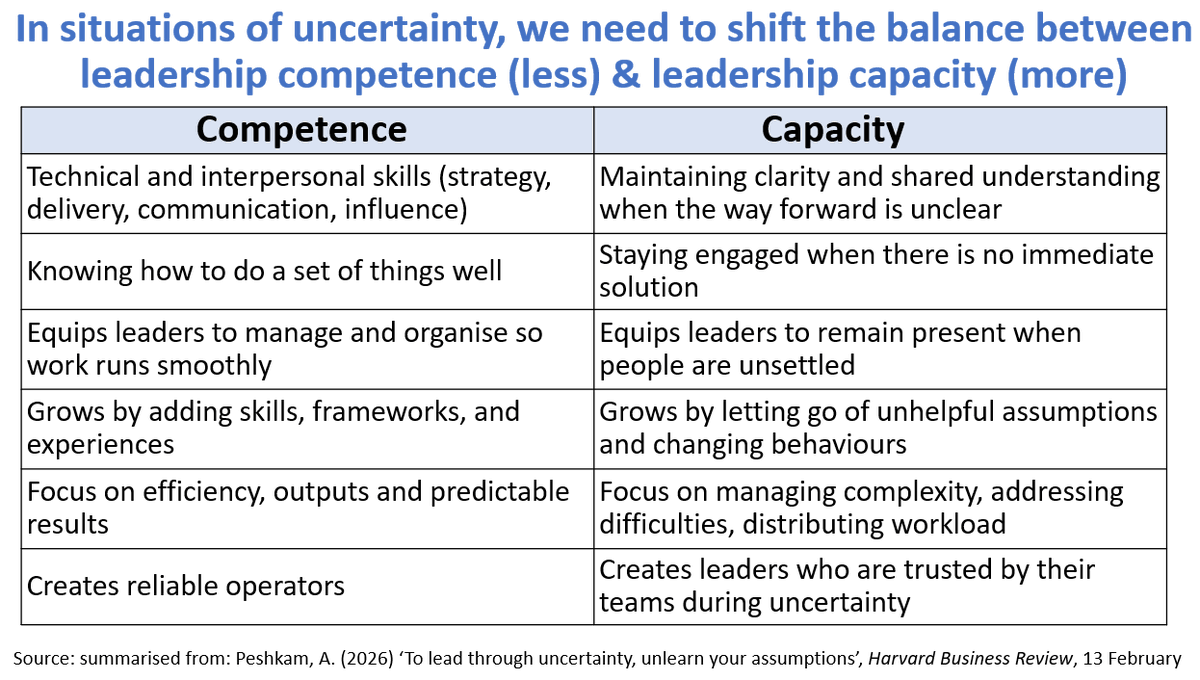
To thrive and survive as a change or improvement leader in a big system, we need to be competent. We need to be able to redesign processes, apply improvement methods, analyse data, mobilise teams & achieve outcomes.
A February 2026 HBR article by Annie Peshkam (“To lead through uncertainty, unlearn your assumptions”) says that this isn’t enough. She distinguishes between “competence” (doing things well) and “capacity” (staying present when action will not resolve the tension). As change and improvement leaders, we have invested heavily in competence: QI methods, governance, pathways, PMO disciplines. We have invested far less in capacity: the inner steadiness, emotional regulation and shared sensemaking that allow us to hold complexity with our teams. Capacity is the ability to pause instead of jumping to solutions; say out loud what is difficult about a change; keep conflict in the room and work with it rather than pushing it into the “meeting after the meeting”.
The systems we work in are in sustained uncertainty: financial pressure, workforce depletion, reform agendas, unrelenting demand. Deloitte's Global Human Capital Trends survey of 14,000 leaders found that, in this context, we must look beyond efficiency and predictable results and instead elevate resilience, adaptability, and human connection. Yet our improvement/performance approaches still reward leaders who give quick answers, project confidence and absorb team anxiety. These assumptions shrink rather than expand our capacity to lead.
How can change and improvement leaders build capacity?
1) Embed personal practices of pause and reflection into our leadership routines, especially in "high‑stakes" meetings.
2) Start key conversations by naming the tension in the room and giving people time to speak to it before moving to plans.
3) Design our improvement structures (huddles, steering groups, programme boards etc) as “holding environments”, where disagreement and emotion are legitimate data, not distractions.
4) Stop carrying the burden alone: share sensemaking work with our teams, service users and communities, and make that sharing visible.
5) Invest in development focused on emotional steadiness, presence and curiosity, alongside the technical disciplines of QI and "change management".
We talk a lot about learning cultures. This article challenges us to cultivate unlearning cultures in addition. The shift from competence to capacity is not a “nice to do”; it is central to our ability to lead change and improvement in the face of relentless uncertainty.
https://t.co/nViMIBVw6N
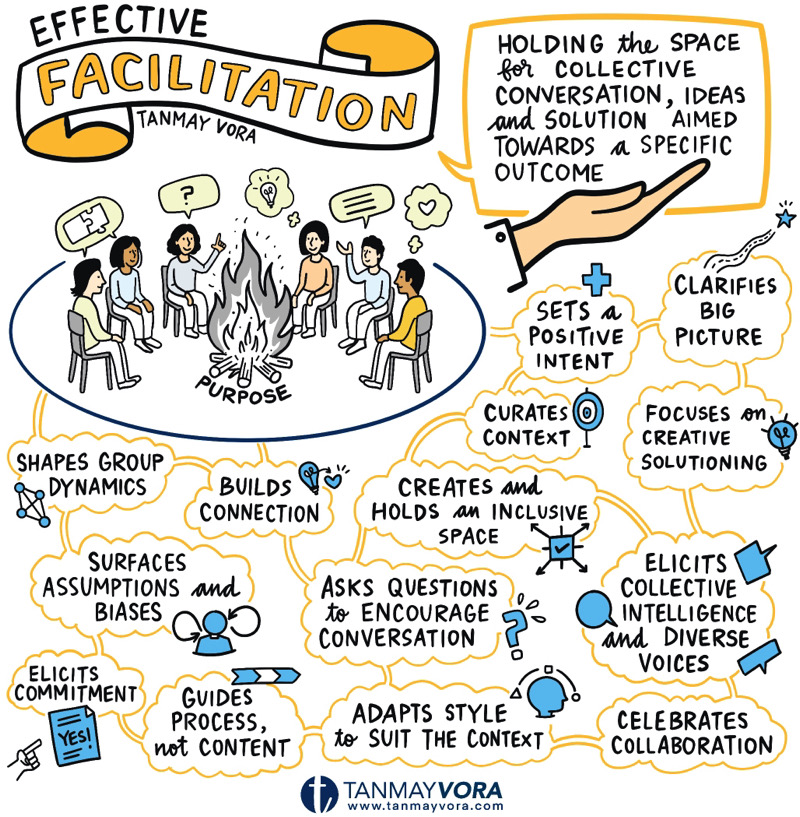
Facilitation skills are not just for change & improvement "experts". Every leader should have them.
Organisations that integrate facilitation into their leadership approach report more productive & engaged teams, improved innovation & better decision-making.
Facilitative leadership is even more important in the era of AI. AI can analyse trends, detect patterns & generate content, but it can't replicate the trust built through dialogue, or the remarkable outcomes that can emerge when people collaborate to make sense of complex issues together.
How we might go about making facilitative leadership the norm:
1) Integrate facilitation into leadership development activities, providing training, coaching, resources & safe spaces to practice.
2) Have senior leaders role model facilitative approaches.
3) Build understanding of situations where we should limit the number/style of decisionmakers & those where we should be facilitative.
4) Make facilitative approaches the leadership norm/expectation & build them into organisational processes.
5) Encourage peer learning so leaders can share experiences, discuss challenges & learn from one another.
Inspired by a very good new blog & sketchnote from @tnvora: https://t.co/OSynryQ3WM.
Paradox: Where the magic happens
*Be ruthless in business but relaxed in life.
*Make strong partnerships but stand out.
*Form the crowd but don' t follow the crowd.
*Soar but remain grounded.
* Be easily recognized without labels.
* Be a savage and a saint.
When bad things happen to good people by Harold S. Kushner 2/2
5.Let go of the need for answers to tragedies.
6.Resilience comes from faith & community.
7. Human connection heals.
8. Embrace life's fragility: cultivate gratitude.
When bad things happen to good people by Harold S. Kushner 1/2
1. Suffering is not evidence of divine punishment.
2. Life is inherently unpredictable.
3.God`s role is compassion & solace.
4. Focus on what you can control.
'
Behind many organisational failures are groups of people who knew bad things were happening but felt unwilling or unable to express their concerns. New research shows how leaders can make constructive challenge not just possible but an integral part of a thriving organisational culture. Five actions for leaders:
1) Ask better questions - ones that directly invite disagreement
2) Acknowledge the legitimacy of the challenge
3) Keep meetings interactive & friendly
4) Allocate enough time for open discussion
5) Create a sense of accountability among team members
Summary article: https://t.co/DIfcD7fwDk. From @mitsmr.
A fantastic free White Paper on "Facilitating Constructive Challenge" based on the research: https://t.co/otaXtuRO1Q. By @ProfCeliaMoore.
"Njia ya uponyaji inaweza kuambatana na maumivu pia. Kwani hata nguo hushonwa kwa kutobolewa na sindano. Ukiona nguo imependeza, imeshonwa. Ukiona mtu imara na mwenye furaha, kafumwa kwa maumivu mengi." ~Togolani Mavura.