Nobody talks about the student who came ready to learn, sat through the disruption, said nothing, and fell further behind while every adult in the building focused on the one who made the most noise. She is still waiting for someone to notice she was there, too.
Can’t remember who shared this absolute beauty of a paper on here! I just want to say thank you though, it was a belter of a Paper 2 to go through the day before the exam! 11/3 LOVED it! Another year done 🙌👍
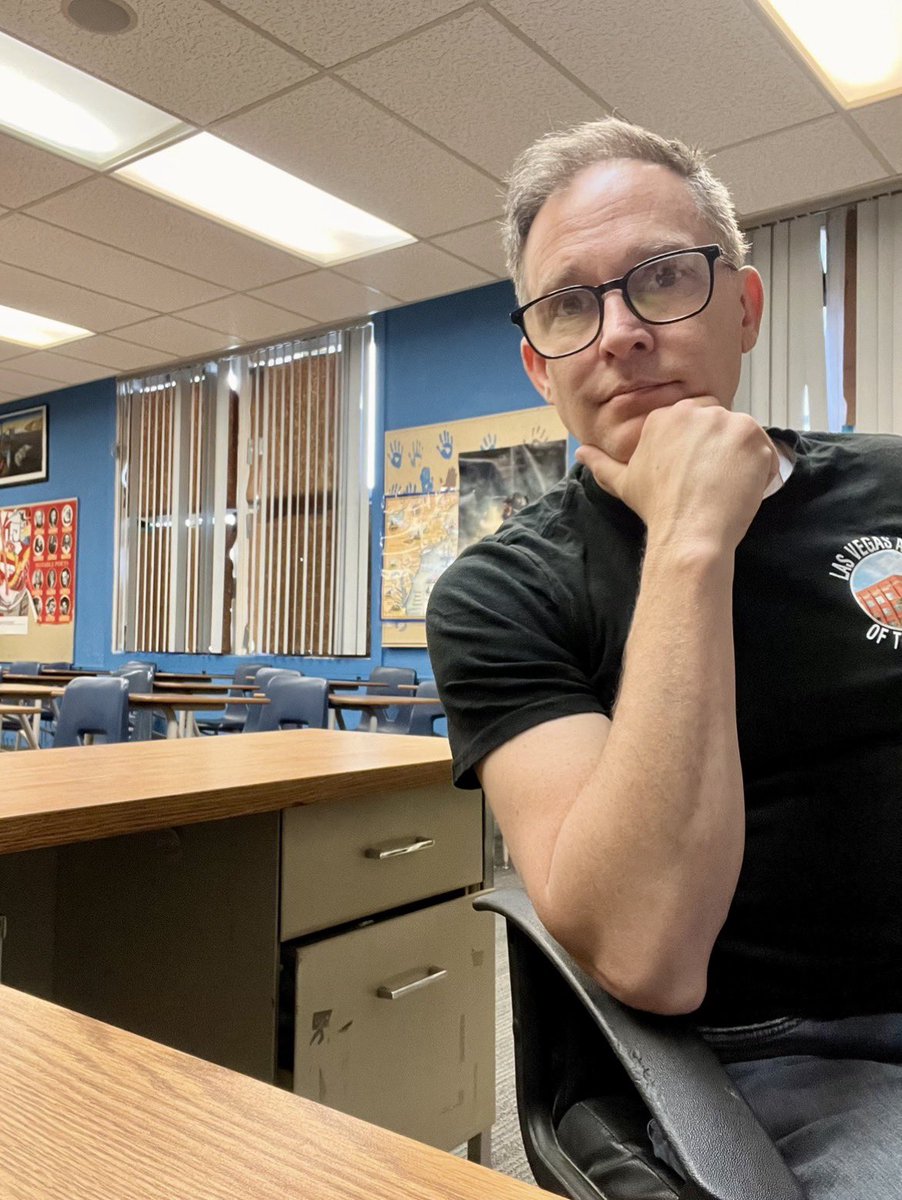
An empty desk can only mean the end of another school year. Today I finish my 26th year as a teacher.
After more than a quarter century in the classroom, here are five things I’ve learned:
A headteacher said something to me this week that I’ve been thinking about since.
Her teachers enjoy reading to their classes.
They value it.
They know pupils enjoy it too.
But they do not always see it as the best use of their time.
Strong KS3 does not begin in Year 10.
It begins in Year 7, when pupils are given serious texts, serious ideas and serious intellectual attention.
KS3 isn’t the bridge, it’s the foundation.
https://t.co/z6yh7j2h0h
Mini-white boards are great. I genuinely love them. But as with any means of participation, they have benefits and limitations and teachers should be aware of both and use accordingly.
On the upside, they offer maximum observational efficiency. When everyone writes i can see the full data set—everyone’s answer—and when they hold them up I can scan and review with maximum speed. That’s a big win.
Plus they feel low stakes to students and therefore low-risk… if it’s wrong I just erase it. Ideal for settings like retrieval practice.
And when the routine is installed well they are fast and engaging.
Some limitations to consider though.
There’s a downslide to disposable writing that disappears. It’s harder to go back to it: to study and revise it later or to improve it. The answers are not in your notes!
By the way we have a video of a chemistry teacher, Abi Mincer of Totteridge Academy in London who writes the answer on her smart board after students erase so there’s a list of the answers permanently visible. Love that.
MWBs can also socialize hasty or even sloppy writing- with the sloppy referring to the production or to the thinking. The goal can easily become speed of response. The marker slips easily across the board and this just maybe makes it so that students don’t write as slowly and thoughtfully as they might on paper. Slow, deliberate thinking leads to careful word choice, the inclusion of new ideas and assists with encoding.
MWBs can be a crutch. It’s an easy way to engage students. A bit easier than other also important ways to engage them such as cold call and stop and jot. That means there’s a risk of over relying on it. It’s a great tool for some situations. But a craftsperson needs lots of tools.
I’m sure you can think of other benefits and limitations. Just wanted to share a few so that teachers are more likely to use a great tool for maximum gain.
Norway is reversing its mistaken 2016 decision to give every student an iPad, which damaged education immediately. Many countries are going back to books and handwriting. I hope many American schools will go back to analog next September, and let's see if that works for us too:
A maths teacher I know found an error in one of OCR’s GCSE exams last summer - this complaint has been upheld by Ofqual.
Kids will have missed out on grades. He has a petition to force OCR to remark papers for kids who missed out!
Sign it!
https://t.co/zMiCjh99Rq
Haunted by something I read this morning in a book on the Vikings: “A society without books is ... a society without a history.” We have no idea what we’re throwing away when we abandon literacy as a culture. The rejection of reading is the birth of a new dark age.
Donald Trump's latest meltdown on Iran is deeply disturbing
And yes, we have to take it seriously.
I talked it over with the brilliant @stephenwertheim 👇
https://t.co/piMbwdhXT2
NEW: for AQA Lang P1 June 2026 onwards
✅ Rebecca
Complete specimen paper and PPT slide deck with scaffolds, indicative content, student activities and model answers, like so 👇
Help yourself #teamenglish
https://t.co/WnfmQcQ95i
"Requires Attention."
Schools with high FSM are far more likely to sit under that label in the new Ofsted framework, especially the Achievement section.
Daft thing is, it already has our attention. It always will.
Poverty requires attention. Hunger requires attention. Trauma requires attention.
A judgement that ignores all of that - and then penalises the people giving their lives to the cause?
That requires attention too.
Inference in reading - as in spoken language - is the ability to reason using available evidence and prior knowledge to understand something implicit.
>>
It's that revision push time of year! Revision session for Macbeth
Focus on: Guilt and supernatural
chronological planning
Trying to help students link extract → whole play
Happy to share 👇
https://t.co/pkheE9jxgH
#GCSEEnglish#TeamEnglish#EnglishTeacher#Macbeth
Schools put a lot of emphasis on “belonging” these days, but many miss one of the best, most organic ways to cultivate this sense of belonging. Reading and discussing great (whole) books together creates connections with others like nothing else. Schools don’t need to implement another gimmicky program; they need to get back to reading and teaching great books.