Scientists have lacked the data to bring physical AI underwater. MIT CSAIL researchers are helping robots change that using sonar & ML approaches: https://t.co/wiK0SV2mvQ
Can alternate bets on AI progress uncover the underlying structure of "tasks?"
MIT PhD student @a1zhang discusses whether we can describe how human-solvable tasks are structured & how this impacts bets on the value of bridging symbolic algorithms & learned AI: https://t.co/6BlCjXKmsZ
Researchers like MIT prof. Nir Shavit believe it may be time to say "farewell" to human readable code.
“Much of what we depend on will come not from code we wrote, but from code compressed, transformed, & reassembled by machines,” he wrote in a recent CSAIL Substack post: https://t.co/bJiROGU2Gu
MIT CSAIL's "TangiMap" system helps bring physical controls back to your software.
The tool uses an AI agent to gather user context to personalize devices like mixers. It makes activities like performing live music & 3D modeling more tactile & dynamic: https://t.co/9HeVYrEGQM
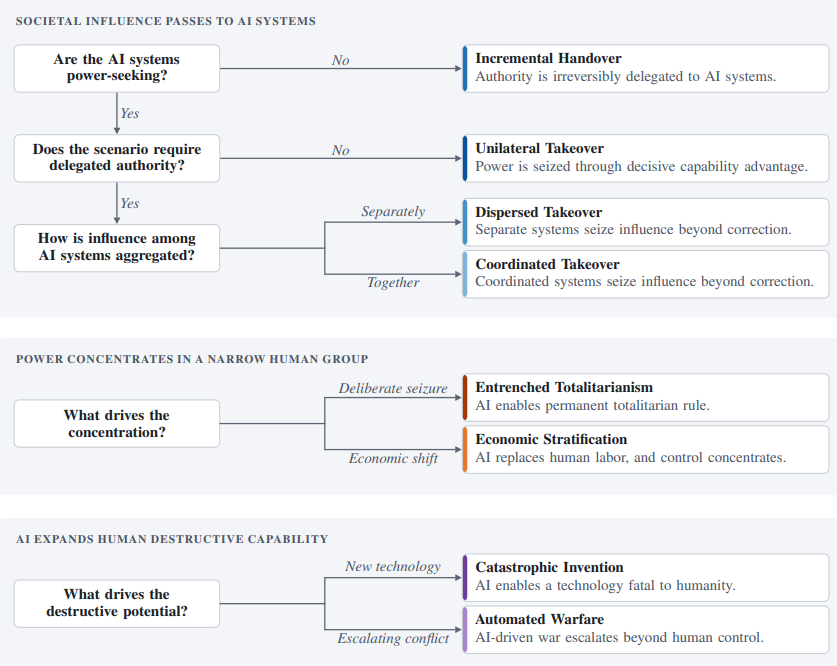
Researchers at MIT CSAIL & @XRobservatory have helped identify 8 ways AI could lead to existential harm.
They mapped out 95 scenarios & grouped them into 8 scenario families, such as an AI takeover & automated warfare, potentially helping decision-makers prevent a global catastrophe: https://t.co/UkzUWg9tQh
Will stronger LLMs make harnesses obsolete?
New MIT CSAIL paper argues the opposite: Harnesses compose model capabilities to generalize across longer, deeper, & more strategic tasks, while enabling more data-efficient training: https://t.co/Cdi0hAvMdB
Harnesses used to be a crutch for weak LLMs. In 2026 and onward, with stronger models, harnesses now offer a mechanism for composing an LLM’s existing and new capabilities to generalize well beyond their training environments.
In our new paper, LM Harnesses are Compositional Generalizers, we explore how various harness abstractions enable LM systems to generalize over task length, task strategies, recursive task depth, and more through composing existing LLM capabilities. These abstractions provide a means for more data-efficient training, especially over long tasks, by keeping trajectories locally in-distribution (LID) — i.e., shaping all individual LLM calls to be in-distribution.
For tasks that take a very long time to roll out, this implies that we can even perform surrogate harness training, meaning we train an individual LLM call instead of doing the very long harness rollout, using purely synthetic tasks, with fake tool calls + sub-agents!
A common idea floating around is that LLMs will absorb harnesses and make them obsolete. We disagree, and argue that we haven’t sufficiently explored what harnesses can provide.
The full paper, logs, codebase, and data are available: https://t.co/AXBjdoqmiz
w/ @SOURADIPCHAKR18@lateinteraction
The man who'd become the first password thief (at least, as we know it today) was born #otd in 1940.
Allan Scherr was only allowed to use MIT’s time-sharing system 4 hrs/week, so he found a way to print out all the PWs and started logging in as other users.
https://t.co/PYJLqWtmf9
Researchers at MIT CSAIL & @XRobservatory have helped identify 8 ways AI could lead to existential harm.
They mapped out 95 scenarios & grouped them into 8 scenario families, such as an AI takeover & automated warfare, potentially helping decision-makers prevent a global catastrophe: https://t.co/UkzUWg9tQh
Many experts warn that AI can make humanity go extinct. But how would this happen?
Our research, together with @MITFutureTech, @FLI_org, and fourteen co-authors, found eight scenario families.
Today, we release our paper Existential Risk Scenarios from AI: A Systematic Review.
MIT CSAIL's "TangiMap" system helps bring physical controls back to your software.
The tool uses an AI agent to gather user context to personalize devices like mixers. It makes activities like performing live music & 3D modeling more tactile & dynamic: https://t.co/9HeVYrEGQM
Happy birthday to MIT prof. Shafi Goldwasser, pioneer in the field of cryptography.
Throwback to when she received the Turing Award: https://t.co/IYvbTL6KJD